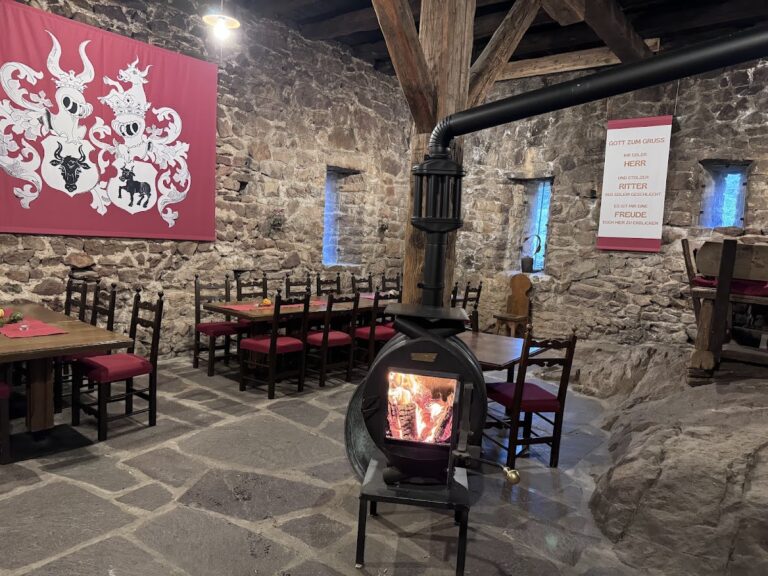
Greifenstein Castle: A Medieval Fortress in Italy


Site at a Glance
- Rating
- 4.6
- Popularity
- Very Low
- Country
- Italy
- Primary era
- Medieval
- Eras represented
- Medieval
- Civilizations
- Holy Roman Empire
- Site type
- Military
- Remains
- Castle
On this page10 sections
History
Greifenstein Castle is a ruined medieval fortress in Italy, first recorded in 1158 and associated with Arnold III, a count linked with Bolzano, Morit, and Greifenstein. Its history reflects the territorial conflicts and shifting lordships of the Tyrolean region, while its repeated destruction and rebuilding shaped the complex that later became known as Sauschloss, or “Pig Castle.”
Foundation and destruction in the thirteenth century
Arnold III is associated with the establishment of Greifenstein Castle. In the second half of the thirteenth century, the fortress became involved in the struggle between Meinhard II, a major territorial lord of the Tyrolean-Gorizian ruling dynasty, and the Bishop of Trent. Fighting in 1275 caused extensive destruction to the complex.
Greifenstein was rebuilt in 1334, but a fire destroyed it again in 1348. A further reconstruction followed in 1363. These successive phases left the castle with a history of repeated renewal rather than a single, uninterrupted period of construction.
The Greifenstein and Starkenberg families
In the late fourteenth century, Greifenstein passed to the Lords of Starkenberg. This transfer followed the death of Friedrich, the last member of the von Greifenstein family, who was killed at the Battle of Sempach in 1386.
The castle later became a stronghold in the conflict between Duke Frederick IV of Austria-Tyrol and the Tyrolean aristocratic opposition. Frederick, a Habsburg duke also known as Frederick of the Empty Purse, ordered two sieges against Greifenstein. The first, launched in spring 1418, failed. Oswald von Wolkenstein, a late-medieval German-language poet and composer, is thought to have referred to a sortie during that siege in a song connected with Greifenstein.
A second siege began in spring 1423 and continued until November 1426. Wilhelm von Starkenberg had departed earlier in 1426, and the castle’s servants finally surrendered it on 27 November. The event formed part of Frederick’s wider campaign to suppress the Starkenberg opposition.
Legends and the 1423 siege
The nickname Sauschloss is traditionally linked with one of the sieges. According to the story, the defenders threw a roasted pig toward Frederick’s army to make it appear that the garrison still had ample food. The pig was supposedly their last provision. This tale is a recurring old legend also associated with Ovid, and the earliest written version connected specifically with Greifenstein dates from 1737.
The fighting surrounding the later siege also produced a violent episode involving Nikolaus Hochgeschorn, an envoy from Bolzano. He was reportedly killed at Greifenstein by being thrown from the rock. Oswald von Wolkenstein treated the incident humorously in the poem Nu huss. The legal consequences appear in the Starkenberger Rotulus, a medieval manuscript containing a detailed accusation against the besieged Starkenberg rebels.
Habsburg administration and later tenure
After the Habsburg takeover, ducal officials administered Greifenstein. Franzisk Schidmann, a Bolzano official, was recorded as the castle’s keeper in 1451. The Tyrolean territorial rulers retained the property as a fief from the bishopric. A fief was land or a fortified property granted by a superior lord in return for service. From the late fifteenth century, Greifenstein was also granted as a pledge or subfief, arrangements that transferred control in return for a financial or political obligation.
The recorded holders changed repeatedly. The Kässler von Boimont held the property in 1490, followed by the Fugger family in 1501, the Trauttmansdorf family in 1534, and the Khuen family in 1560. Doctor Haselwanter held it in 1629, and Wilhelm Hochenhauser of Thierburg received it in 1634. Hochenhauser’s sons, Uriel and Ehrenreich, then received the castle as a hereditary male fief.
Uriel’s share, which included the actual Greifenstein Castle, was sold to Girardi von Kastell and passed in 1668 to the Counts of Wolkenstein-Trostburg. Ehrenreich’s share was purchased by the Counts of Spaur in 1704. By the nineteenth century, Greifenstein was privately owned, and it is now associated with the Brigl family.
Several phases of archaeological work took place during the 1990s. The investigations recovered medieval material, including ceramic remains, adding physical evidence to the castle’s long sequence of occupation, destruction, and rebuilding.
Remains
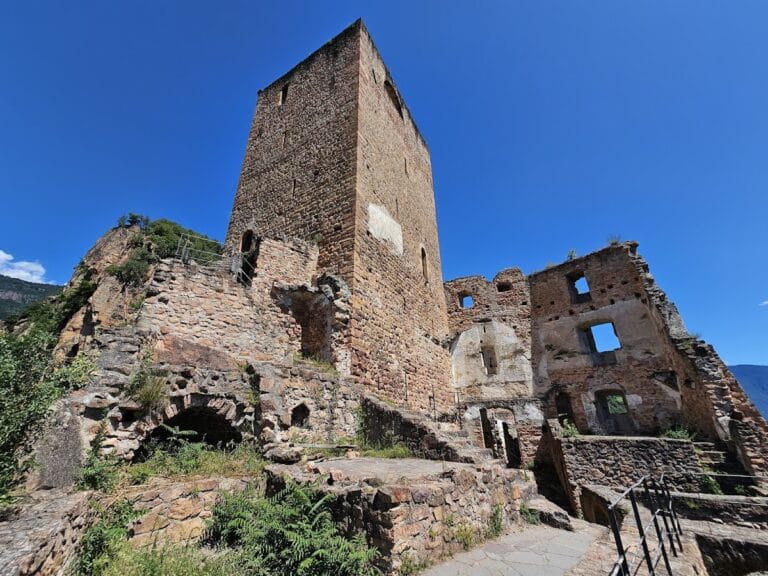
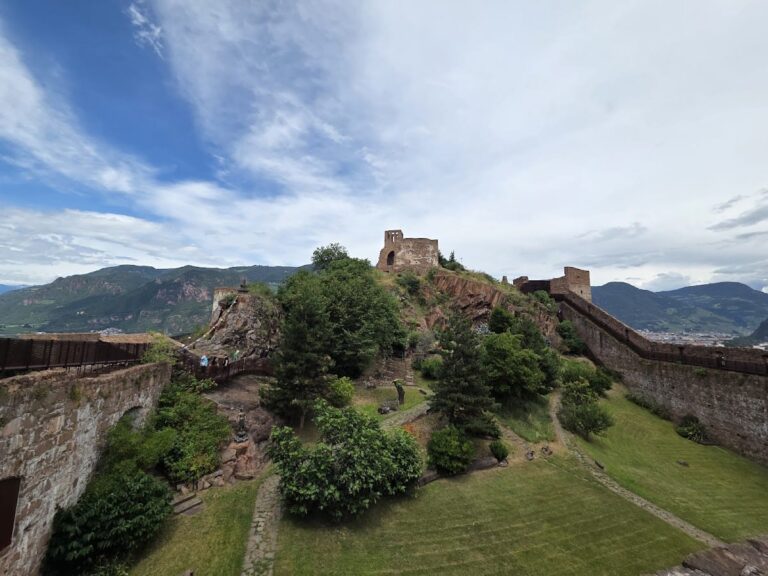
Greifenstein Castle occupies a rocky spur of the Tschögglberg at 746 metres above sea level, high above the Adige Valley and Terlan in the municipality of Jenesien. Steep or near-vertical sides protect the spur on almost every side. The surviving ruins form only part of a formerly extensive defensive complex, whose structures continued farther down the rocky ridge.
Fortified hilltop complex
Upper fortress
The principal ruin stands on the elevated rocky spur. Seen from the valley, the remains appear relatively slight, but the site itself reveals the scale and strength of the former fortification. Its position gave the upper fortress a commanding relationship to nearby Neuhaus Castle. The surviving masonry belongs to a complex repeatedly rebuilt after the destruction of 1275, the reconstruction of 1334, the fire of 1348, and the rebuilding of 1363.
Lower outer bailey
A large lower outer bailey extended down the castle spur below the main fortress. This area formed a substantial defensive addition to the complex and protected the approach to the upper stronghold. The lower works demonstrate that Greifenstein consisted of more than the prominent upper ruin, with defensive structures occupying a considerable section of the rocky site.
Archaeological material
The archaeological campaigns of the 1990s recovered medieval remains from the castle, including ceramic fragments. These finds provide material evidence for the medieval use of the fortress and complement the surviving architectural remains on the spur.