Maretsch Castle: A Medieval Lowland Castle in Bolzano


Site at a Glance
- Rating
- 4.4
- Popularity
- Medium
- Country
- Italy
- Primary era
- Medieval
- External website
- Open
- Eras represented
- Medieval, Early Modern
- Civilizations
- Habsburg, Holy Roman Empire
- Site type
- Military
- Remains
- Castle
On this page7 sections
History
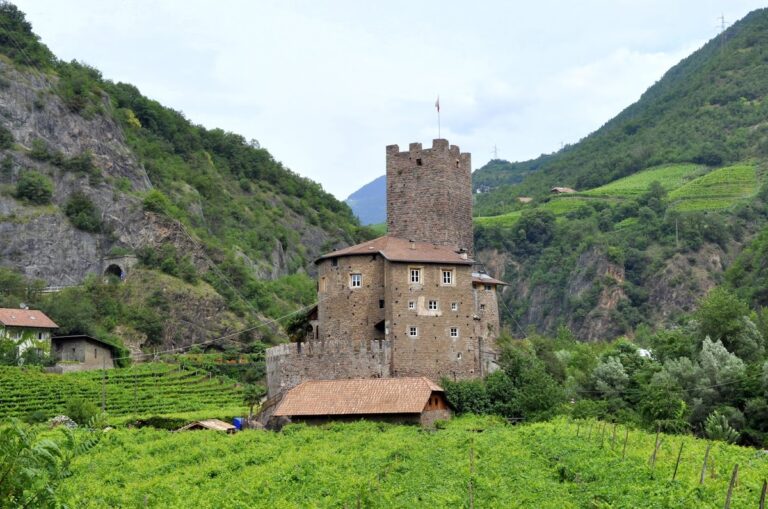
Maretsch Castle is a medieval lowland castle in Bolzano, Italy, whose oldest substantial phase dates to the thirteenth century. Its urban position made it more suitable for residence than for prolonged defense, and successive owners expanded and transformed it over several centuries.
Medieval origins and expansion
The place-name appears as “Moretes” in records from 1180 to 1190. The Maretsch family is first recorded in 1275 through Heinrich of Maretsch, a ministerial, meaning a noble or knightly official who held land and served a higher-ranking lord in administrative or military matters. The older claim that Berthold of Bolzano built the first castle around 1194 is not accepted. The castle’s earliest substantial construction belongs instead to the thirteenth century, followed by several enlargements from the fourteenth century onward.
The name was recorded as “Maretsch bey Botzen” in 1431 and “Maretsch ober Botzen” in 1438. One tradition holds that Christofer Reifer was imprisoned and fined after disobeying Duke Sigismund, then surrendered Maretsch and its adjoining land to the duke. Sigismund sold the property to the Metzner family in 1476, after which the Metzners sold it to the Römer family. This sequence does not align clearly with a separate succession associated with the Mareccio family.
Renaissance transformation
Between 1558 and 1570, the Römer family changed the fortress into a castle. Lukas Römer led this transformation while serving as land commander of the Teutonic Order’s regional branch on the Adige and in the Mountains. The Teutonic Order was a medieval religious-military order, and a land commander administered one of its territorial divisions. Renaissance wall paintings made on fresh plaster were commissioned for the castle, including biblical and heraldic scenes. The Römers were later raised to baronial rank by Archduke Ferdinand II of Austria.
After Magdalena, Lukas Römer’s widow, married Baron Maximilian von Hendl, Maretsch passed to the Hendl family in 1581. Ulrich von Hendl embellished the castle between 1629 and 1634. The principal portal and the renewed western half belong to this period.
Later ownership and public uses
Stams Abbey, a Cistercian monastery in Tyrol, bought Maretsch in 1657. It passed to Archbishop Guidobald von Thun and Hohenstein the following year, and the Thun family retained it until 1851. Count Karl Thun then sold it to Countess Anna Sarnthein, who leased the castle for state use as an arms depot. It continued in that role for more than half a century.
The castle passed by inheritance to the Toggenburg family in 1894. It served as a military quarter in 1918. After South Tyrol was annexed to Italy, sections of the Innsbruck archive relating to South Tyrol were transferred to Maretsch in 1919.
The Napoleonic Wars, the European conflicts of Napoleon’s era, caused no major visible damage to the castle. Prolonged abandonment nevertheless damaged much of its interior decoration and ceilings. Restoration took place in 1930 and 1931. Maretsch later became the seat of the Bolzano State Archive, but it was declared structurally unsafe in 1972. Its archival holdings were moved elsewhere while the Dr. Friedrich Teßmann Regional Library was completed, and the archive left the castle during the 1980s.
In 1974, Bolzano’s municipal tourism administration acquired Maretsch from the Toggenburg family. Extensive restoration subsequently repaired the structures and frescoes, after which the castle was adapted for conferences, exhibitions, and events. The Bolzano Castles Foundation now manages it, together with Runkelstein Castle, on behalf of the City of Bolzano.
Remains
Castle layout and defenses
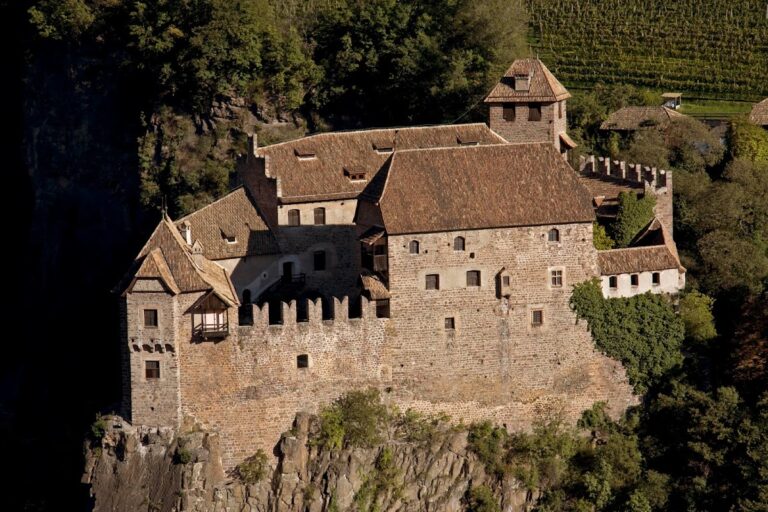
Maretsch stands in Bolzano’s historic city center, immediately east of the Talfer promenade. The surviving complex is organized around a massive thirteenth-century main keep. From the fourteenth century onward, a curtain wall, an enclosing defensive wall connecting fortified elements, was added, together with a wall-walk bearing swallowtail merlons, battlements with forked, V-shaped tops.
The sixteenth-century redesign gave the castle four external round towers that vary in height and diameter. An enclosing defensive wall, moat, and bridge completed this later arrangement. The principal portal and the renewed western half were added during the Hendl period in the seventeenth century.
Frescoes, chapel, and tower inscription
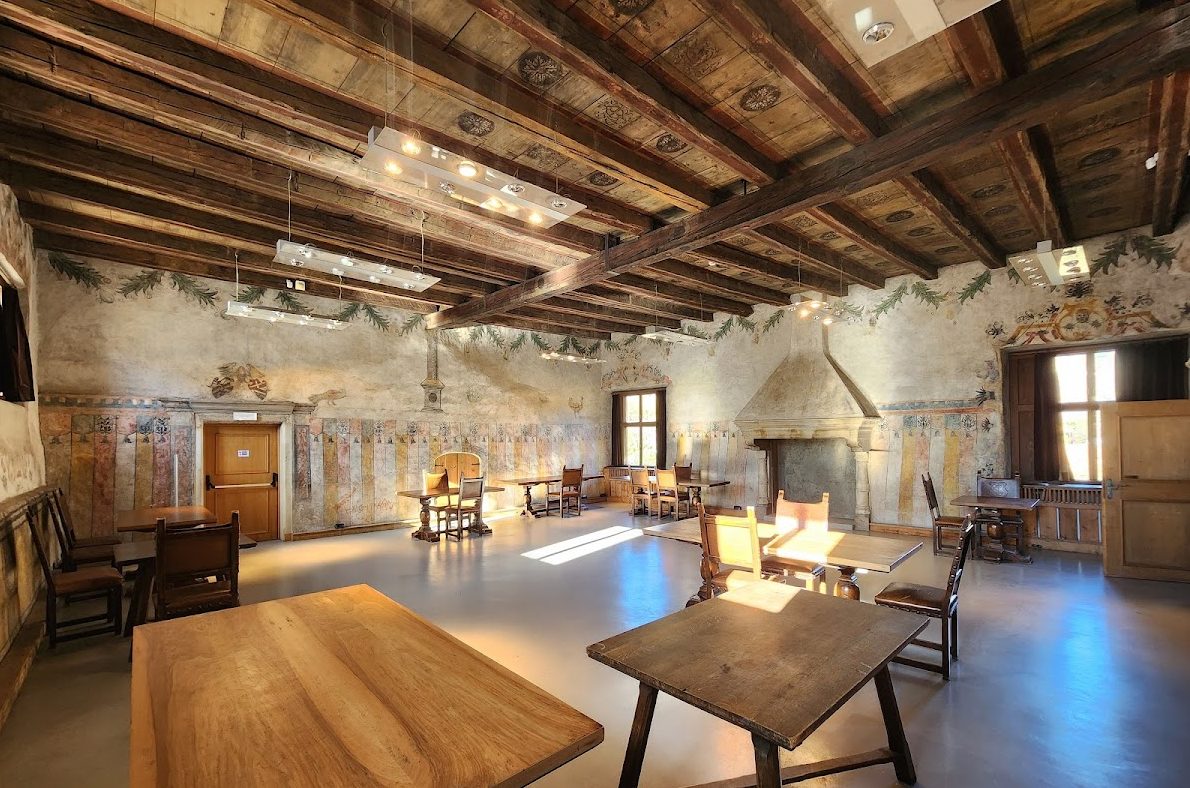
Renaissance frescoes, wall paintings created on fresh plaster so that the pigments become integrated with the surface, decorate the Knights’ Hall, the towers, and the chapel. Their artists are unknown. Biblical scenes and heraldic imagery connect the decoration with the artistic milieu of Archduke Sigismund, a Habsburg ruler associated with Tyrol in the late fifteenth and early sixteenth centuries.
One of the castle towers bears a Sator square, a Latin word square formed from the repeated words “SATOR AREPO TENET OPERA ROTAS.” Its arrangement is a palindrome, and its interpretation is associated with the Lord’s Prayer and the Christian symbols alpha and omega.
Maretsch remains a standing castle complex. Its restored spaces accommodate conferences, exhibitions, and other events.
Nearby sites