Grottenstein Castle Ruin: A Medieval Cave Castle in Switzerland


Site at a Glance
- Rating
- 4.3
- Popularity
- Very Low
- Country
- Switzerland
- Primary era
- Medieval
- External website
- Open
- Eras represented
- Medieval
- Civilizations
- Holy Roman Empire
- Site type
- Military
- Remains
- Castle
On this page7 sections
History
Grottenstein Castle Ruin is a probable medieval cave castle near Haldenstein in Switzerland, built around 1180 at the foot of the Calanda mountain massif. Its construction sequence remains uncertain because archaeological excavations have not established the order of its building phases. The castle may have served as an emergency refuge or flight castle during warfare rather than as a permanent residence.
Medieval associations
The site lies only a few hundred metres from Lichtenstein Castle and Haldenstein Castle. This close position suggests that Grottenstein probably belonged to the Lords of Lichtenstein or to their closely related Haldenstein relatives. The Lords of Lichtenstein and Haldenstein were medieval noble families associated with nearby castles, while a lordship was a territorial jurisdiction governed by a noble family.
The Lichtenstein family line ended around 1275. The male line of the Haldenstein family ended in the late fourteenth century, after which its lands passed among relatives. By 1424, the lordship of Haldenstein was held by Ursula von Hohenems and her husband, Peter von Grifensee.
Records and name
Grottenstein was already a ruin when the site was first recorded in 1672. Written forms included Crottenstein in 1672 and Krottenstein in 1742, before the name developed into Grottenstein. The earlier form probably referred to toads sheltering beneath the rock overhang. A medieval derivation from the word “grotto” is not possible, since that word entered German only toward the end of the fifteenth century.
Remains
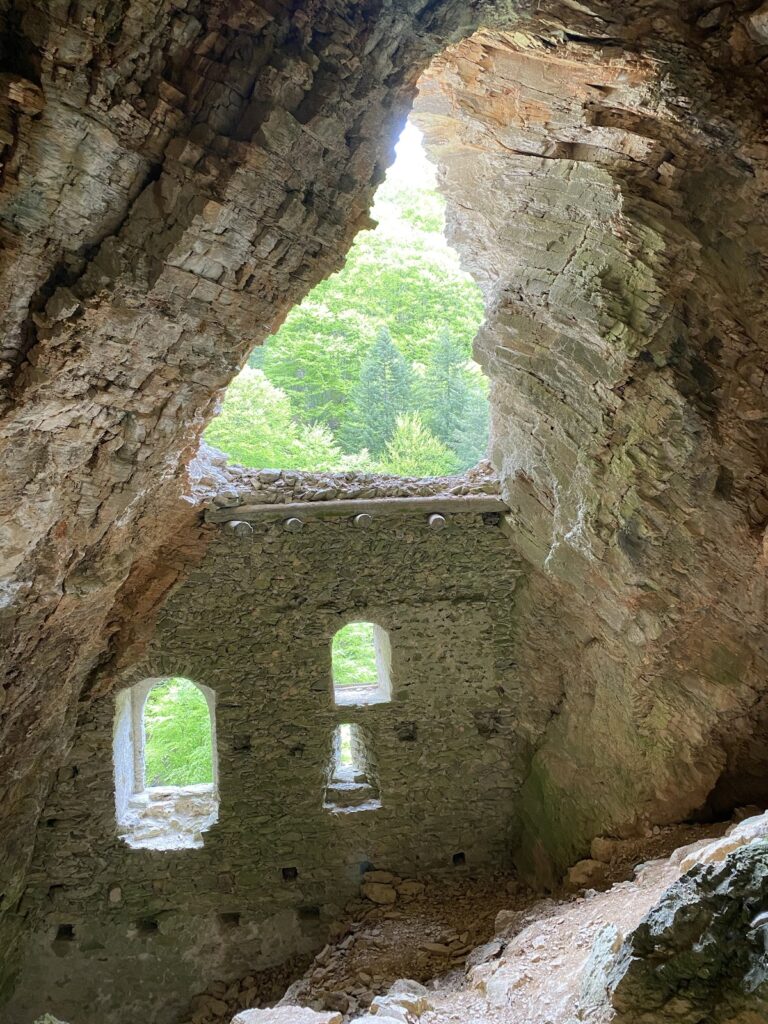
The ruin is a cave castle and slope castle set within a spacious natural rock shelter, or balme, at an elevation of 840 metres beneath the Calanda rock face south of Haldenstein. A balme is a protected overhang or shelter formed by rock. The castle occupied this shelter by closing the entrance to a small cavern with a substantial rubble-stone wall.
Cave and enclosing wall
Front wall
The surviving front wall is approximately 1.7 metres thick and extends for about 22 metres. One end was built directly against the rock, while the other is understood to have formed a corner or angled junction. The wall survives in ruined condition and preserves part of the main entrance near its centre.
Entrance and cavern
A high entrance stood about 5 metres above ground level, with an associated beam channel still visible. The rear wall of the cavern was left unworked, and a spring lies inside the rock shelter. Together, the natural cavity and the masonry across its entrance formed the physical setting of this small fortified refuge.
Nearby sites