Burg Fürth am Berg: A Former Protective and Administrative Castle in Germany


Site at a Glance
- Rating
- 4.3
- Popularity
- Very Low
- Country
- Germany
- Primary era
- Medieval
- Eras represented
- Medieval
- Civilizations
- Carolingian, Holy Roman Empire
- Site type
- Military
- Remains
- Castle
On this page7 sections
History
Burg Fürth am Berg is a former protective and administrative castle near Neustadt in Germany. Its core dates to the ninth century, when the hilltop refuge helped defend against raids by Hungarian cavalry. A reference from 1317 names the site Feste Furttenberg, although 1348 is also given as the date of its first mention.
Bamberg Administration
The castle stood under the feudal authority of the bishops of Bamberg. As both religious leaders and territorial rulers, they appointed officials from Franconian and Thuringian knightly families to administer justice, collect tithes and tolls, and demand forced labor. Burg Fürth am Berg continued in this protective and administrative role until 1660.
Several established Franconian noble families held the castle at different times. Berthold Schenk von Siemau held it from 1359, while the Lords of Schaumberg are associated with the site in 1383 and 1601. The Lords of Rosenau held it from 1502. From 1590 to 1601, the Lords of Brandenstein and the Lords of Würtzburg occupied the castle in alternating periods.
Destruction, Abandonment, and Ruin
A forest-glass workshop operated on the grounds in 1489. In 1525, during the German Peasants’ War, a major uprising of peasants and lower social groups across the German lands, the castle was destroyed. It was rebuilt by 1528.
The Pömer von Diepoltsdorf family of Nuremberg were the castle’s last residents. In 1660 they moved to a manorial estate in the village, also held by the bishops of Bamberg, and the castle became unoccupied. In 1740 the bishop abandoned the administrative seat, divided the manorial property into parcels, and sold them to villagers. Local residents then used the ruins as a source of building stone until the Coburg government prohibited the removal of material around 1850.
Considerable wall remains were still visible in 1960, as shown in a drawing by Max Schneider. The surviving ruins were demolished by blasting that year and became overgrown during the following decades. Between 1964 and 1967, Richard Gerlicher of Fürth cleared rubble and uncontrolled vegetation from the spur and worked to secure the site as a cultural monument.
Archaeological Recovery
Burg Fürth am Berg received archaeological-monument protection in 1980 and is also listed as an architectural heritage monument in Bavaria. The Förderkreis Fürther Burg association was founded in 1989. Between 1991 and 1996, the University of Bamberg carried out several excavation campaigns directed by excavation technician Werner Feil. The castle grounds and a well-preserved vaulted cellar were subsequently made accessible again.
Remains
Hilltop Setting and Construction
Burg Fürth am Berg occupies a southeast-facing spur of the 420-metre-high Fürther Berg, between the Neustadt districts of Horb and Fürth am Berg. The site lies about 1,700 metres from the Bavarian-Thuringian border. Its exposed position provided views over the old Nuremberg-Leipzig trade road, including its ford across the Steinach River, as well as over the Neustadt-Mitwitz country road.
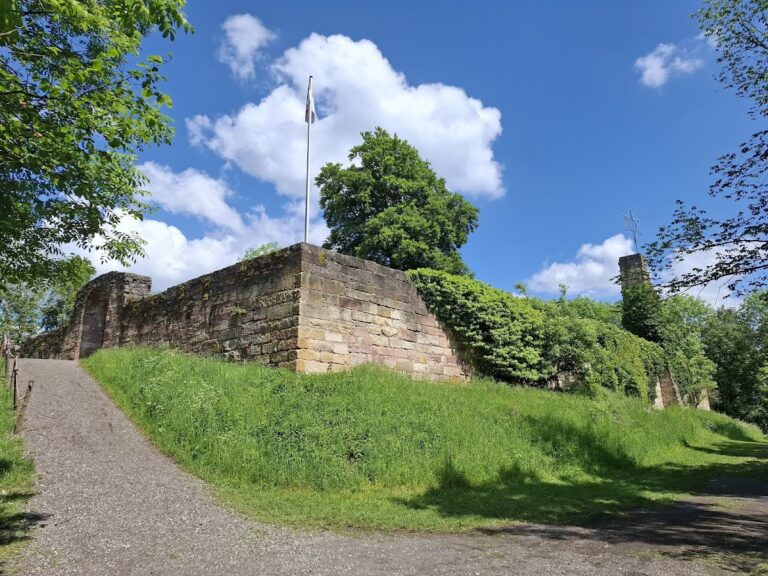
The site is now a Burgstall, an archaeological place where a former castle has largely disappeared, leaving traces such as earthworks, rubble, or ruins rather than standing buildings. The castle was built with ashlar and rubble stone. Today, the castle mound is covered by rubble and vegetation, while the surviving vaulted cellar preserves a substantial part of the former structure. The grounds and cellar can still be walked through.
Associated Industrial Feature
The forest-glass workshop recorded on the castle grounds in 1489 represents an associated industrial installation. Such workshops used wood from surrounding forests as fuel and commonly processed locally available raw materials. Its presence adds a productive function to the castle site alongside its defensive and administrative roles.