Dornhofen Castle: A Renaissance Castle in Austria


Site at a Glance
- Rating
- 4.5
- Popularity
- Low
- Country
- Austria
- Primary era
- Early Modern
- External website
- Open
- Eras represented
- Early Modern
- Civilizations
- Habsburg, Holy Roman Empire
- Site type
- Domestic
- Remains
- Castle
On this page7 sections
History
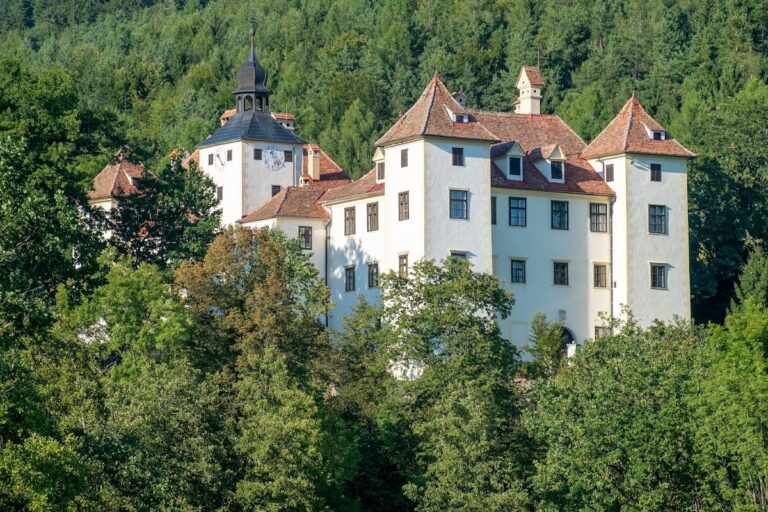
Dornhofen Castle is a seventeenth-century Renaissance castle in Austria, located at Hart in the municipality of Eggersdorf bei Graz, Styria. Its construction began around 1580, when Otto von Radmannsdorf acquired and demolished two farms on the site, and the complex was completed in 1624. The castle and its associated estate farm are protected as historic monuments.
Origins and completion
The site was occupied by the Dornerhof and Pluemberghof until the seventeenth century. Around 1580, Maria von Wilfersdorf sold both farms to Otto von Radmannsdorf, who cleared them and began building a castle. His substantial debts led to the unfinished shell being pledged in 1601. Gottfried von Falbenhaupt then acquired the property and completed the building by 1624, the date displayed on the western portal.
Noble ownership
In 1656, Dornhofen Castle passed to Maria Rosina von Eibiswald and subsequently by inheritance to her daughter, Maria Eusebia Gräfin Galler. The estate at that time included dependent subjects in the parish of Straden. In 1720 it passed to Maria Eleonore Gräfin Steinpeiß, and in 1733 to her son Ferdinand Josef Graf Prankh.
Ferdinand Josef Graf Prankh sold the estate in 1746 to Sigismund von Kollonitz, the Viennese archbishop and cardinal. Kollonitz left it to his adopted nephew, Ladislaus Freiherr Zay von Csömör. The estate remained with the Kollonitz von Kollograd family until 1870, after which the castle changed owners frequently.
Twentieth-century changes
After 1920, Dornhofen Castle served for periods as a children’s home and a guesthouse. It stood vacant for an extended period after the Second World War and deteriorated while its farmer owners concentrated on the associated agricultural property. Konrad Ceh was recorded as the owner in 1955.
The Strahl family acquired the estate in 1972 and began extensive restoration. The castle is privately owned, houses a restaurant, and is used particularly in summer for cultural events. Its associated estate farm, or Meierhof, is protected together with the castle as a historic monument.
Remains
Dornhofen Castle occupies a terrace on the left bank of the Rabnitzbach, on a slope in the hill range between the Rabnitzbach and the Raab. The surviving complex is a two-storey, three-winged Renaissance building arranged around an approximately square courtyard. Four square corner towers project from the building, while the wings form a horseshoe-shaped plan on three sides. A wall closes the courtyard on the east.
Defensive structure and courtyard
The corner towers and the surviving traces of small western bastions give the complex a defensive character. The former surrounding defensive wall is represented in a 1681 engraving by Georg Matthäus Vischer. The courtyard is enclosed by two-storey column arcades, galleries formed by regular rows of columns. These arcades belong to a later phase and replaced the original wooden galleries.
Portal, chapel, and grounds
The western portal carries the date 1624, commemorating the completion of construction. Above it rises a small square bell tower with a clock and an onion dome, a rounded, swelling dome. A Baroque chapel occupies the southeastern wing. Its altar painting, dating from the end of the seventeenth century, depicts the Lamentation of Christ.
A park surrounds the castle, and two fishponds survive within the estate grounds. Access passes through the Meierhof, an agricultural service complex belonging to a manor or castle. The farm buildings lie somewhat below the castle and include two square corner towers.
Nearby sites