Fort de la Crèche: A Coastal Battery Protecting Boulogne-sur-Mer


Site at a Glance
- Rating
- 4.5
- Popularity
- Low
- Country
- France
- Primary era
- Modern
- External website
- Open
- Eras represented
- Modern
- Civilizations
- French, German
- Site type
- Military
- Remains
- Fort
On this page19 sections
History
Fort de la Crèche is a French coastal battery near Wimereux, on the English Channel coast, completed around 1879 as part of the Séré de Rivières system. This network of French fortifications was built mainly after the Franco-Prussian War to protect frontiers, ports, and strategic routes. Fort de la Crèche formed the northern end of four batteries defending the port of Boulogne-sur-Mer, alongside Alprech, Mont de Couppe, and the Tour d’Ordre.
Napoleonic and nineteenth-century defenses
The battery replaced part of an earlier Napoleonic defense complex created during Napoleon I’s preparations for war. Fort Terlincthun was built between 1806 and 1808, while another fort stood offshore at the end of Pointe de la Crèche. Fort Terlincthun later disappeared, and the offshore work survives only in its foundations.
The four nineteenth-century batteries shared a defensive plan. Each combined a barracks, powder magazine, traverse shelters, gun platforms, and a well within a stone enclosure and dry moat. In this arrangement, the artillery positions and ammunition stores formed part of a coordinated system for protecting Boulogne-sur-Mer.
Service during the world wars
Fort de la Crèche remained operational during the First World War, when Boulogne-sur-Mer served as an important port for supplying troops and evacuating wounded soldiers. The battery also had a logistical function during the conflict.
Between the two world wars, the position was modernized. Four 194 mm Model 1902 naval guns replaced its earlier armament, with two ammunition magazines serving each gun. Part of the perimeter wall was demolished to make room for the new emplacements. Four 75 mm Model 1897 guns were also installed behind the fort in 1931 for antiaircraft defense.
During the Battle of France, Lieutenant Commander René de Forton commanded the battery. German tanks and armored cars attacked on 23 May 1940. The defenders destroyed one light tank and two armored cars at close range, but surrendered after about two hours when their ammunition was exhausted. The French destroyer Chacal was sunk off Le Portel while attempting to halt the German advance.
German occupation and the Atlantic Wall
The Kriegsmarine, Nazi Germany’s navy, occupied the fort in June 1940. A detachment of the 240th Naval Artillery Group, commanded by Korvetten-Kapitän Fritz Diekmann, repaired and camouflaged the damaged French 194 mm guns. The position became known as Battery Crèche I.
In 1942, Germany incorporated the fort and associated batteries into the Atlantic Wall, its coastal-defense system against an Allied invasion of western Europe. In 1943, the three Crèche batteries and the point were grouped as a single fortified position called Stützpunkt 01 La Crèche. The position was renamed Arnika, position 221, in 1944.
From 1943, increasingly heavy Allied bombing reflected the expected invasion threat. In 1944, a new German battery with four 105 mm SK/C 32 guns replaced the French naval guns. Two of the 194 mm weapons were retained, while a fourth bunker on the road to Terlincthun was later destroyed. On 1 June 1944, the position held 405 Kriegsmarine personnel and 25 Heer personnel, the Heer being the German army.
Canadian forces captured the position on 21 and 22 September 1944. Tanks and M10 self-propelled guns were brought close to the fort overnight, after which the German garrison surrendered to the Queen’s Own Rifles, a Canadian infantry regiment.
Decline and preservation
After the war, the site deteriorated. Some structures were occupied by homeless people or hermits, and a nearby farm used part of the fort while it remained under naval ownership. Other works were abandoned and damaged by vegetation, vandalism, and collapses of the coastal cliffs.
The site was decommissioned in 1999 and is owned by the Conservatoire du Littoral. The Association of Fort de la Crèche has progressively restored it since 2002 and presents its history through guided visits using historical illustrations and photographs. Safety risks have led to the closure of most structures in the Crèche II and Pointe de la Crèche sectors.
Remains
Fort de la Crèche occupies a coastal cliff south of Wimereux, behind Pointe de la Crèche. The surviving complex brings together the original French battery, later gun positions, German bunkers, observation works, and remains of the earlier Napoleonic defenses. The fort’s original arrangement placed artillery and support buildings inside a stone wall and dry moat, while later concrete works altered the perimeter and expanded the defended area across the point.
The main French fort
Original battery
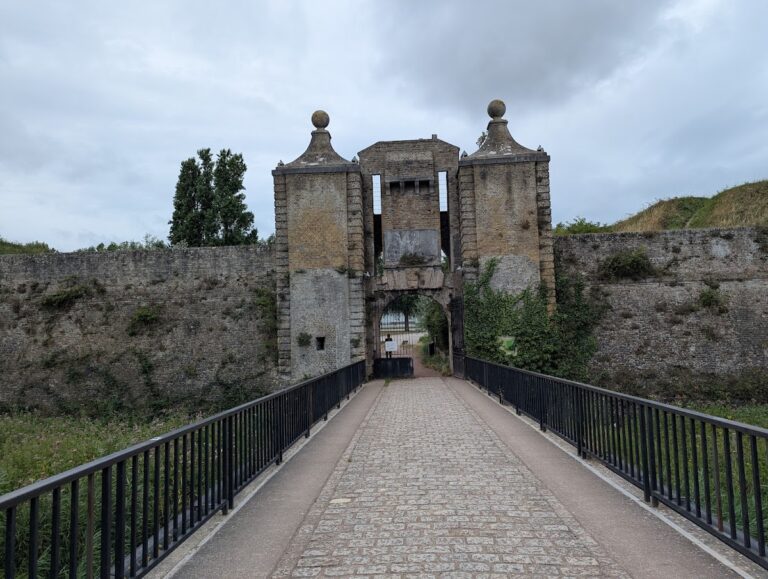
The original fort consisted of a stone-walled enclosure with a dry moat. Inside were a barracks, powder magazine, traverse shelters, gun platforms, and a well. These elements formed the standard layout used by the Séré de Rivières coastal batteries.
Interwar gun positions
The interwar modernization changed the original layout by installing four 194 mm naval guns, each backed by two ammunition magazines. The removal of part of the perimeter wall made space for the new emplacements. The later German battery reused these magazines when four 105 mm guns were installed in a concrete bunker.
Fire-control and observation works
Pointe de la Crèche fire-control post
A concrete casemate for directing artillery fire was built on top of the cliff at Pointe de la Crèche. The French returned the fire-control post to service in summer 1940, adding a small observation structure with a rangefinder on its roof. From 1941, a modified searchlight for locating ships stood forward of the post inside a protective bunker.
Searchlights and observation posts
The point also contained antiaircraft guns and light shelters. A German searchlight with a 150 centimetre diameter replaced the French searchlight. Secondary observation posts serving the Todt, Friedrich August, and Grosser Kurfürst batteries were installed at Pointe de la Crèche.
German batteries
Battery Crèche I
Battery Crèche I occupied the main fort. At the beginning of the Second World War, a personnel bunker was built behind each naval gun. In 1944, the former gun platforms were destroyed to create a bunker for four 105 mm guns, which incorporated the earlier French ammunition magazines. A fourth German bunker on the road to Terlincthun has since been destroyed.
Battery Crèche II
Battery Crèche II occupied the northern part of the point. It reused a British battery of four 94 mm Vickers M39 guns intended for defense against aircraft and warships. German gun pits and personnel bunkers were added, and in 1944 the guns were enclosed in four Regelbau 671 bunkers. A Regelbau was a standardized German bunker design built to prescribed plans and specifications.
Battery Crèche III
Battery Crèche III comprised four 75 mm Model 1897 guns installed behind the fort in 1931 for antiaircraft defense. On 6 June 1940, one gun was transferred to Boulogne harbor’s southern pier to replace a British gun whose ammunition had run out. It did not return to Fort de la Crèche.
Harbor-blocking defenses
Gun bunkers at the point
Part of the harbor-blocking battery was installed along the southern flank of the point in 1943. The wider battery extended from the maritime station through Nausicaà and the hamlet of Moulin Wibert to Pointe de la Crèche, with the purpose of attacking Allied forces attempting to seize the harbor from the sea.
The installations at the point included a French 155 mm gun in a Regelbau 611 bunker and two Russian 76.2 mm guns. One of the Russian weapons was protected by a Regelbau 669 bunker, and a Regelbau 634 bunker was also built at the point. In 1944, the two harbor-blocking gun bunkers and the Regelbau 634 were joined by a common underground passage.
Napoleonic and surviving coastal remains
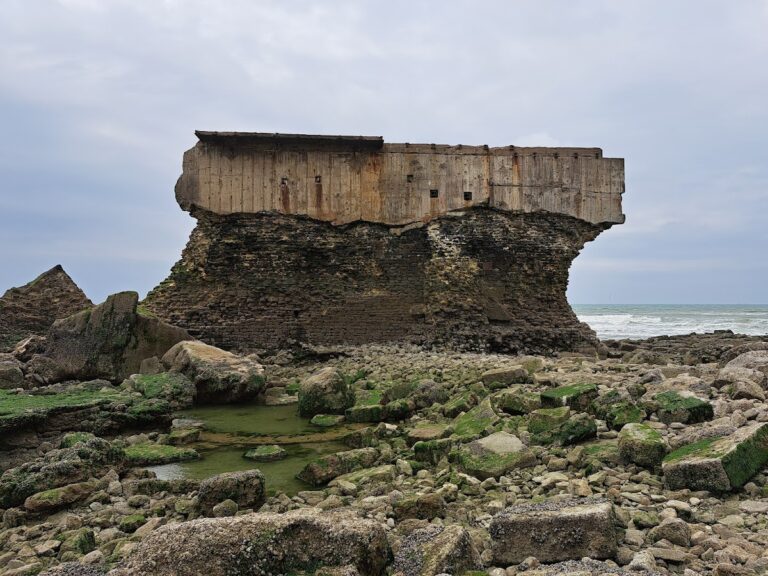
The foundations of the offshore fort built as part of the Napoleonic defense complex remain opposite Pointe de la Crèche. Several bunkers and other works in the Crèche II and Pointe de la Crèche sectors have been damaged or lost through cliff collapses, vegetation, vandalism, and graffiti. Many surviving structures in these sectors are closed for safety reasons.