Fort de Villey-le-Sec: A Séré de Rivières Fortification in France

Site at a Glance
- Rating
- 4.7
- Popularity
- Low
- Country
- France
- Primary era
- Modern
- External website
- Open
- Eras represented
- Modern
- Civilizations
- French
- Site type
- Military
- Remains
- Fort
On this page18 sections
History
Fort de Villey-le-Sec, also known as Fort Trévise, is a nineteenth-century French fortification at Villey-le-Sec in France, built between 1875 and 1879 as part of the Séré de Rivières system. This network of forts and batteries was developed after the Franco-Prussian War of 1870–1871 to defend France’s eastern frontier. The fort formed part of the fortified camp of Toul and is described as the only example in this defensive line of a closed fortified enclosure built around an existing village.
Planning and construction
The fortified camp of Toul closed the defensive curtain of the Hauts de Meuse. Villey-le-Sec was intended to protect the approaches to Toul, secure the exits from the Forest of Haye, and provide flanking support for Fort de Gondreville and Fort de Chanot. Its planned location was initially about 1,000 metres farther west, at the position later occupied by the Chaudeney redoubt.
Design work began on 5 December 1873, following the declaration of public utility in 1874, and construction started on 26 July 1875. The Morel company carried out the work over four years, employing hundreds of workers. The resulting fort was the most expensive in the region. Its location was retained because the village occupied the most favorable ground and one of the few places in the commune where a clay layer kept water close to the surface. The inhabitants opposed moving their houses, so the fort was built around the settlement, avoiding the greater time and cost of demolition and rehousing.
Reinforcement and modernization
After 1885, the development of high-explosive artillery, including melinite shells, made exposed stone fortifications increasingly vulnerable. Villey-le-Sec was therefore reinforced with concrete and metal armor. Its artillery was also dispersed across the plateau because the original arrangements were considered insufficiently protected.
Modernization took place in 1888 and through further works between 1903 and 1914. Four barracks made from special concrete were added in 1890, serving the central fortified work, the redan, and the two batteries. A firing range was established at Gondreville around 1900 to test the fort’s weapons, while another range in the Bois de l’Embanie served military training. Work begun in 1912 to install two 155 mm gun turrets was interrupted by the First World War and never completed.
Wars and the end of the strategic role
During the First World War, the front stabilized several dozen kilometres from Villey-le-Sec after the Battle of Grand Couronné near Nancy. The fort did not see military action. The village population was evacuated, leaving the garrison and the men required for farm work.
After Alsace-Moselle returned to France, the fort lost strategic importance. The army retained only a small maintenance presence, later described as a battery guard, and no longer maintained the complex fully. Its strategic function ended in 1918. During the Second World War, the German army removed steel and other metal components for scrap. American forces also bombarded the fort during the liberation of Toul. The 155 mm guns from the Mougin turret were transferred to Fort Barbonnet in the Alps, where that fort had been modernized for use within the Alpine section of the Maginot Line.
Preservation and interpretation
The preservation association La Citadelle has worked to restore and interpret Fort de Villey-le-Sec since 1961. Parts of the site opened to the public from 1967, and the fort entered the French inventory of historic structures in 1973. On 20 June 1973, approximately 21 hectares were registered as a scenic site under the law of 2 May 1930. The Meurthe-et-Moselle department now owns the site, which is used as a museum.
Restoration has returned the Mougin turret and the north battery’s artillery to functional condition. The restored 75 mm guns can fire blank rounds. La Citadelle also maintains the fort’s approximately 20-hectare grounds with Highland cattle.
Remains
Fort de Villey-le-Sec is a fortified enclosure surrounding the village, with a principal area of approximately 40,000 square metres. Its main components are the central réduit, a fortified central work and rallying point, a redan, which is a projecting defensive work, and north and south batteries. Associated outer works, magazines, artillery positions, an infantry position, and a narrow-gauge military railway extended the defensive complex across the surrounding plateau.
The village enclosure
Réduit
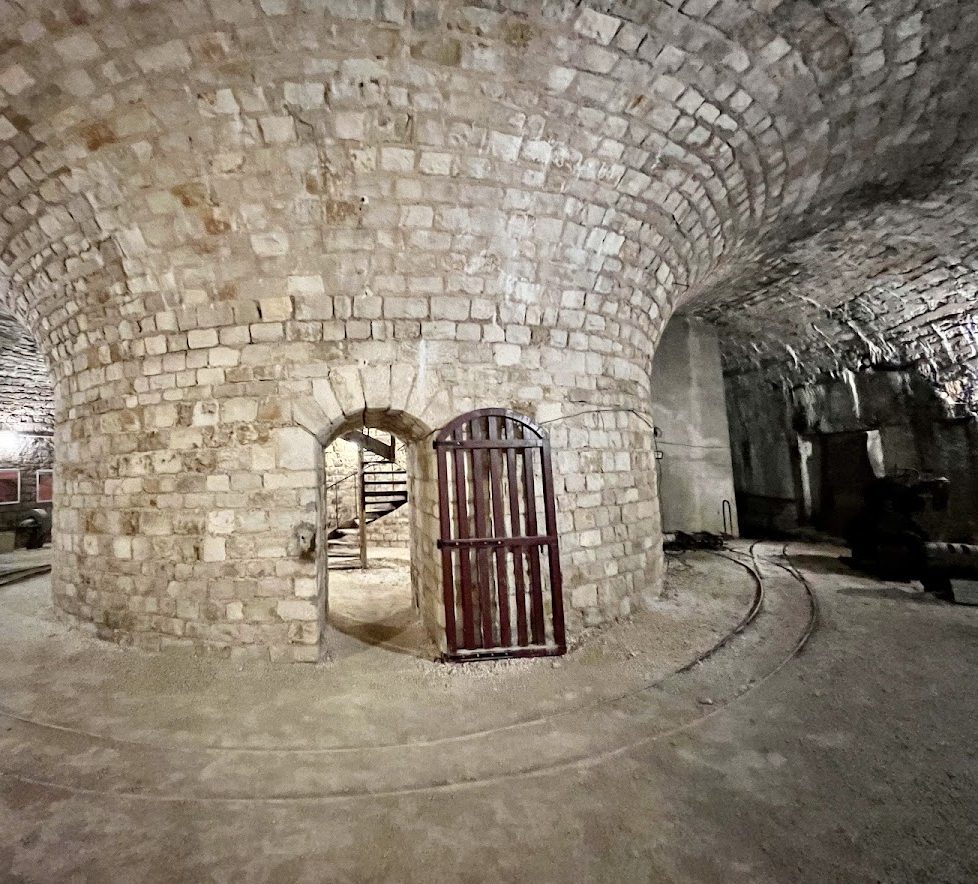
The réduit occupies the southwestern angle of the enclosure and forms a square approximately 180 metres on each side. Designed as an independent fort, it concentrated stores, accommodation, and ammunition magazines. Its arrangement resembles that of Fort de Lucey, although later modernization substantially changed its appearance. A Mougin turret, an armored rotating gun turret, stands at its center and was designed for two 155 mm guns. The guns were returned from Fort Barbonnet, and the turret is one of only two working Mougin 155 mm turrets.
Four rectangular courts mark the original barracks arrangement. A barracks protected by special concrete was built in 1888, followed by another in reinforced concrete in 1910. The later building forms the present entrance to the réduit. A separate armored battery for two 155 mm turrets was under construction in 1914 but remained unfinished.
Redan
The redan lies between the north and south batteries on the side of the village opposite the réduit. It contained a 75 mm gun turret and two armored observatories, with a concrete barracks added beneath the turret in 1890. A third observation point was added during the First World War.
The village water tower and church steeple overlooked the redan. Both were demolished with explosives in 1914 to prevent German artillery observation. German forces never reached Villey-le-Sec, and the church tower was rebuilt in 1950. In 2002, the preservation association pumped water to a depth of 2.5 metres from the redan’s works, making the barracks and turret accessible for limited stabilization work. The area awaits restoration and is not currently open to the public.
North battery
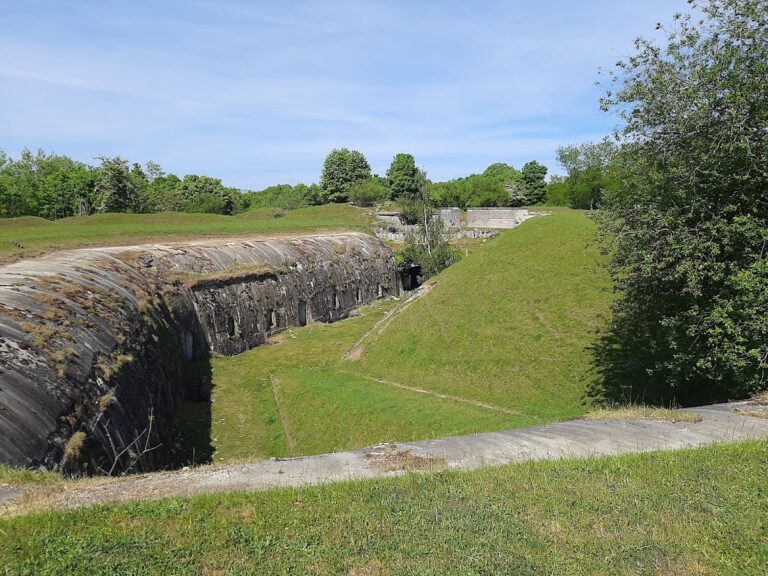
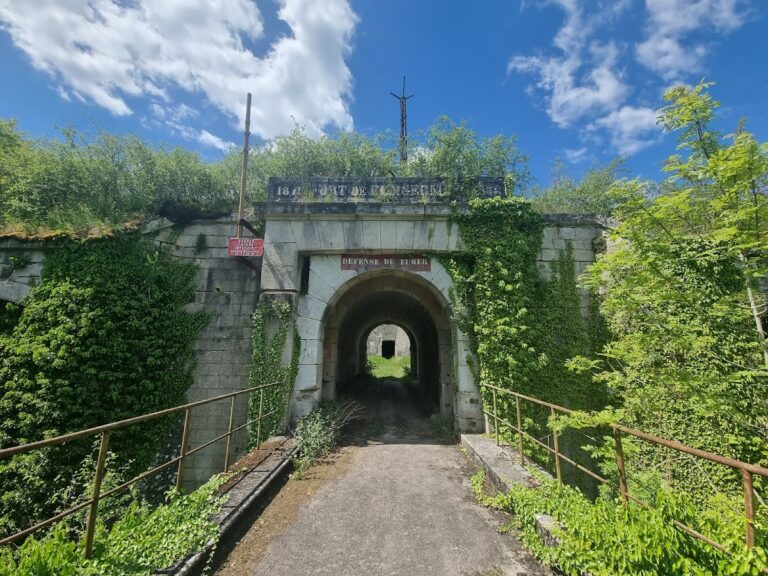
The north battery lies north of the village at an altitude of approximately 310 metres. Its V-shaped plan has legs about 160 metres long and was intended to control the plain. The armament included a retractable 75 mm gun turret, a machine-gun turret, and two armored observatories. A Pilter-type drawbridge protected the entrance, and the battery retains its double caponier, a protected position for flanking fire along a ditch or defensive line.
The restoration association recovered the north battery’s 75 mm turret guns from Ouvrage du Mordant. Both the guns and the turret’s retractable mechanism have been restored to working order, allowing the guns to fire blank rounds.
South battery
The south battery stands southeast of the village at approximately 320 metres above sea level. More substantial than the north battery, it was intended to cover the road to Maron, fire along the Moselle valley, and face the Bois l’Évêque state forest. It also follows a V-shaped plan.
The battery retains its original stone construction because it was not reinforced with concrete after 1885, apart from a concrete barracks added on its southern side in 1890. A 75 mm gun was planned but never installed. Its entrance had a laterally retractable rolling bridge manufactured by Th. Pilter. The south battery was later used by the National School of Applied Geology and Mineral Exploration in Nancy to store a collection of radioactive minerals.
Outer defenses and magazines
Chaudeney redoubt
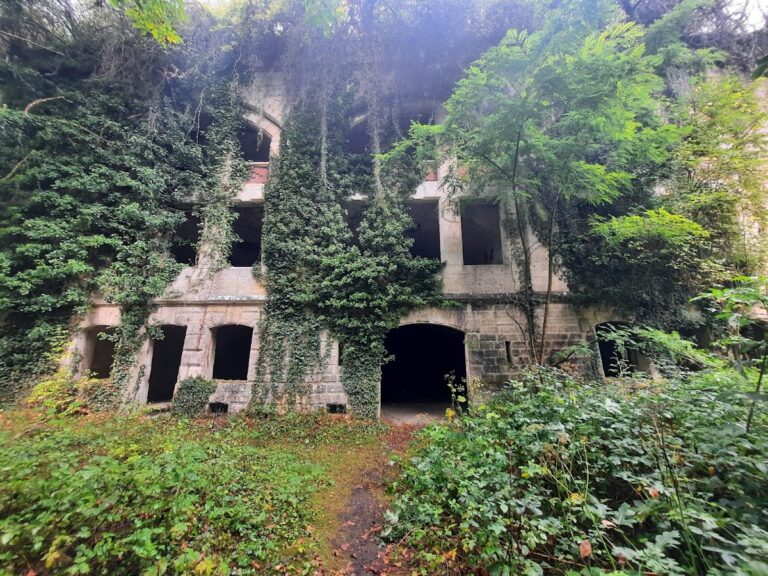
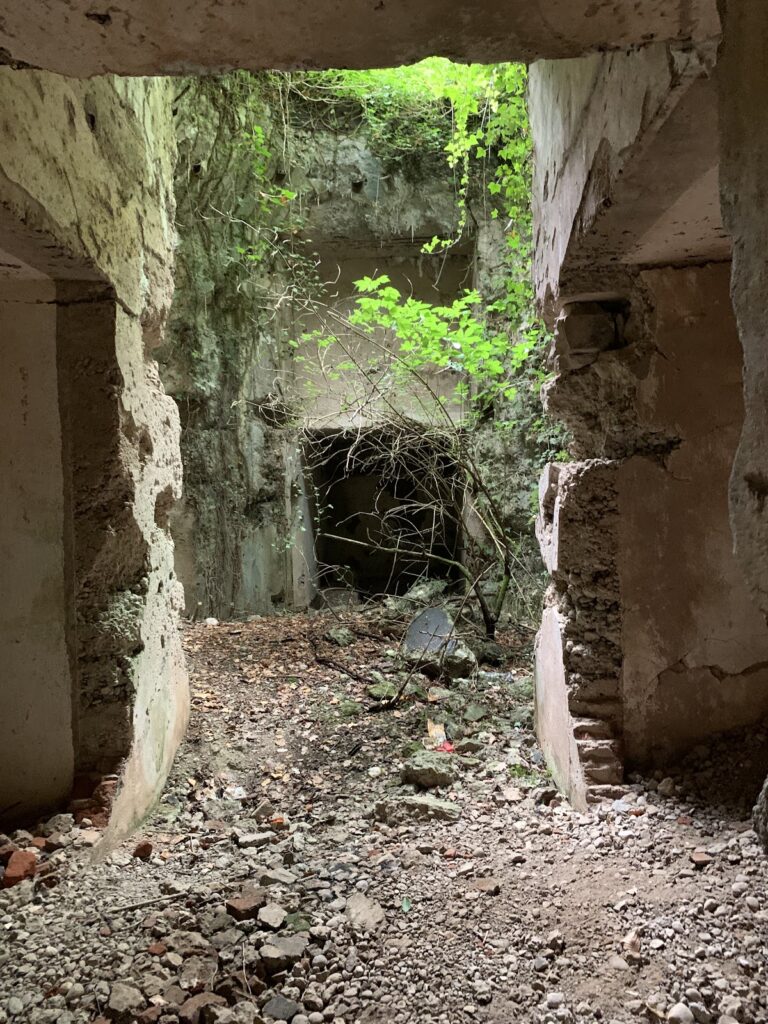
The Redoute de Chaudeney, also called the Charton redoubt, lies about one kilometre behind the main fort, at a position from which Toul could be bombarded. Construction was initiated at the end of 1874 to anticipate delays at the main fort and began in December 1875. The pentagonal work contained a Haxo casemate, a protected gun emplacement designed for fire over or through an earth-covered position, and a 164.7 mm naval gun. An earth rampart and masonry walls protected the redoubt, which is now abandoned and overgrown.
Chaudeney batteries
Four batteries were planned behind the Chaudeney redoubt, but only one was built, to the west, in 1912. It contained four 155 mm guns. A magazine was constructed about 500 metres to its southeast. The magazine is abandoned but accessible.
Bois sous roche magazine
The Bois sous roche powder magazine lies approximately 1,800 metres southwest of the fort. Built in 1890–1891, it had its own drinking-water well, which is now dry. The ruined magazine provides hibernation conditions for greater mouse-eared bats, long-eared bats, and whiskered bats. It has consequently become a nature reserve, and access to its galleries has been closed.
Western batteries
Six batteries were planned along the route between the fort and the Bois sous roche powder magazine, but only the four western batteries were built in 1888. Together they contained 24 gun platforms for 120 mm or 155 mm artillery. An earth embankment about 100 metres behind them sheltered ammunition niches and concealed the narrow-gauge military railway from direct observation.
Ouvrage du Fays
Ouvrage du Fays is a small infantry position approximately one kilometre north of the fort. It was established under the declaration of public utility of 23 August 1889 and probably received limited modernization between 1907 and 1914.
Supply railway and plateau works
A 600 mm-gauge Péchot military railway supplied the fortified complex. The Péchot system was a French narrow-gauge railway system developed for military supply lines serving fortified positions. The line was built between 1889 and 1891, extended to the Chaudeney redoubt in 1906, and extended again in 1913–1914 toward the road between Villey-le-Sec and Gondreville. A Péchot wagon, traces of the former line, and the protective embankment survive. The preservation association recreated approximately 1,500 metres of track.
Other associated works on the plateau include the Redoubt of Dommartin, the Battery of Dommartin, the field work of Haut-des-Champs, the Battery of Charmois, and Fort de Gondreville. Together with the enclosure, batteries, magazines, and railway, these remains show how Villey-le-Sec operated as part of the wider fortified camp of Toul rather than as an isolated fort.
Nearby sites