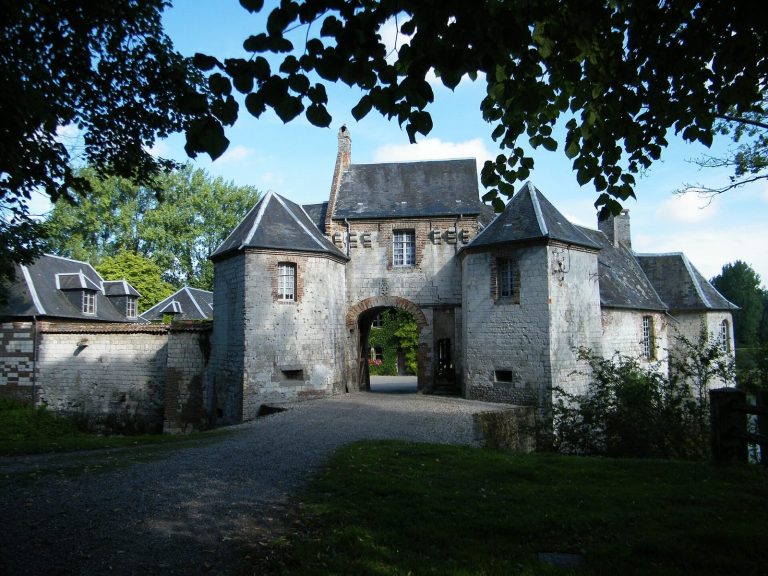
Hardelot Castle: A Medieval Fortress and Neo-Tudor Cultural Centre


Site at a Glance
- Rating
- 4.5
- Popularity
- Medium
- Country
- France
- Primary era
- Modern
- External website
- Open
- Eras represented
- Medieval, Modern
- Civilizations
- French
- Site type
- Domestic
- Remains
- Castle
On this page13 sections
History
Hardelot Castle is a historic castle in France whose present neo-Tudor manor was built in the nineteenth century above a medieval fortress begun in 1222. The site developed from a wooden stronghold established by the counts of Boulogne and later became a royal fortress before its ruins were adapted into an estate and cultural centre.
Medieval foundation and fortress
The earliest stronghold, known as Ardrelo, was a wooden castle built by the counts of Boulogne during the twelfth century. In 1194, Renaud de Dammartin, a nobleman and count of Boulogne, signed Boulogne’s first communal charter at the site.
A more substantial fortress was constructed between 1222 and 1231 under Philippe Hurepel de Clermont, son of King Philippe Auguste, with the project also associated with Mathilde de Dammartin, Countess of Boulogne and Dammartin. The fortress changed hands repeatedly. French, English, and Burgundian troops occupied it or passed through it, and by the fifteenth century it had become a royal fortress of the kingdom of France.
Destruction and estate transformation
In 1615, Marie de Médicis, queen consort and regent of France from 1610 to 1617, ordered the Marshal of Ancre to besiege the castle because Protestants occupied it. The fortress was largely destroyed, after which a farm was established among the ruins. Parts of the medieval curtain walls, defensive walls enclosing the stronghold, survived.
The property was sold as national property in 1791 to the lord of Châteaubourg for 26,400 livres. It was sold again in 1820 with an extensive estate of dunes, warrens, marshes, woods, and ponds reaching toward the coast. Conifer plantations were established several years later to slow the movement of coastal sand.
Nineteenth-century rebuilding
Sir John Hare, an English magistrate from Bristol, acquired the property in 1848 and attempted to restore the medieval ruins. The castle hosted large receptions during this period, and Charles Dickens, who was staying in the area with Ellen Ternan, visited regularly.
Captain Henry Guy bought the castle in 1865 and commissioned a neo-Tudor manor. Neo-Tudor was a nineteenth-century revival style based on architectural forms associated with Tudor England, including the imagery of fortified manor houses. Completed during the nineteenth century above the medieval foundations and underground structures, the new building incorporated a surviving medieval tower. Guy’s daughter Helen later became a noted composer under the name Guy d’Hardelot.
Estate development and twentieth-century use
John Robinson Whitley and several associates acquired the castle and surrounding properties in 1897. They developed the estate as a sporting and leisure centre with golf, tennis, hunting, fishing, and archery, and participated in creating the nearby resort of Hardelot-Plage. Hotels and restaurants had been established near the castle by 1910.
During the First World War, the castle was made available to the British Army. Abbé Bouly, the priest of Condette and Hardelot, acquired it in 1934, and a congregation of nuns subsequently occupied the building.
Municipal ownership and cultural centre
The municipality of Condette received the castle in 1987. In 2001, the municipality and the Pas-de-Calais departmental council signed a 50-year emphyteutic lease, a long-term lease allowing use and development while ownership remains with the lessor, to establish a cultural centre.
Extensive renovation followed the discovery of dry rot in the roof structure, woodwork, and walls. Work carried out between 2007 and 2009 enabled the castle’s cultural reuse. The Centre culturel de l’Entente cordiale opened there on 13 June 2009. The Entente cordiale was the diplomatic understanding established between France and Britain in 1904; at Hardelot, the centre promotes French-British relations through music, visual arts, cinema, literature, and heritage.
In 2014, the interiors were reorganised as a permanent exhibition on the history of the castle and French-British relations. The annual Midsummer Festival focuses on early, Baroque, and classical music, while the castle has also hosted theatre, exhibitions, and concerts. A new Elizabethan theatre opened in the park in 2016, and the building received the WAN Award for the world’s best wooden building in 2017. The castle was also used as a filming location for Roman Polanski’s Tess in 1979 and Bruno Dumont’s Ma Loute in 2016.
Hardelot Castle is owned by the Pas-de-Calais departmental council and functions as the Centre culturel de l’Entente cordiale. It lies within the Regional Nature Reserve of the Condette Marshes and is included in France’s general cultural-heritage inventory.
Remains
Hardelot Castle occupies a mound approximately 30 metres above sea level, rising less than 10 metres above the Lake of Mirrors. It overlooks the marshes and lake within a wider landscape of ponds, woodland, dunes, and the surrounding natural reserve. The Ecault dunes and forest lie to the north, while Hardelot Forest extends to the south.
Medieval fortifications and foundations
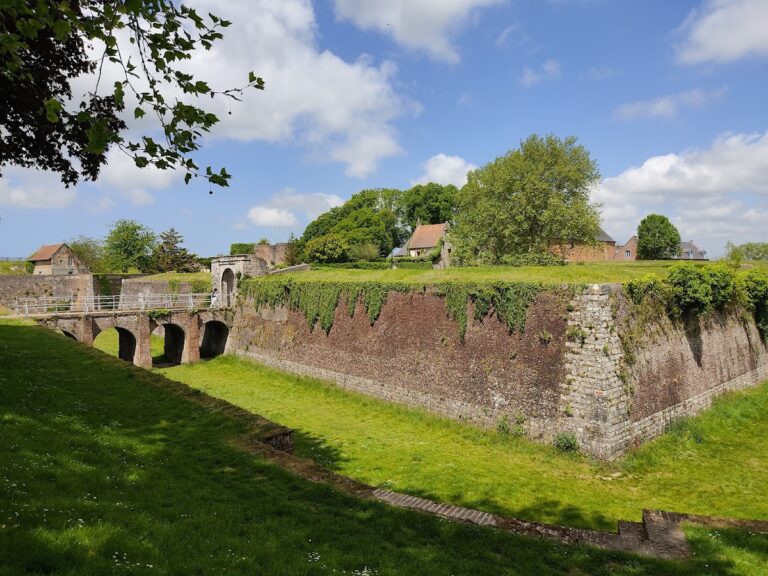
The medieval complex has a polygonal plan with nine towers and two broad concentric moats. Sections of the original curtain walls remain, while the present manor stands above the thirteenth-century fortress foundations and underground structures. One of the best-preserved medieval towers was incorporated into the nineteenth-century building, linking the surviving defensive fabric with the later residence.
The neo-Tudor manor
The nineteenth-century manor is built in natural stone above the medieval foundations. Its neo-Tudor design draws on the fortified manor-house forms associated with Tudor England, while its position over the earlier tower and underground structures preserves the physical connection between the later residence and the medieval castle.
Interiors and cultural buildings
Permanent interior exhibition
The 2014 interior installation recreates the atmosphere of English and French houses from the second half of the nineteenth century. The Mobilier national, the French state institution that preserves and manages furnishings and decorative works in national collections, deposited 66 pieces of furniture at the castle. These include planters from the collections of the Duchess of Berry, rosewood furniture associated with the Ministry of State under Napoleon III, Second Empire bookcases from the Rothschild collections, and ten English framed chairs dating from the eighteenth century.
The exhibition’s art collection was supplemented with works from the Louvre and the museums of Boulogne-sur-Mer and Saint-Omer. Objects associated with the French-British alliance include a marble bust of Napoleon III by Lefèvre-Deumier, a biscuit porcelain bust of Émile Loubet from Sèvres, and a biscuit porcelain statuette representing Peace by Alfred Boucher.
Elizabethan theatre
The Elizabethan theatre in the castle park is built entirely of wood, using larch, spruce, oak, and bamboo. An Elizabethan theatre is associated with the period of Queen Elizabeth I of England and its early modern performance traditions. The building seats 352 people in conference configuration and up to 388 in its Elizabethan-theatre configuration.
Gardens and surrounding grounds
Tudor-inspired gardens were created outside the medieval enclosure by the landscape designers Emmanuel de Quillacq and Christophe Laborde. They form part of the castle’s wider estate, which includes marshes, ponds, woodland, dunes, and the natural reserve surrounding the site.