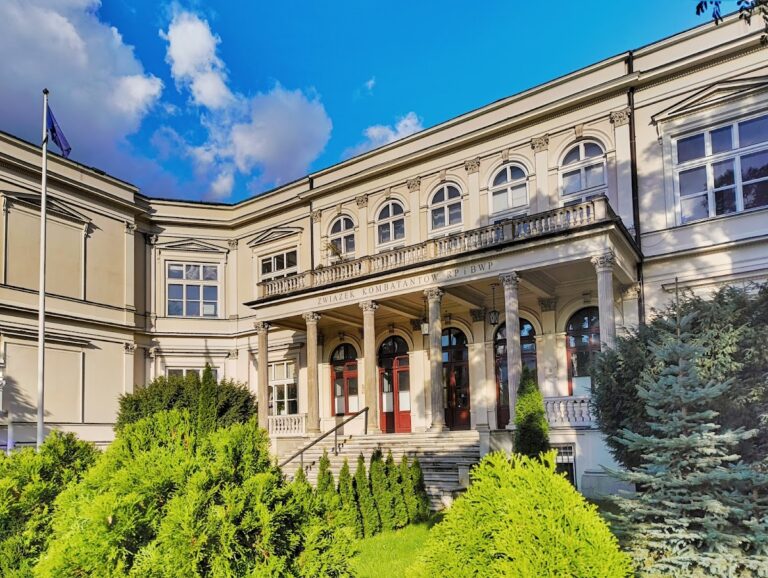
Belweder: A Presidential and State Residence in Warsaw, Poland


Site at a Glance
- Rating
- 4.6
- Popularity
- Low
- Country
- Poland
- Primary era
- Modern
- External website
- Open
- Eras represented
- Modern
- Civilizations
- German, Kingdom of Poland, Russian
- Site type
- Domestic
- Remains
- Palace
On this page20 sections
History
Belweder is a palace complex in Warsaw, Poland, built in the neoclassical period by the Polish architect Jakub Kubicki between 1818 and 1822 on the site of an earlier residence. Its elevated position on the Warsaw Escarpment and its long association with rulers, presidents, and state ceremonies have made it one of the city’s most important historic residences.
Medieval and early modern origins
The estate occupies the highest central section of the Warsaw Escarpment, about 25 metres above the surrounding ground. In the Middle Ages, the land belonged to the dukes of Masovia, who donated it to the Augustinian order associated with St. Martin’s Church. A square-plan villa probably stood on the site from 1533, and tradition connects it with Queen Bona, the Italian-born wife of King Sigismund I the Old.
The property later changed hands several times. King Sigismund III Vasa acquired it from the Augustinians, while his son, King Władysław IV Vasa, gave it to Bartłomiej Pękiel, chapelmaster at the royal court. In 1659 Pękiel sold the estate to Krzysztof Zygmunt Pac, who built a suburban residence there in 1659 and 1660 for his wife, Klara Izabella Pacowa. The new building may have incorporated parts of Queen Bona’s earlier residence. Its broad outlook gave the estate the Italian name Belvedere, meaning “beautiful view,” which later became Belweder in Polish usage.
In 1685 Klara Izabella Pacowa bequeathed the property to the Pac family’s adopted son, Kazimierz Michał Pac. He sold it in 1687 to Katarzyna Michałowska, but the estate returned to the Pac family during the first half of the eighteenth century. Around 1740, the family replaced the earlier residence with a new two-storey late-Baroque palace designed by Józef Fontana. The property subsequently passed to the Lubomirski family.
The royal estate and faience manufactory
Stanisław August Poniatowski acquired Belweder in 1767. The following years brought plans to transform the estate into a more representative royal residence. In 1770, under pressure from the king, Belweder was incorporated into the area enclosed by Lubomirski’s earthworks. Poniatowski intended to demolish the existing building and replace it with a palace, and one of three proposed designs was prepared by Jan Chrystian Kamsetzer. None of the plans was carried out.
In December 1768, Poniatowski established the Royal Faience Factory in the palace’s northern annex. Faience is glazed earthenware, distinct from true porcelain, and suitable raw material had been found in nearby Mokotów. After unsuccessful experiments with porcelain, the factory concentrated on faience, producing tableware, bowls, water jugs, urinals, stove tiles, candlesticks, and vases.
The factory marked its products with “Varsovie” or the letter “B.” Its wares were sold in Warsaw and in cities including Kraków, Lublin, Grodno, and Vilnius. Production followed a craft-based system in which each worker made, finished, and decorated a complete object. High costs and competition from the Bernardi and Wolff manufactory, founded in Bielino in 1779, led to the closure of the Royal Faience Factory in 1783.
Rebuilding for the Kingdom of Poland
After Stanisław August Poniatowski’s death, Belweder passed to his nephew Józef Poniatowski. In 1808, Józef transferred it to Onufry Kicki to settle debts. Kicki’s daughter, Teresa Kicka, sold the estate to the government of the Kingdom of Poland in 1818. The Kingdom of Poland, also called Congress Poland, was a nineteenth-century Polish kingdom politically linked to the Russian Empire. The property was acquired as the residence of Grand Duke Constantine Pavlovich, the Russian imperial figure who exercised effective authority in the kingdom.
The earlier palace was completely remodelled between 1818 and 1822 to designs by Jakub Kubicki. Since Belweder stood at the edge of the city, Kubicki gave it the character of a country residence. The complex became the home of Grand Duke Constantine and his wife, Joanna Grudzińska, Duchess of Łowicz, until the outbreak of the November Uprising. This Polish insurrection against Russian rule began in November 1830.
A parish church dedicated to Saint Anne and Saint Margaret, together with its cemetery, had stood south of the palace since 1593. The church and cemetery were closed in February 1818. The remains of prominent people, including Kazimierz Poniatowski and Marcello Bacciarelli and his wife, were transferred to the crypts of Holy Cross Church and St. John’s Cathedral, while other remains were moved to the Świętokrzyski Cemetery. The new Church of Saint Alexander took over the parish function, and a terrace was formed on the former church site.
Convicted civilians were used to maintain the gardens and courtyard. Maurycy Mochnacki spent 40 days performing this punishment in the garden while shackled. Belweder also became associated with Fryderyk Chopin, who performed several times in the palace’s Blue Room, later called the Pompeian Room.
The November Uprising and imperial residence
On the night of 29 November 1830, insurgents attacked Belweder in an attempt to capture Grand Duke Constantine at the beginning of the November Uprising. Ludwik Nabielak and Seweryn Goszczyński were among those involved, but Constantine hid inside the palace and escaped capture. The Russian general Aleksiej Gendre, who was present in the building, was killed by bayonet blows.
After the uprising was suppressed, Belweder and Łazienki served as imperial residences. An Orthodox chapel was established in one of the palace rooms, and Ivan Paskevich, governor of the Kingdom of Poland, moved to Belweder with his family during the summer. Grand Duke Mikhail Romanov died there in 1849.
During the First World War, Hans Hartwig von Beseler lived at Belweder from 1915 to 1918 while serving as Warsaw’s governor-general. His official residence remained at the Royal Castle.
Piłsudski and the presidential period
From 29 November 1918 to 13 December 1922, Belweder was the seat of Chief of State Józef Piłsudski. From 14 December 1922, it became the residence of Presidents Gabriel Narutowicz and Stanisław Wojciechowski.
Belweder became the centre of government resistance during the May Coup, Piłsudski’s seizure of political power in Poland in May 1926. On 12 May, government forces moved there from the Namiestnikowski Palace at President Wojciechowski’s request, after Piłsudski’s forces advanced south from Castle Square. The General Staff and the command of Warsaw’s defence also transferred to the palace. General Marian Kukiel commanded the resulting “Belweder Group,” reinforced by the 10th Infantry Regiment from Łowicz.
On 14 May, Piłsudski’s forces attacked Belweder and Mokotów airfield, and artillery struck the palace twice. At about 4 p.m., Wojciechowski and most of the government left on foot for Wilanów. From 5 June 1926 until his death, Piłsudski again lived at Belweder as Minister of Military Affairs. He occupied rooms on the first floor and in the southern wing with his wife, Aleksandra, and their two daughters. In September 1926, a military families’ association established a nursery for about 20 children in the southern wing, which Piłsudski’s younger daughter, Jadwiga, attended. Aleksander Prystor and Walery Sławek were among the people living in the northern wing.
On 4 May 1935, Piłsudski was brought from the General Inspectorate of the Armed Forces to Belweder and placed in the Corner Room, where his office was located. He died there on 12 May. After embalming, his body was dressed with the broad ribbon of the Order of Virtuti Militari, Poland’s highest military decoration, and placed in a metal coffin on a catafalque in the large salon.
After Piłsudski’s death, Aleksandra Piłsudska moved to a villa on Klonowa Street. From 1935 to 1939, Belweder housed the Józef Piłsudski Museum. The nursery was removed, and the museum director Adam Borkiewicz lived in the northern wing. The museum collections were later transferred to the National Museum, where a substantial part was subsequently destroyed.
War and occupation
In 1936, the gardens of Łazienki and Belweder were connected again. In November 1938, a house transferred from Magdeburg and associated with Piłsudski’s wartime imprisonment was ceremonially installed near the palace. It was demolished after the Second World War.
German artillery damaged Belweder during the defence of Warsaw in September 1939. Adolf Hitler visited the palace on 5 October 1939, after the German victory parade in Ujazdowskie Avenues, and toured Piłsudski’s office. After Joseph Goebbels inspected Warsaw in November, the Piłsudski Museum was closed with Hitler’s approval.
During the German occupation, Belweder became the Warsaw residence of Hans Frank, governor of the General Government, the German occupation administration established in central Polish territories during the Second World War. Extensive building work took place between 1940 and 1943. After the Warsaw Uprising in 1944, German forces drilled holes for dynamite in the palace walls, but they did not blow up the building.
Communist Poland and the restored presidency
In 1945, Belweder became the seat of the Presidium Bureau of the State National Council and its chairman, Bolesław Bierut. From 1952, it served as the residence of the chairman of the Council of State, the chief collective state authority of communist Poland until the restoration of the presidency in 1989. Successive occupants included Aleksander Zawadzki, Edward Ochab, Marian Spychalski, Józef Cyrankiewicz, Henryk Jabłoński, and Wojciech Jaruzelski.
The palace assumed functions formerly performed by the Royal Castle, including the presentation of credentials by foreign ambassadors. From 1951 to 1955, meetings about the reconstruction of Warsaw, known as the “Belweder Thursdays,” took place there. Participants included Bolesław Bierut, relevant ministers, and the chairman of the Capital National Council.
In December 1986, a meeting at Belweder established the Consultative Council attached to the Chairman of the Council of State. In 1989, the palace became the seat of President Wojciech Jaruzelski, and from 1990 it was used by President Lech Wałęsa. Wałęsa decided in 1994 to move the presidential seat to the Palace of the Council of Ministers on Krakowskie Przedmieście, subsequently called the Presidential Palace.
Belweder today
President Bronisław Komorowski lived at Belweder with his family from 2010 to 2015. President Karol Nawrocki lived there with his family from August to November 2025. The palace is administered by the Chancellery of the President of the Republic of Poland and is generally used for ceremonial purposes by the president and government. It also serves as an official residence for visiting heads of state and other important guests.
Pope John Paul II visited Belweder three times. He met the authorities of the Polish People’s Republic there on 2 June 1979 and 17 June 1983. On 8 June 1991, he met Lech Wałęsa and blessed the palace chapel dedicated to Our Lady, Queen of Poland. Belweder currently contains a small exhibition devoted to Piłsudski, while a proposal to turn the whole palace into a museum dedicated to him was considered.
The palace’s name gave rise to the name of Belwederska Street in the late eighteenth century. “Belweder” was also used for the starting station of the Wilanów Railway. In 1994, the palace was designated a Historic Monument of Poland as part of Warsaw’s historic city centre, the Royal Route, and Wilanów. A postwar plaque at the junction of Wiertnicza and St. Kostki Potockiego streets commemorates the January 1945 attack by the 14th Infantry Regiment of the Polish People’s Army, which allegedly prevented German forces from blowing up Belweder.
Remains
Belweder is a palace-and-park complex south of Warsaw’s city centre, near Łazienki Park. The present building is made of brick and combines neoclassical architecture with classical and Palladian characteristics. Palladian design draws on balanced compositions derived from ancient Greek and Roman architecture. The palace stands on the elevated Warsaw Escarpment, while its gardens extend across the upper ground and below the escarpment.
The palace building
Main block and porticoes
The palace erected between 1818 and 1822 consists of a two-storey central block and two single-storey wings attached at right angles. Jakub Kubicki placed four-column Ionic porticoes on both elevations of the main block. A portico is a columned entrance or facade, while Ionic columns are identified by their scroll-shaped capitals. Balconies are set above the porticoes, giving the principal elevations a formal architectural arrangement.
Interior alterations
Alterations made for the Piłsudski Museum gave the roof a reinforced-concrete covering. German work between 1940 and 1943 changed the roof pitch and covered it with copper sheet. The north-eastern wing received fire-resistant floors in place of wooden ones. In the central block, partition walls were removed to create two broad corridor-galleries. The main entrance hall received a black-marble floor and red-painted walls.
The palace also bears the physical effects of twentieth-century conflict. Artillery struck it twice during the May Coup, and German artillery damaged it in September 1939. German preparations for demolition in 1944 did not destroy the building, which is described as one of the few original buildings in Warsaw to survive the Second World War.
Gardens and former church site
Upper garden and terrace
The small garden adjoining the palace was enlarged and provided with a viewing terrace. The former parish church and cemetery south of the palace were replaced by another terrace after the church was demolished. The lower part of the palace contains a chapel dedicated to Our Lady, Queen of Poland, belonging to the parish of Saint Alexander.
Lower garden and pond
Below the escarpment, a separate garden was laid out with a pond of irregular shoreline and a tree-covered island. The gardens of Belweder and Łazienki were later reconnected. The arrangement preserves the relationship between the palace on the elevated ground and the landscaped areas below it.
Service buildings and riding arena
Stable and coach-house pavilion
The palace grounds did not have enough room for service buildings, so a plot opposite the palace, between present-day Klonowa Street and Lubomirski’s earthworks, was incorporated into the estate. A three-wing pavilion containing a stable and coach house was built there between 1819 and 1820.
Manege
A rectangular manege, a purpose-built enclosed riding arena, followed in 1823 and 1824. It is described as the only surviving building of its type in Warsaw. Together with the stable and coach-house pavilion, it formed the service and equestrian area associated with the nineteenth-century residence.
Courtyard and commemorative features
On the street side, an iron fence supported by stone posts enclosed the palace. During the German alterations, old horse chestnut trees along the courtyard fence were cut down, and the gravel surface of the courtyard was replaced with granite slabs. The house brought from Magdeburg in 1938, associated with Piłsudski’s imprisonment during the First World War, stood near Belweder for a time before being demolished after the Second World War.
Nearby sites