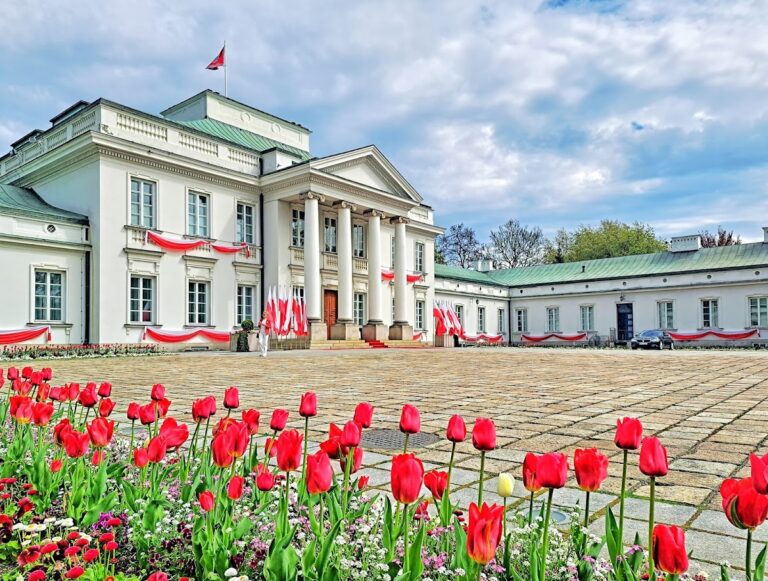
Sobański Palace in Warsaw: Aristocratic Residence and Public Seat


Site at a Glance
- Rating
- 4.6
- Popularity
- Very Low
- Country
- Poland
- Primary era
- Modern
- External website
- Open
- Eras represented
- Modern
- Civilizations
- Russian
- Site type
- Domestic
- Remains
- Palace
On this page9 sections
History
Sobański Palace in Warsaw is a historic palace in Poland, built in 1876 in the Renaissance Revival style to plans by Leandro Marconi. It replaced, or possibly incorporated, an earlier Renaissance-style villa built between 1852 and 1854 for Aniela Bławicka, née Ostrowska, by the architect Julian Ankiewicz.
Villa and palace construction
The earlier villa was commissioned by Aniela Bławicka on the property now occupied by the palace. Ownership before the construction of the present building is partly uncertain. Ludwig Krasiński probably acquired the site from Aleksander Bobrownicki in about 1861 and sold it later that year to Emilia Sobańska, née Łubieńska, the wife of Feliks Sobański.
Marconi’s palace was completed in 1876 and initially served as an aristocratic residence. It is generally regarded as a new building replacing the villa, although Marconi may have incorporated the smaller structure into a comprehensive rebuilding. From 1921 to 1923, the palace was the residence of Karol Jaroszyński.
War damage and changing public uses
The palace was heavily damaged during the Warsaw Uprising, the 1944 armed struggle against German occupation in Warsaw. Piotr Biegański directed its rebuilding between 1946 and 1950. From 1947, while this postwar period was still under way, the building temporarily housed the Warsaw Conservatory of Music.
After the conservatory moved out, the palace became the headquarters of the Front of National Unity and later the Patriotic Movement for National Rebirth, political organizations of communist Poland. In the early 1990s, it housed the Citizens’ Committee “Solidarity,” associated with the opposition movement that emerged around the Solidarity democratic movement, and was subsequently occupied by the Institute of Lech Wałęsa.
Restoration and later status
Jan Bohdan Wejchert acquired the palace in the 1990s through Wejchert Investments and had it renovated. The building currently houses the Polish Business Council and the associated Amber Room restaurant. The palace and its two pavilions entered the heritage register in 1965, while the garden was added in 1999. The palace also served as Professor Rafał Wilczur’s residence in the opening scenes of Jerzy Hoffman’s 1982 film Znachor.
Remains
Palace structure
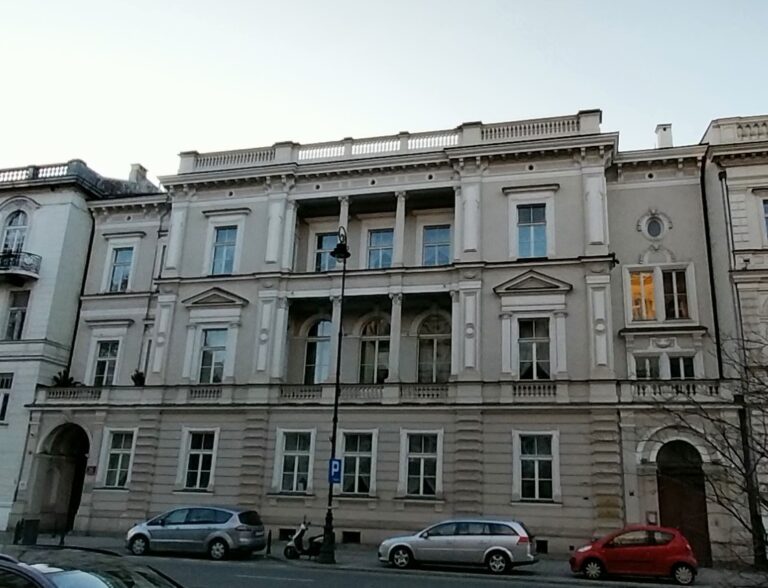
The palace stands at Aleje Ujazdowskie 13, about 20 metres back from the avenue, with the Ministry of Justice building to the south and the Wielopolski Palace to the north. Its main block is a two-storey building with a basement, set on a rectangular plan. A terrace extends from the building, and small single-storey, pavilion-like annexes stand on both sides.
Its eclectic architecture is dominated by Renaissance Revival forms, a nineteenth-century style that reinterprets Renaissance shapes and decoration. The exterior carries highly detailed ornament. The palace and its paired pavilions form the principal surviving architectural group on the property.
Grounds and decorative features
Statue and royal busts
A nineteenth-century statue of David stands on the property. It is a copy of a sculpture by Donatello made around 1440. In 1912, busts of the Polish kings Casimir the Great and Władysław II Jagiełło were added to the front façade. Their forms were modelled on the kings’ sarcophagi in Wawel Cathedral in Kraków, Poland’s traditional royal cathedral and burial church.
Garden and protected oak
A large park originally surrounded the palace, but its area was greatly reduced during the interwar period. In the 1930s, the former garden land was parcelled out for the creation of Aleja Przyjaciół. The remaining grounds cover about 3,500 square metres. A pedunculate oak beside the palace is protected as a natural monument, a legally protected individual natural feature such as a notable tree.
Nearby sites