Marienburg: A Former Augustinian Convent and Fortress in Germany


Site at a Glance
- Rating
- 4.2
- Popularity
- Low
- Country
- Germany
- Primary era
- Medieval
- Eras represented
- Medieval, Early Modern, Modern
- Civilizations
- German, Holy Roman Empire
- Site type
- Religious
- Remains
- Monastery
On this page10 sections
History
Marienburg is a former Augustinian convent and fortress on Petersberg near Zell in Germany. Its history began in the twelfth century with the establishment of a women’s convent and the construction of a church dedicated to the Virgin Mary. The site later served the Electorate of Trier, a major ecclesiastical principality of the Holy Roman Empire ruled by the Archbishop of Trier, who held both religious and territorial authority.
From Peterskirche to Augustinian convent
Marienburg occupied the site of an earlier fortress belonging to the Electorate of Trier. The older name castrum Mariae and surviving fortifications point to this earlier defensive role. On 22 April 1143, Pope Innocent II confirmed Springiersbach Abbey’s possession of the parish church on St. Peter’s Hill and five dependent churches. Springiersbach Abbey was a religious institution in the Moselle region.
In 1146, Abbot Richard I began creating a women’s convent governed by the Rule of Saint Augustine. This rule emphasized communal religious life, prayer, discipline, and shared possessions. Richard ordered the demolition of the increasingly dilapidated Peterskirche. Archbishop Hillin of Falmagne consecrated the new convent church on 18 October 1157 to the “pure and immaculate Virgin Mary.” The community included choir nuns, women religious who took part in the convent’s formal liturgical prayer.
Fortification and dissolution
Around 1280, Archbishop Henry II of Finstingen strengthened the fortifications to defend the Electorate of Trier and protect the choir nuns. Repeated military conflicts placed such pressure on the convent’s finances that the nuns often had to seek refuge for years in neighboring convents.
Pope Leo X authorized the archbishop to dissolve the convent in documents dated 20 January 1514 and 28 December 1515. The arrangements transferred the nuns to the convent of Saint Nicholas on the Stuben peninsula near Bremm, regulated their support, and granted the Archbishops of Trier and their successors the right to use and occupy Marienburg. The Augustinian convent was dissolved in 1515, and the site became a fortified installation.
Around 1520, Archbishop Richard von Greiffenclau ordered the former convent buildings to be converted into stronger defenses. The plans were never fully completed. During the Thirty Years’ War, the European conflict of 1618 to 1648 involving religious, dynastic, and territorial struggles, Bavarian and Swedish forces occupied the fortifications at different times. French auxiliary troops serving Trier Elector Philipp Christoph von Sötern destroyed them in 1650.
Pilgrimage church and Baroque restoration
During this period, a rector administered the church, which continued to serve as a pilgrimage church. Such churches were visited because of a sacred image, relic, shrine, or associated religious tradition. Hermits also lived on St. Peter’s Hill. Around 1700, the fortress and church were restored in the Baroque style, an artistic and architectural tradition of the seventeenth and eighteenth centuries associated with elaborate decoration and dramatic spatial effects.
Destruction, sale, and secular use
French Revolutionary troops occupied the area in 1794. In January 1797, Matthias Clar of Zell succeeded the rector Justus and apparently maintained activity at Marienburg until that month. French soldiers then removed usable metal, the bells, organ pipes, and window lead, and destroyed the roofing. A hermit rescued the venerated image of Mary and carried it to Kaimt. Citizens of Pünderich tried unsuccessfully to save the tower. Although a prefect in Koblenz had granted their request, the destruction had already occurred when they returned.
On 8 September 1803, Marienburg and all its possessions were declared French national property and auctioned. The physician Jodokus Crossius of Zell bought the site and adjoining garden for 1,075 francs. Stephan Kallfelz of Merl later acquired the property. In 1838, District Administrator Moritz von Zell, merchant Clemens von Alf, and ironworks owner Ferdinand Remy zu Alfereisenwerk purchased the ruins, convent garden, and estate from Kallfelz’s son.
A small inn opened at Marienburg in 1841. In May 1849, Karl Grün delivered a speech there in support of the campaign for the imperial constitution at a public meeting attended by about 5,000 people. In 1875, one wing of the castle building was enlarged and fitted out as an inn.
Return to diocesan use
On 25 February 1950, the last owner, Gertrud Weinbach, sold the estate and church ruins to the Diocese of Trier so that Marienburg could again serve a religious purpose. Bishop Matthias Wehr reconsecrated the church on 8 September 1957.
After more than two centuries, a priest again took up residence at Marienburg in 1996. Regional Youth Chaplain Joachim Keil became Rector Ecclesiae, the priest responsible for the religious life or administration of a church, and later served as spiritual adviser to the youth education center. Management of the center passed to the Trägergesellschaft Bistum Trier TBT mbH in 1998. On 1 October 2000, the Diocese of Trier established a youth education center at Marienburg for political, social, religious, and arts-and-culture education.
The entire estate was renovated in 2000 and 2001, while the rooms of the Café-Restaurant Marienburg underwent comprehensive renovation in 2003. On 31 March 2006, the Diocese of Trier closed all three of its youth education centers, including Marienburg, as part of a restructuring of its children’s and youth ministry. A specialist office for church children’s and youth work, together with a church for young people at Marienburg, was established there on 1 April 2006 under Youth Chaplain Jan Lehmann.
On 4 March 2021, the Diocese of Trier announced that Marienburg would be abandoned as a church youth-work institution and as a building by 31 December 2023, with youth work transferred to Himmerod Abbey. The ProMarienburg interest group subsequently campaigned for the site’s preservation.
Remains
Hilltop setting and fortifications
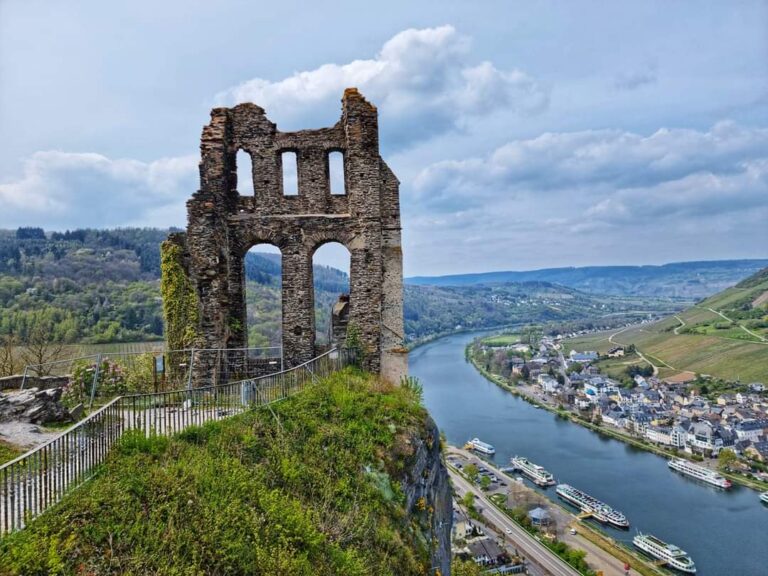
Marienburg stands on Petersberg, a hill within the Moselle loop formed by Zell and Pünderich. The hill overlooks a constriction of the nearly 14-kilometre-long Zeller Hamm, while the Moselle flows at its foot on two sides. The slope toward Pünderich is used for viticulture. Most of the hill lies within Pünderich’s cadastral area, a legally surveyed land unit used for administrative and property records, while the cadastral boundary of Kaimt, part of Zell, begins along the road beside Marienburg.
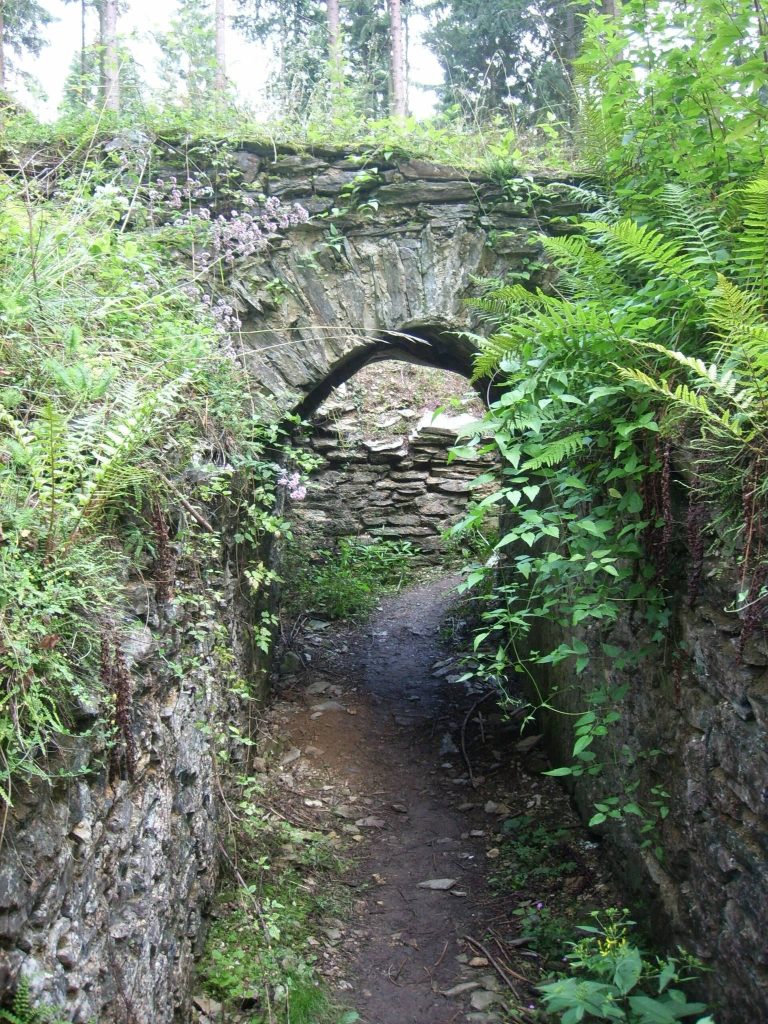
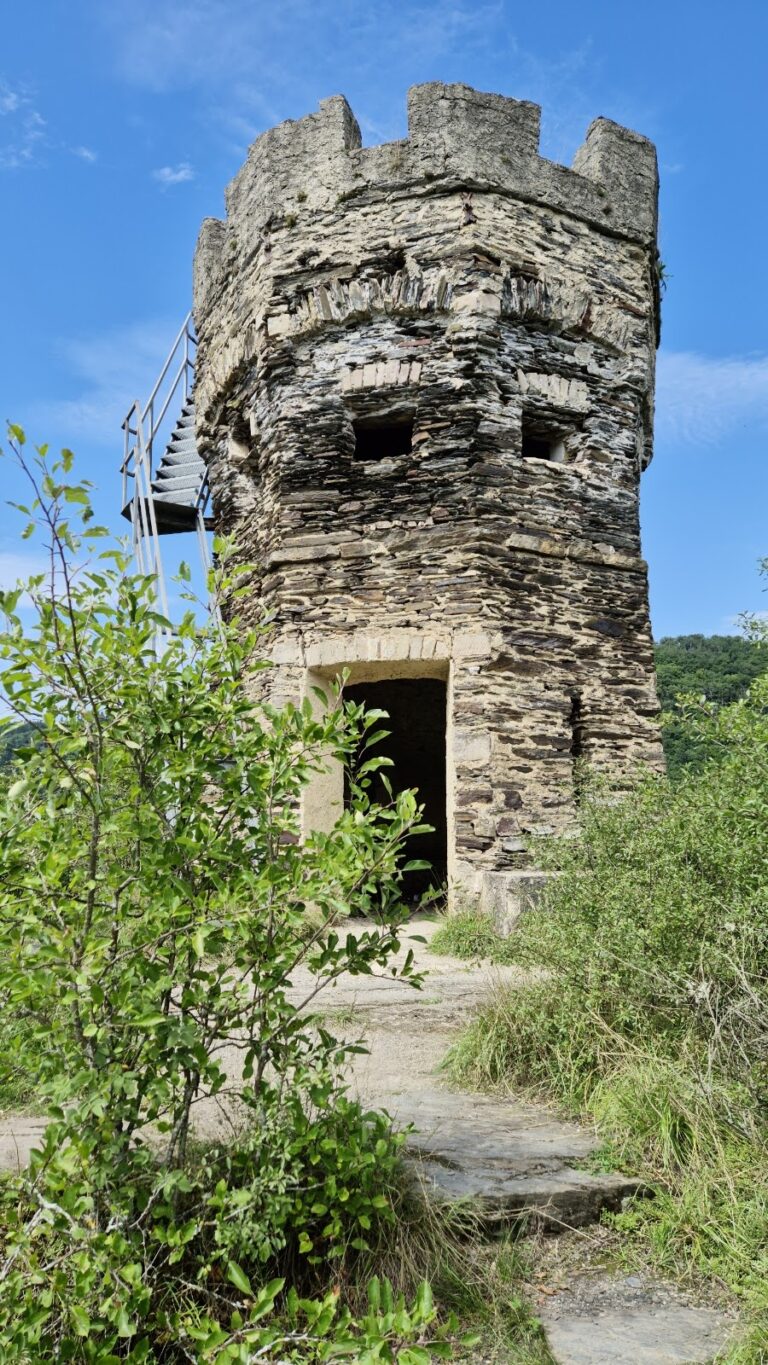
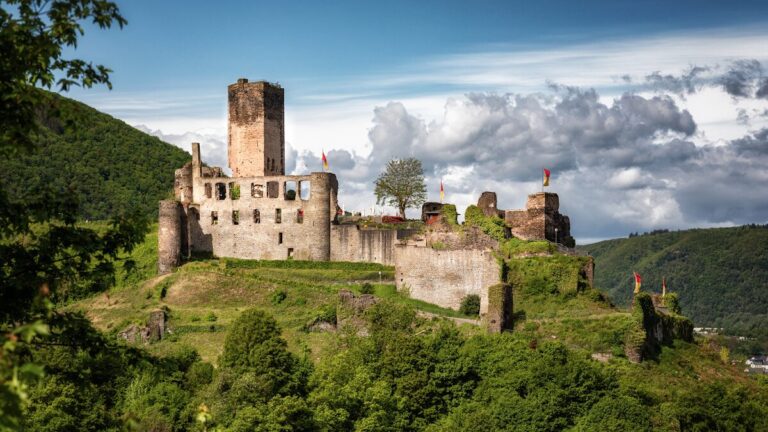
The site retains remains of the older Electorate of Trier fortress and later defensive works. These defenses were strengthened around 1280, and further expansion was attempted around 1520. The military installations were destroyed in 1650, leaving the surviving fortification remains alongside the later estate buildings and church ruin.
Convent church
The convent church was built in the twelfth century and dedicated to the Virgin Mary in 1157. In 1787, it was described as being in good condition and contained three altars. The eastern choir held a linden-wood high altar dedicated to the Three Magi. A south-side altar was dedicated to the Virgin Mary and was probably accompanied by a raised pulpit. On the north side stood a stone altar donated in 1639 by Maas, an administrative official from Zell.
The church’s roofing and metal fittings were destroyed or removed during the French military depredations of 1797. The bells, organ pipes, and window lead were also taken. The building is described in the modern period as a ruin, although its later reconsecration in 1957 returned it to religious use.
Convent estate and castle building
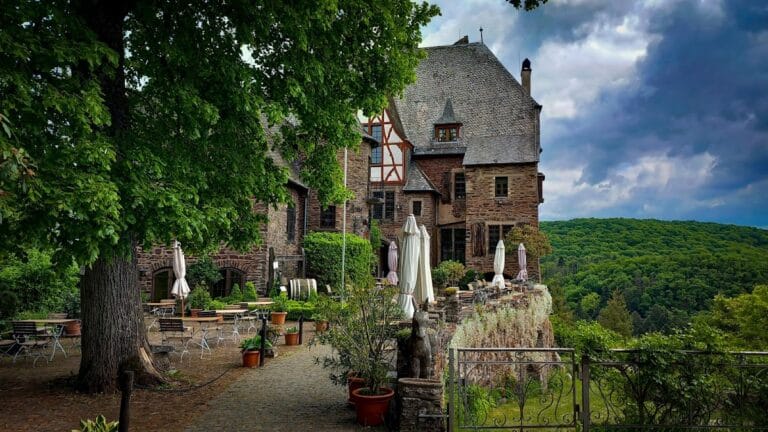
The property included the former convent buildings, a convent garden, and a castle building. One wing of the castle building was expanded in 1875 and arranged as an inn. The estate was renovated in 2000 and 2001, and the rooms of the Café-Restaurant Marienburg were comprehensively renovated in 2003.