Susa, Italy: An Alpine Crossroads from the Roman Era to the Modern Age


Site at a Glance
- Rating
- 4.6
- Popularity
- Very Low
- Country
- Italy
- Primary era
- Medieval
- Eras represented
- Iron Age, Classical, Medieval, Modern
- Civilizations
- Celtic, Duchy of Savoy, French, Kingdom of Sardinia, Roman
- Site type
- City
On this page24 sections
History
Susa is a historic city in Italy at an Alpine crossroads linking the Italian peninsula with France. Its history reaches from a Celtic-Ligurian settlement to the Roman capital of Alpes Cottiae, and later to a medieval Savoyard centre and an important route for armies, pilgrims, commerce, and railways.
From the Iron Age to Roman rule
The earliest occupation of the Susa area and the identity of its first inhabitants remain uncertain. Ligurian communities lived there before Celtic groups entered the region from approximately 500 BC. During the Iron Age, the Segusini, a Gallic tribe, occupied Susa and its surroundings. The settlement, known in antiquity as Segusio, became the capital of the Celtic-Ligurian kingdom of the Cozii.
In the mid-first century BC, the local ruler Donnus formed an alliance with Rome. The agreement secured the movement of Roman troops and goods across the Alpine passes. His son and successor, Marcus Julius Cottius, accepted incorporation into the Roman Empire under Augustus, the first Roman emperor, in approximately 15 or 14 BC. Cottius continued to govern the indigenous Alpine communities under Roman authority as prefect of the Cottian kingdom.
Under Roman rule, Segusio became the capital of the province of Alpes Cottiae, created in AD 63. The province was centred on the territory governed by the Cottian dynasty. Susa prospered until the period of Constantine, the emperor who defeated his rival Maxentius during the civil wars of the early fourth century. The Arch of Augustus, erected in approximately 9 or 8 BC by Cottius or his successor in honour of Augustus, reflects the political integration of the local kingdom into the Roman imperial system.
During the third century, the settlement acquired defensive walls, an amphitheatre, and an aqueduct. In 312, Constantine’s troops besieged Susa because the city supported Maxentius. The city was burned or destroyed during the attack, marking a severe disruption in its Roman history.
Late antiquity and early medieval transitions
After the fall of the Western Roman Empire in 476, Susa entered a period of decline. Following the death of Odoacer, the ruler who had deposed the last western Roman emperor, the city became part of the Ostrogothic kingdom of Theoderic. After the Gothic War, it was incorporated into the Praetorian Prefecture of Italy, an administrative territory of the Eastern Roman Empire, and later into the Lombard kingdom under Alboin.
In 575, the Frankish king Gontran annexed Susa and Aosta after defeating the Lombards. When Charlemagne conquered the Lombard kingdom in 774, Susa followed the political history of the kingdom of Italy. Charlemagne established Theubald as marquis of Susa, reinforcing the city’s role within the political and military organization of the Alpine frontier.
The Savoyard connection and medieval communications
Susa remained an important communications centre because routes through the valley connected the Alpine passes with Italy and France. Ancient and later roads crossed the nearby Mont Cenis, Clapier, Montgenèvre, and Finestre passes. The settlement was associated with the Via Domitia, the Via Cozia, the Itinerarium Burdigalense, an early Christian pilgrimage itinerary from Bordeaux toward the Holy Land, and a branch of the Via Francigena, the medieval pilgrimage route to Rome.
During the eleventh century, Susa became increasingly connected with the House of Savoy. Adelaide of Susa, daughter of the marquis of Turin, married Odo, count of Savoy, in 1035. The castle then became a centre of Savoyard power. Adelaide is also traditionally associated with the foundation of San Giusto in the early eleventh century, often dated to 1027. Susa may have been among the earliest mints of the counts of Savoy, since coins from the eleventh and twelfth centuries bear the name “Secusia.”
In 1167, Frederick I Barbarossa, the Holy Roman Emperor, and his empress Beatrice were attacked at Susa. Frederick escaped disguised as a servant, while Beatrice was detained until she was allowed to leave in 1168. Frederick later plundered the city in 1174. In 1349, the transfer of the Dauphine to France placed the border only a few kilometres west of Susa. The upper valley belonged to the Dauphine at that time and was later transferred to the Duchy of Savoy.
Wars, fortifications, and French rule
French troops captured Susa in 1629 after their victory at the Pass of Susa during the War of the Mantuan Succession, a conflict over control of territories in northern Italy. The capture was followed by the Treaty of Susa. Nicolas de Catinat, a French military commander, occupied the city on 18 November 1690 after defeating the Piedmontese at Staffarda on 18 August.
After the Treaty of Utrecht in 1713, the vulnerable Alpine valleys were strengthened with major fortifications. Ignazio Bertola built the Brunetta fortress on a rocky site above Susa. Napoleonic troops captured and completely destroyed it in 1796. From 1796 to 1814, Susa formed part first of the French Republic and then of the French Empire. Napoleon conferred city status on Susa, and the Via Napoleonica was built during this period.
Railways and industrial change
The completion of the Napoleonic road in the early nineteenth century increased traffic through Susa and encouraged lodging and commerce. The continuing military presence also supported the local economy. The railway reached the city in 1854 with the Turin-Susa line, inaugurated on 22 May.
Between 1868 and 1871, Susa served as an interchange with the Fell-system Mont Cenis Railway. The Fell system used an additional central rail to improve traction and braking on steep gradients. The line crossed the pass at approximately 2,000 metres and formed part of the route known as the “India Mail.” The later Bussoleno-Modane line and the Frejus Tunnel shifted the principal railway depot to Bussoleno.
Susa’s economy continued to depend on transalpine movement. Factories such as the Vallesusa cotton mill and the ASSA steelworks provided several hundred jobs for almost a century. Industrial activity declined gradually after the Second World War and later disappeared.
Religious and archaeological renewal
Susa has a Waldensian evangelical Christian church, reflecting the presence of a Christian movement that originated in the medieval Alpine region and developed a distinct Protestant tradition. The city became the seat of a Roman Catholic diocese established in 1772.
Archaeological work in the 1960s led to the rediscovery of the Roman amphitheatre. Excavations in Piazza Savoia exposed parts of the Roman city, including the forum area. Later investigations by heritage authorities also examined ancient underground passages beneath private houses. The castle now houses the civic museum, while the diocesan museum of sacred art preserves the cathedral treasury and important works from the Diocese of Susa. Since 2017, the civic museum has been undergoing the reopening and reinstallation of its collections alongside the development of a valley interpretation centre. Recent heritage work has included rehabilitation and pedestrianisation in the historic centre, renewed investigation of the Roman forum area, and restoration of the medieval castle.
Remains
Susa occupies the terminal part of the lower valley where the Cenischia stream meets the Dora Riparia. From this point, the valley divides towards the deep Cenischia Valley and the upper Susa Valley. The historic centre lies beneath the hill of the Castle of Countess Adelaide to the west and the rocky site of the Brunetta fortress to the north. The 3,538-metre Rocciamelone rises above the town in neighbouring Mompantero, while the Dora Riparia runs through the Gorge between Exilles and Susa.
Roman urban remains
Piazza Savoia and the forum
Piazza Savoia, the principal square, occupies part of the ancient city. Excavations have revealed the forum area and other remains of the Roman urban settlement beneath the modern square. The discoveries provide a physical view of the city that developed when Segusio served as the centre of Alpes Cottiae.
Arch of Augustus
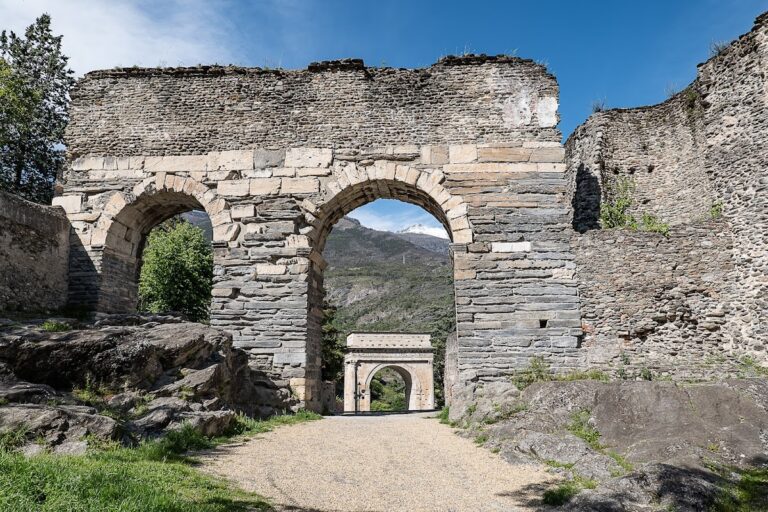
The Arch of Augustus is a marble monument on the ancient acropolis. Dating to approximately 9 or 8 BC, it is associated with Cottius or a successor who erected it in honour of Augustus. Its position and dedication connect the monument with the incorporation of the local Alpine kingdom into the Roman imperial system.
Walls and gates
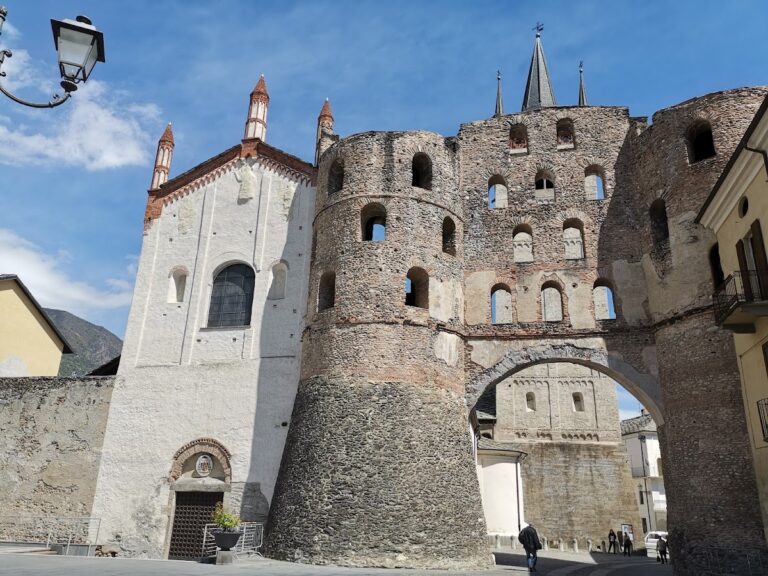
The Roman walls survive in relatively good condition and form a characteristic triangular plan. Porta Savoia, beside the Cathedral of San Giusto, is one of the best-preserved Roman gates of its type in Piedmont. Remains of the eastern gate also survive, helping define the ancient city’s defensive boundary.
Amphitheatre and aqueduct
The Roman amphitheatre survives as an archaeological ruin and was rediscovered during excavations in the 1960s. The Roman aqueduct remains in part. A surviving section is dated to AD 375 and is also identified with the structure known as the Terme Graziane.
Medieval religious and civic complexes
Castle of Countess Adelaide
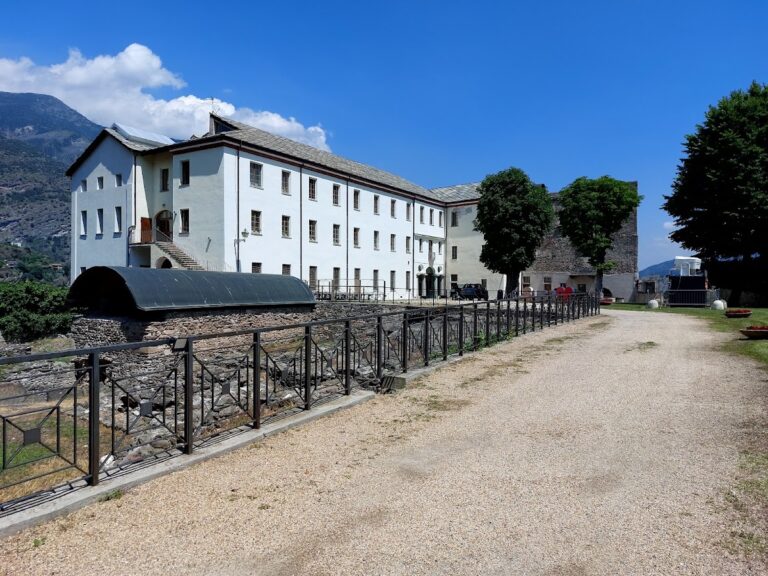
The Castle of Countess Adelaide was built on the remains of the Roman praetorium, an administrative or governmental residence associated with a provincial or military authority. The surviving complex includes a tower and a postern, a small entrance giving access to the court. From the castle court, the Roman walls can be seen. The castle is described as the first Savoyard residence in Italy and now houses the civic museum.
San Giusto
The Cathedral of San Giusto originated as a Benedictine abbey founded by the Arduinid dynasty in the early eleventh century. It later became the cathedral of the Diocese of Susa. Its bell tower remains a prominent element of the historic centre, and the cathedral treasury is preserved in the diocesan museum of sacred art at the Church of the Madonna del Ponte.
Santa Maria Maggiore
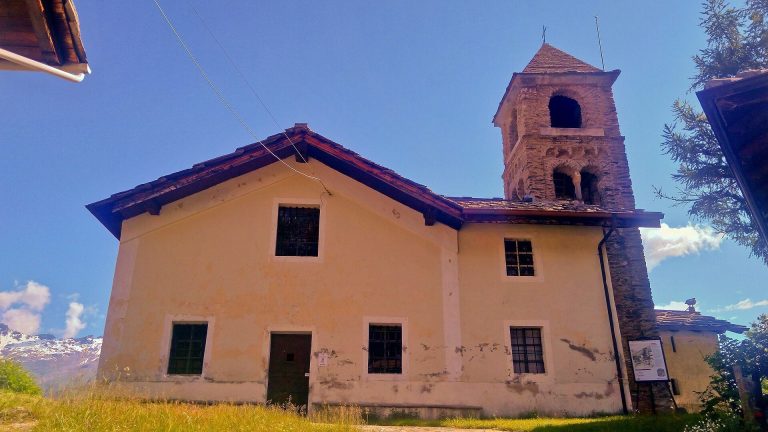
The baptisterial complex of Santa Maria Maggiore belonged to an Augustinian canonic institution and is older than San Giusto. It was the principal and oldest baptisterial church of Susa and the valley, with authority over numerous churches in other settlements.
San Francesco
The complex of San Francesco was founded in the first quarter of the thirteenth century and became the first Franciscan convent in Piedmont. Its surviving remains include cloisters, which form part of Susa’s medieval religious fabric.
Other churches
San Saturnino was built on the site of an ancient Roman temple. Sant’Evasio became the city’s second parish. The Church of Santa Maria delle Grazie is a work by Carlo Andrea Rana. The Church of the Madonna del Ponte contains the diocesan museum of sacred art and the treasury associated with San Giusto.
Medieval houses and urban features
Other surviving medieval fabric includes arcaded urban houses, the De Bartolomei house, and two towers in the town centre. An ancient portico retains a pedestrian passage, while a fresco survives beneath the arcades of Via Palazzo di Città. Heraldic decorations remain on the facade of an old public building identified as the former court.
Military and transport remains
Brunetta fortress
The Brunetta was an eighteenth-century fortress excavated into the rock on the northern rocky spur above the city. Built by Ignazio Bertola, it was captured and destroyed by Napoleonic troops in 1796. Its rocky site remains part of the military landscape above the historic centre.
Railway station
The former terminal station of the Turin-Susa railway remains almost intact. It represents the nineteenth-century expansion of the transalpine transport system that connected Susa with Turin and, through later routes, with the Fréjus crossing.
Napoleonic inscriptions
Two marble inscriptions from the Napoleonic period remain visible on a building in present-day Corso Francia. One reads “rue impériale,” while the other commemorates Prince Camille, governor general. Together they preserve physical evidence of the period when Susa formed part of the French Republic and French Empire.
Susa’s surviving fabric brings together Roman monuments and infrastructure, medieval religious complexes and houses, the Savoyard castle, later military works, railway remains, and underground passages beneath some private houses. The museums add sacred-art collections, the cathedral treasury, and objects connected with the city’s religious and civic history.