Citadel of Huy: A Fortress on the Meuse in Belgium


Site at a Glance
- Rating
- 4.2
- Popularity
- Medium
- Country
- Belgium
- Primary era
- Modern
- External website
- Open
- Eras represented
- Early Modern, Modern
- Civilizations
- Holy Roman Empire
- Site type
- Military
- Remains
- Citadel
On this page10 sections
History
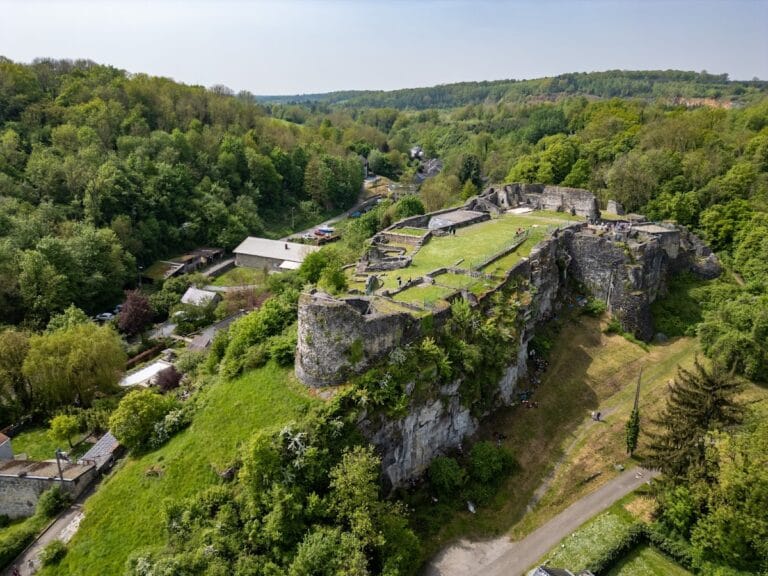
The Citadel of Huy is a nineteenth-century fortress in Belgium, built by the armed forces of the United Kingdom of the Netherlands between 1818 and 1823 on a rocky hill beside the Meuse. Its construction formed part of the Wellington Barrier, a post-Napoleonic defensive system created to protect the United Netherlands from another French invasion. The fortress replaced the former Château de Huy, known locally as Li Tchestia, and later became a prison, an internment centre, and a museum of wartime persecution.
The medieval castle
The site was occupied by the Château de Huy, a castle documented from the ninth century. Its strategic position above the Meuse led to repeated expansion during the Middle Ages. The river bend gave the rocky height a commanding defensive position, with several hundred metres of unobstructed visibility along the Meuse in both directions. The castle was regarded as one of Huy’s four wonders.
The wars fought during the reign of Louis XIV, king of France from 1643 to 1715, severely damaged the castle. After the Barrier Treaty, it was demolished in 1715, leaving the hill vacant for about a century. An old well dug for the castle on the orders of Everhard van der Mark, a medieval prince-bishop of Liège, continued to provide water when the later fortress was built.
Construction under the United Kingdom of the Netherlands
The present citadel followed the creation of the United Kingdom of the Netherlands by the Congress of Vienna in 1815. This state united the northern and southern Netherlands under King William I and ceased to exist after the Belgian Revolution of 1830. The United Kingdom of Great Britain and Ireland heavily financed the Wellington Barrier, which consisted of three roughly parallel fortified lines near the French border. Huy formed part of the Meuse citadels associated with the first of these lines.
Lieutenant Colonel Heimerick Camerlingh of the Dutch engineering corps laid the foundation stone on 6 April 1818. Camerlingh prepared the plans, while Captain Engineer Johannes Allatus Anemaet supervised the work. Construction lasted five years, ending in 1823, and the completed fortress was planned to accommodate approximately 600 troops in large dormitories.
The Belgian Revolution and nineteenth-century uses
During the Belgian Revolution, an uprising that ended the United Kingdom of the Netherlands in 1830, Huy’s bourgeois city guard captured the fortress without fighting on 7 September. Its garrison consisted of about 20 invalid artillerymen under Captain Banneux, who personally handed over the keys. The Liège flag was raised over the citadel, and the soldiers were imprisoned before being taken by boat to Liège.
Isidore Donckier became military commander of the fortress and was later succeeded by his brother Charles when Isidore entered the Belgian army. The Belgian army did not use the citadel operationally. Between 1848 and 1855, it instead served as a state prison for political prisoners, including people convicted in the Risquons-Tout Affair, an attempted Belgian republican uprising, and in the Prado trial. Prisoners were held in poor conditions in isolation cells.
The city of Huy received the fortress in 1876, but the Belgian state bought it back in 1880. During the second half of the nineteenth century, General Henri Alexis Brialmont incorporated it into the defensive system of the Meuse. The citadel was formally reintegrated into that system in 1914.
Military and prison history in the twentieth century
On 7 April 1899, at about 10:30 a.m., a 12-centimetre shell exploded during an inspection. Four soldiers were killed, six were injured, and the fortress caught fire.
During the First World War, German forces used the citadel as a prison and disciplinary camp, including for German deserters. After the war, it held Russian prisoners and later accommodated a regimental school for Belgium’s 14th Line Regiment. In 1937, as the threat of another war grew, the Belgian army stationed a garrison of Ardennes Chasseurs there. The unit remained until Huy and Liège fell to German forces in May 1940.
In 1939, German soldiers who had crossed into Belgium were interned at the citadel. After Germany invaded Belgium on 10 May 1940, they were reclassified as prisoners of war. German forces attacked the fortress to free them, but the prisoners had already been transferred elsewhere.
Under German occupation, the citadel became an internment centre for political prisoners and hostages under the administration of the Wehrmacht, Nazi Germany’s regular armed forces. The commandant, Frimberger, oversaw a system in which more than 6,500 people were held, including resistance members, alleged black-market participants, opponents of forced labour, communists, strikers, and hostages of several nationalities.
From July 1940, British prisoners, French strikers, and Russian prisoners were also confined there. About half of the internees were hostages threatened with execution. None was executed at the citadel, although those later murdered were transferred elsewhere. From 22 September 1941, Huy also operated as a transit camp before deportation to concentration camps, principally Herzogenbusch at Vught in the Netherlands and Neuengamme near Hamburg in Germany.
A further 1,240 prisoners were deported from northern France, many of them striking miners, while approximately 6,000 Belgians and people of other nationalities were imprisoned at the fortress. About 100 women were held separately in one hall. At least ten prisoners died there because of the harsh conditions.
Shortly before liberation on 5 September 1944, small groups of prisoners were released, and the gate was opened fully that afternoon. After the war, the Belgian Ministry of Justice operated an internment camp at the citadel until December 1946 for people classified as politically disloyal.
Commemoration and interpretation
Since 1992, the fortress has housed the Museum of the Resistance and Concentration Camps. Its displays examine the wartime life of prisoners in the citadel and their subsequent deportation to concentration camps. The museum gives the surviving fortress a continuing role as a place of historical remembrance.
Remains
Hilltop fortress beside the Meuse
The citadel occupies the rocky site of the former Château de Huy on a hill beside the Meuse, overlooking the city. Its position beside a bend in the river allowed the fortress to observe several hundred metres of the waterway in both directions. The site belongs to the group of Meuse citadels and was associated with the first fortified line of the Wellington Barrier.
Accommodation and water supply
The fortress was designed for approximately 600 troops, who were housed in large dormitories. Its water supply included the old well excavated for the medieval castle on the orders of Everhard van der Mark. The continued use of this well connected the physical infrastructure of the nineteenth-century citadel with the earlier castle that had occupied the height.
Museum of the Resistance and Concentration Camps
The Museum of the Resistance and Concentration Camps has been installed within the citadel since 1992. Its displays present the conditions experienced by prisoners in the fortress and in the concentration camps to which many were deported during the Second World War.
Nearby sites