Fort Manoel: A Star Fort on Manoel Island, Malta


Site at a Glance
- Rating
- 4.2
- Popularity
- Medium
- Country
- Malta
- Primary era
- Early Modern
- External website
- Open
- Eras represented
- Early Modern, Modern
- Civilizations
- British, Knights Hospitaller
- Site type
- Military
- Remains
- Fort
On this page10 sections
History
Fort Manoel is a star fort on Manoel Island in Gżira, Malta, built by the Order of Saint John in the eighteenth century to protect Marsamxett Harbour and the anchorage of Sliema Creek northwest of Valletta. The island was once called l’Isolotto, while its later name came from the fort, which was financed by the Portuguese Grand Master António Manoel de Vilhena.
Planning and construction
After Valletta was built, the Order of Saint John, a Catholic military religious order that ruled Malta from 1530 to 1798, recognized the island as a weakness in the city’s defenses. Francesco Collignon proposed a small fort with a raised defensive platform, or cavalier, in 1569. Military engineers Scipione Campi and Giovanni Battista drew attention to the same danger in 1577 and 1582.
Several larger schemes followed. In 1670, Antonio Maurizio Valperga proposed a roughly hexagonal fort with a Dutch-style hornwork. After the Order’s engineers criticized that design, Carlos de Grunenbergh suggested a four-bastioned fort in 1687, supported by a ravelin, ditch, protected passage, and low outer firing line. A ravelin is an outwork set beyond a main wall, while a covertway is a protected passage along the outer edge of a ditch.
René Jacob de Tigné and a group of French engineers prepared further proposals in 1715. These included a coastal battery, a redoubt, a four-bastioned fort, or combinations of those elements. The final design was approved in 1723 and incorporated work by de Tigné and Charles François de Mondion, the Order’s military engineer.
Grand Master Vilhena laid the first stone on 14 September 1723. The main enclosed defensive line, or enceinte, the cavaliers, and the gateway were complete by 1727. The ditch was excavated by 1732, while the chapel, barracks, magazines, and underground defensive passages called countermines were completed around 1733. The fort became an active military establishment by 1734. After Mondion died in 1733, he was buried in the crypt beneath the chapel.
Vilhena also established the Manoel Foundation to maintain the fort, its garrison, and its outer defenses. By 1761, Fort Manoel was regarded as one of the best-completed fortifications. Comte de Bourlamaque, a French military officer and commander, described it as a carefully constructed model of fortification.
Defensive outworks
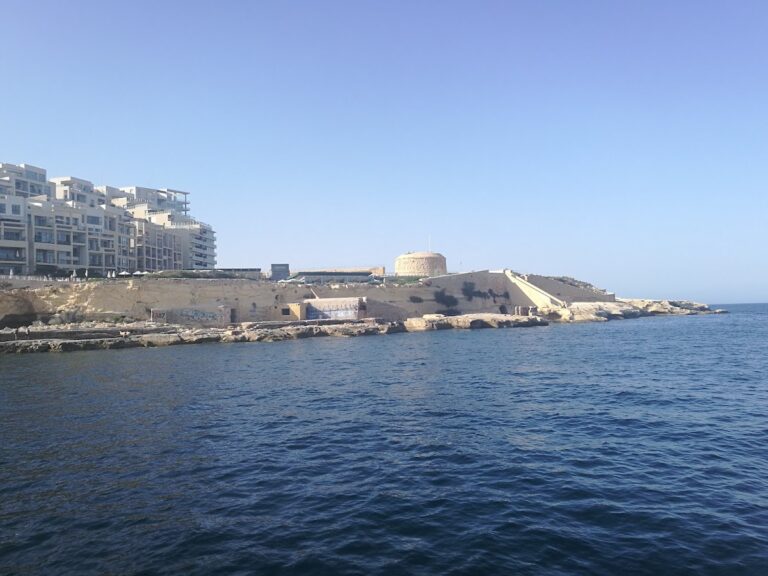
Lembi Battery was built near Tigné Point in Sliema in 1757 as an outer defense of Fort Manoel. Financed by the Manoel Foundation, it was intended to prevent enemy bombardment of the fort’s northern flank. The battery was decommissioned after Fort Tigné was built in 1795, a project that the Manoel Foundation also partly financed.
French invasion and British service
Fort Manoel first entered combat during the French invasion of Malta in June 1798. It was commanded by the Portuguese knight Gourgeau and held by the Cacciatori volunteer light infantry regiment, together with several men from the Birkirkara militia. The fort surrendered after Grand Master Ferdinand von Hompesch capitulated to Napoleon.
A French garrison of several hundred soldiers took possession on 12 June 1798. During the Maltese uprising against French rule, insurgents built the Għargħar and Sqaq Cappara batteries to bombard the fort and attacked it several times. French forces answered with bombardment at least once. On 12 September 1799, troops from Fort Manoel attempted to silence an insurgent gun position at San Ġwann but were repelled.
The British military formally took over the fort in September 1800, when Malta became a British protectorate. The guns were decommissioned in 1906, although the site continued as a military establishment. Fort Manoel also housed refugees from the Burning of Smyrna in 1922. It was placed on Malta’s Antiquities List in 1925.
War damage and decommissioning
During the Second World War, the fort held a battery of 3.7-inch heavy anti-aircraft guns. Their concrete emplacements formed a semicircle inside and around the historic fortifications. Aerial bombing caused considerable damage to the ramparts, barracks, and chapel.
Between 1957 and 1961, three commanders-in-chief of the British Mediterranean Fleet, Lambe, Bingley, and Holland-Martin, flew their flags from HMS Phoenicia, the Royal Navy name for its base in the fort. Fort Manoel was finally decommissioned in 1964.
Abandonment and restoration
Following decommissioning, the fort was abandoned, deteriorated, and suffered vandalism. The Royal Malta Yacht Club acquired part of the complex for use as its clubhouse in 1970 and remained there until moving to new premises in Ta’ Xbiex in 2008.
Restoration began in August 2001. The first phase repaired the central square and reconstructed the ruined chapel, concluding in 2009. A second phase, approved in 2012, addressed the outer fortifications and the sloping defensive bank known as the glacis. Fort Manoel has been on Malta’s tentative UNESCO World Heritage List since 1998 as part of the Knights’ Fortifications around the Harbours of Malta.
A local tradition holds that a “Black Knight” apparition resembling Grand Master Vilhena haunts the fort. The legend connects the figure with the bombed chapel, the vandalized crypt, and the scattered remains of knights. It reportedly ceased after the crypt was restored and the remains were reburied, but allegedly returned after the crypt was vandalized again in 1980.
Remains
Fort Manoel follows a square plan with a pentagonal bastion at each corner, producing the angled geometry of a star fort. Its principal building material is limestone. The four bastions are named St. Helen, St. Anthony, St. John, and Notre Dame. St. Helen and St. Anthony face the sea and Valletta, while St. John and Notre Dame stand on the landward side.
Bastions and defensive walls
The curtain wall between St. Helen and St. Anthony contains the principal gate. A curtain wall is the defensive wall joining two bastions. The entrance is protected by the Couvre Porte, a lunette that projects to defend the gateway. On the opposite, landward curtain wall, between St. John and Notre Dame, stands a pentagonal ravelin largely hewn from the rock.
Each landward bastion has a low cavalier, or raised defensive platform, within the fortifications. The seaward bastions originally contained small projecting sentry turrets called echaugettes and gunpowder magazines. The echaugettes were dismantled during the nineteenth century. St. Anthony’s magazine was demolished to make room for three quick-firing 12-pounder gun emplacements, while the magazine in St. Helen Bastion remains intact.
Central buildings
Inside the defensive walls are a central open square called the piazza, the rebuilt Chapel of St Anthony of Padua, several barrack blocks, an armoury, and other buildings. The chapel has a crypt beneath it. Charles François de Mondion and knights were buried there, connecting the surviving religious building with the fort’s eighteenth-century construction and military community.
A bronze statue of Grand Master Vilhena, possibly designed by Pietro Paolo Troisi, once stood in the piazza. It was removed during the nineteenth century, transferred to Valletta, and later moved again to Floriana, where it is now located.
Outworks and wartime installations
Lembi Battery near Tigné Point formed part of Fort Manoel’s defensive outworks from 1757. Its purpose was to protect the fort’s northern flank from enemy bombardment, extending the defensive system beyond the main island fortification.
The Second World War anti-aircraft battery introduced concrete gun emplacements into and around the older fortifications. Arranged in a semicircle, the positions held 3.7-inch heavy anti-aircraft guns. Bombing damaged the ramparts, barracks, and chapel, and the chapel was later reconstructed as part of the twenty-first-century restoration.
Nearby sites