Burg Kirkel: A Medieval Hill Castle in Germany


Site at a Glance
- Rating
- 4.4
- Popularity
- Medium
- Country
- Germany
- Primary era
- Medieval
- External website
- Open
- Eras represented
- Medieval, Early Modern, Modern
- Civilizations
- Holy Roman Empire
- Site type
- Military
- Remains
- Castle
On this page11 sections
History
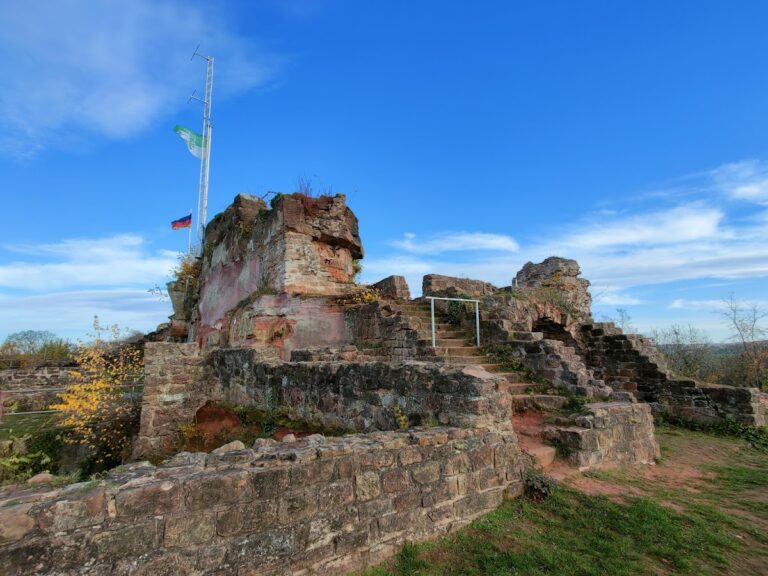
Burg Kirkel is a medieval hill castle in Kirkel-Neuhäusel, Germany, dated to around 1075 and built on the Schlossberg in Saarland. Its elevated position gave it a defensive and observational role near the Kaiserstraße, an important escort road, and it became the symbolic landmark of the locality.
Early lords of Kirkel
The date around 1075 also marks the first mention of Count Gottfried von Kirkel. At the beginning of the twelfth century, the castle passed to the Counts of Saarwerden. Following the division of their possessions between 1212 and 1214, it went to the Saarwerden-Kirkel line.
When Count Heinrich I of Saarwerden-Kirkel died childless in 1242, his possessions were divided among his nephews, including Arnold and Johann von Siersberg. Johann received Kirkel and adopted the name von Kirkel in 1250. He and his descendants held the castle as an imperial fief, meaning an estate granted directly by the Holy Roman Emperor rather than by an intermediate lord. The lords of Kirkel also attained imperial immediacy, a direct relationship with the Empire. Their line ended in 1386.
The castle was also a place of negotiated coexistence and political conflict. In 1341, the Kirkel and Lichtenberg families agreed to a castle peace that regulated their shared life within the stronghold. Between 1328 and 1337, the castle held Berthold II of Bucheck, bishop of Strasbourg. He had first been imprisoned at Waldeck Castle and was then transferred to Kirkel, where he spent part of a sixteen-week captivity. Duke Albert II of Austria eventually negotiated his release under severe conditions.
Palatinate rule and residential transformation
After the extinction of the lords of Kirkel, the imperial fief passed to the Electorate of the Palatinate. From 1410 to 1689, the castle was held by the dukes of Palatinate-Zweibrücken.
Between 1580 and 1596, Duke Johann I of Palatinate-Zweibrücken converted the medieval stronghold into a residential palace. The alteration reflected a change in use, as the castle became a princely residence as well as a fortified site. When warned that the higher Hirschberg could expose Kirkel to enemy fire, Johann reportedly replied that he would fire even more strongly from within the castle.
War, destruction, and abandonment
A fire severely damaged the castle in the mid-1630s. It was provisionally rebuilt before 1677, but Duke Charles V of Lorraine besieged and captured it in that year during the Franco-Dutch War, a conflict fought from 1672 to 1678. The capture caused further heavy damage.
The castle was finally destroyed in 1689 during the War of the League of Augsburg, also known as the Nine Years’ War, which lasted from 1688 to 1697. It then remained largely abandoned. From about 1740, the ruins were used as a stone quarry, further linking the surviving fabric to the practical needs of the surrounding settlement.
Archaeology and later use
The round tower was rebuilt in 1955 as an observation tower and given a roof or tower cap. Archaeological excavations began in 1994 and have yielded more precise information about the castle’s building history, former appearance, and furnishings. An archaeological research project has continued since that year, while excavation of the castle well began in 2011.
The lower castle level now hosts the summer Kirkeler Burgsommer and Kirkeler Wine Festival, with craft installations and workshops established there. These activities form part of the modern use of the ruins as a local excursion destination. The fifteenth-century village of Kirkel developed under the castle’s protection and later clustered around it.
Remains
Hilltop layout and defensive position
The ruins occupy the summit of the Schlossberg at about 307 metres above sea level. The castle stands on an isolated cone of Buntsandstein sandstone, while the neighboring Hirschberg rises to about 380 metres and overlooks it. This elevated setting belongs to the defensive character of a hill castle, a fortified site built on high ground for protection and observation.
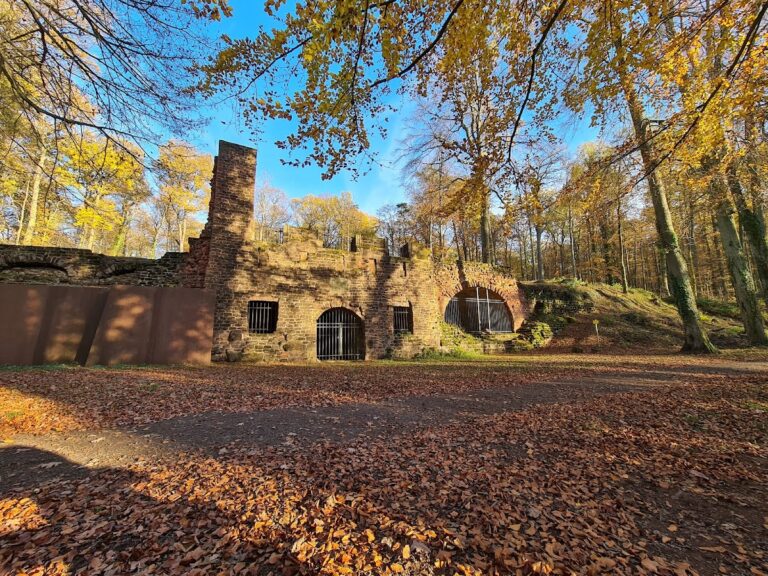
Burg Kirkel stands near the Kaiserstraße, formerly an escort road. Its keep, the principal fortified tower of a castle, controlled or observed the route connecting Alsace, Sturzelbronn Abbey, and the Palatinate. The surviving archaeological areas and excavated sections help reconstruct the castle’s former appearance and equipment, although the site now survives principally as a ruin.
Towers and water supply
Round tower and small tower
A small tower and a round tower were constructed in the thirteenth century. The round tower was reconstructed in 1955 and now rises 32 metres as an observation tower, giving the surviving castle complex a prominent vertical feature. Its roof or tower cap belongs to the twentieth-century rebuilding rather than to the medieval structure.
Castle well
The castle well was cut into the sandstone beneath the stronghold and may be more than 60 metres deep. Its excavation, begun in 2011, forms part of the continuing archaeological investigation of the castle and contributes to understanding how the hilltop settlement obtained and used water.
Settlement and local museum
The fifteenth-century village of Kirkel grew in the protection of the castle and later clustered around it. Immediately below the ruins, a former day-laborer’s house contains a small museum devoted to the castle and local history. Together, the village setting, the surviving masonry, and the excavated areas preserve the relationship between the hilltop stronghold and the community that developed beneath it.
Nearby sites