Admiralty House (Valletta): Former Residence of the British Mediterranean Fleet Commander


Site at a Glance
- Rating
- 4.4
- Popularity
- Low
- Country
- Malta
- Primary era
- Early Modern
- External website
- Open
- Eras represented
- Early Modern
- Civilizations
- Crusader, Knights Hospitaller
- Site type
- Domestic
- Remains
- Palace
On this page5 sections
History
Admiralty House is a palace in Valletta, Malta, rebuilt as a late-Baroque residence between 1761 and 1763 under the Order of St John. Its many names reflect successive occupants, while its later use as the official residence of the Commander-in-Chief of the British Mediterranean Fleet gave it the name by which it is best known.
From private houses to a palace
The site was first occupied by two private houses built in 1569 and 1570 by Fra Jean de Soubiran dit Arafat, a French knight of the Order of St John. The properties later passed to François le Petit de la Guerche. After his death in 1663, the Treasury of the order took control of them and leased the houses to various knights from 1668 onward.
Between 1761 and 1763, the Treasury rebuilt the two properties as one residence for Fra Raimondo de Sousa y Silva, a wealthy Portuguese knight and Balì of Lessa. A Balì was a senior dignity within the Order of St John, often connected with an administrative or territorial jurisdiction. The reconstruction is attributed to Andrea Belli, an eighteenth-century Maltese architect associated with major late-Baroque buildings in Valletta, and the palace became known as Palazzo Don Raimondo.
Following de Sousa’s death in 1782, the residence was divided into several apartments between 1783 and 1785. It was later restored to use as a single residence and leased again to different knights. From 1795 to 1798, Fra Antonio Miari di Belluno lived there as secretary to Grand Master Ferdinand von Hompesch zu Bolheim, the final elected head of the Order of St John before the French occupation. This period gave rise to the name Casa Miari.
French occupation and British administration
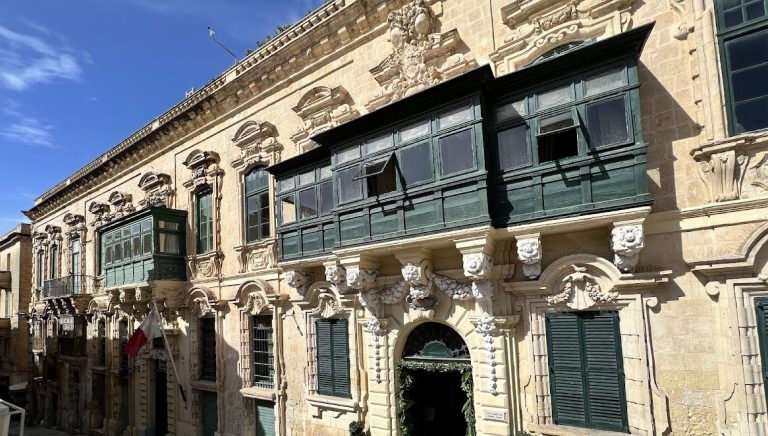
The Order of St John, a Catholic military and religious order that ruled Malta from 1530 to 1798, lost control of the island during the French occupation. The French government proposed giving the palace to Bishop Vincenzo Labini for use as a seminary, but the plan was not carried out because of the Maltese uprising and blockade from 1798 to 1800. During the occupation, Napoleon ordered the defacement of the façade’s coats of arms, including the shields of the order and Grand Master Manuel Pinto da Fonseca.
After Malta became a British protectorate in 1800, Civil Commissioner Alexander Ball occupied the building. Alexander Macaulay, secretary to the Civil Commissioner, lived there from August 1802 to June 1803. In 1808, Louis Philippe, Duke of Orléans, and Louis Charles, Count of Beaujolais, stayed at the palace. Louis Charles died there from tuberculosis on 29 May 1808 and was buried at St John’s Co-Cathedral in Valletta.
British military authorities occupied the building without paying rent from 1808 to 1820. In 1821, it was formally leased to the naval authorities as the official residence of the Commander-in-Chief of the British Mediterranean Fleet, the senior Royal Navy authority for British operations in the Mediterranean. The palace thereafter became known as Admiralty House. Its residents and guests included Lord Mountbatten, Winston Churchill, King George V, and Queen Elizabeth.
Museum use and later status
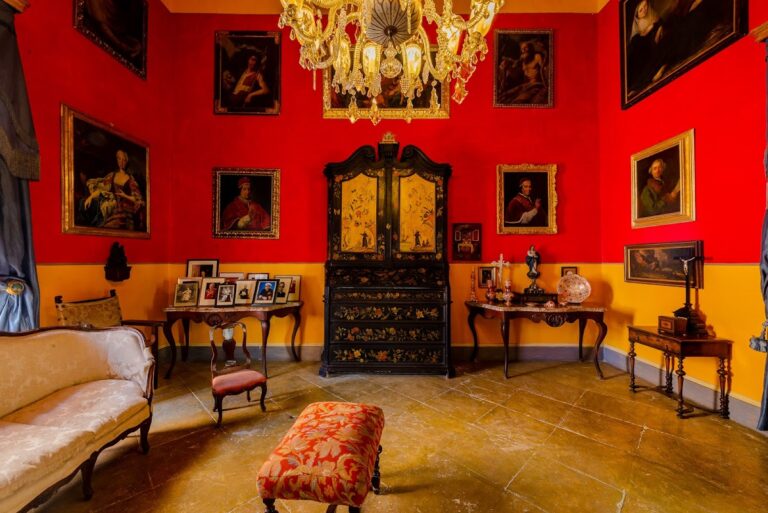
The building was transferred to the Government of Malta in 1961. After restoration, it opened as the National Museum of Fine Arts on 7 May 1974. Minister Agatha Barbara inaugurated the museum in the presence of its director, Francis Mallia, and President Anthony Mamo.
Plans to move the museum to Auberge d’Italie began in 2013, and the new institution was officially announced in 2014 under the name MUŻA. The National Museum of Fine Arts closed at Admiralty House on 2 October 2016. Proposals to place the Ministry for Tourism and the Malta Tourism Authority in Admiralty House and two nearby buildings were also considered in 2013, but were abandoned after the buildings were judged unsuitable for the ministry and its approximately 200 staff members. Admiralty House remains owned by the Government of Malta, and it is designated a Grade 1 monument in the National Inventory of the Cultural Property of the Maltese Islands.
Remains
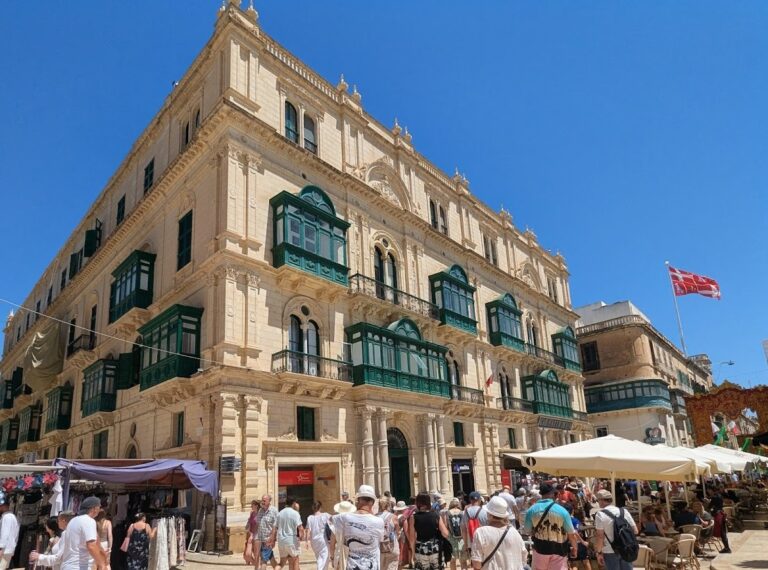
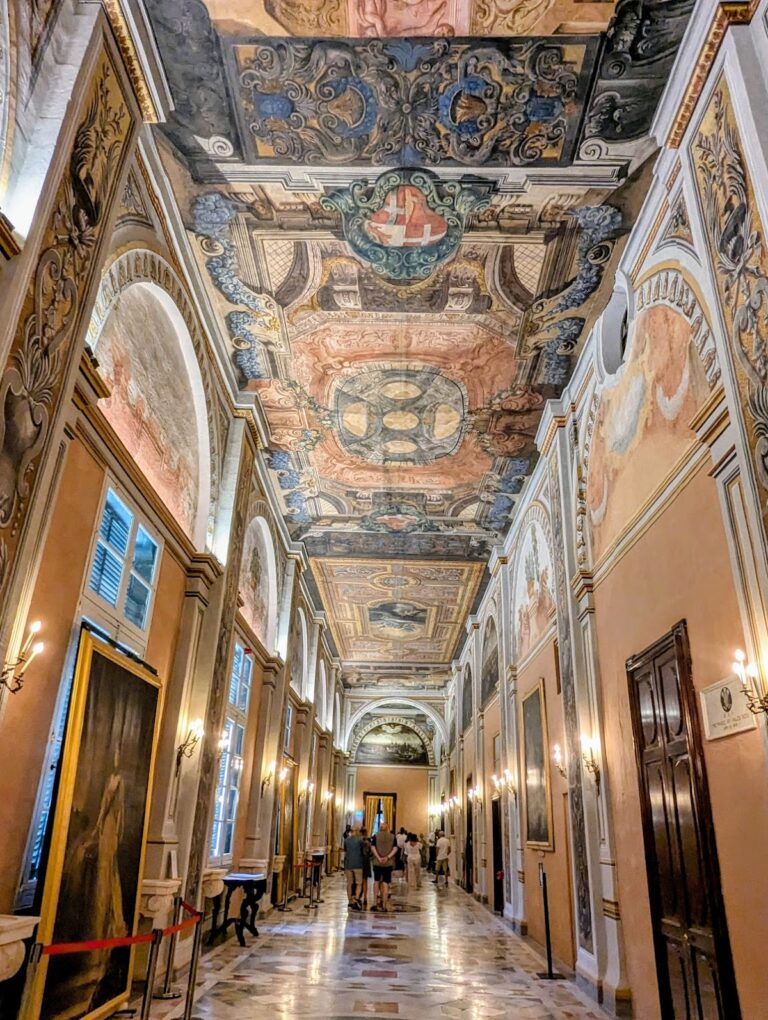
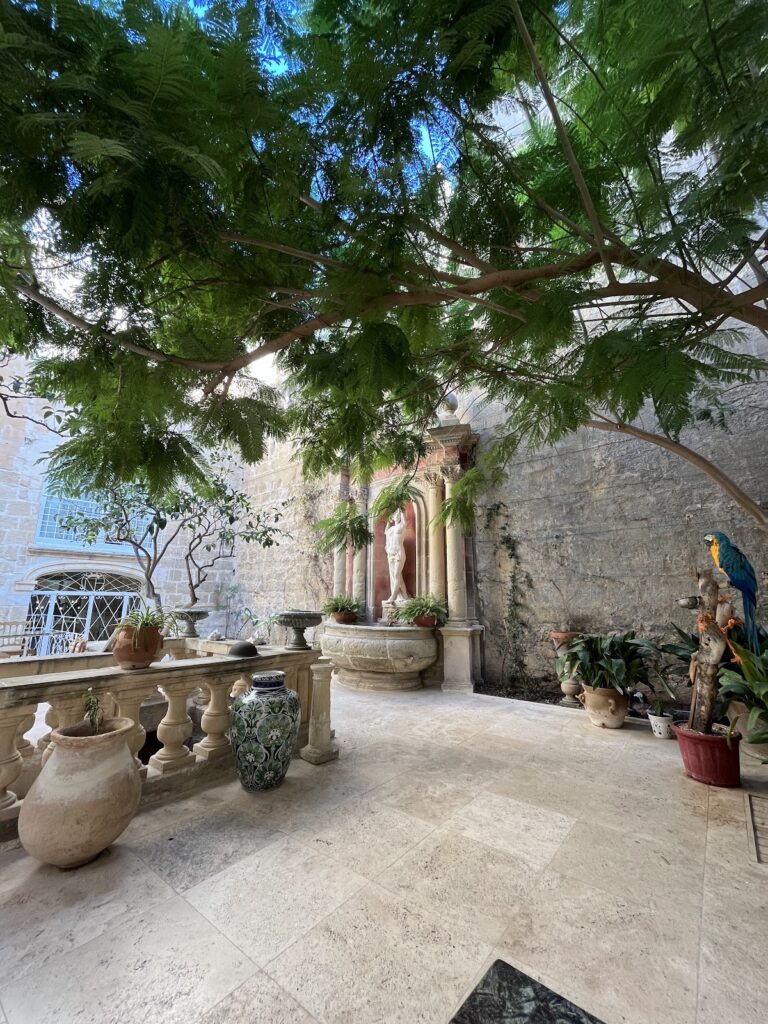
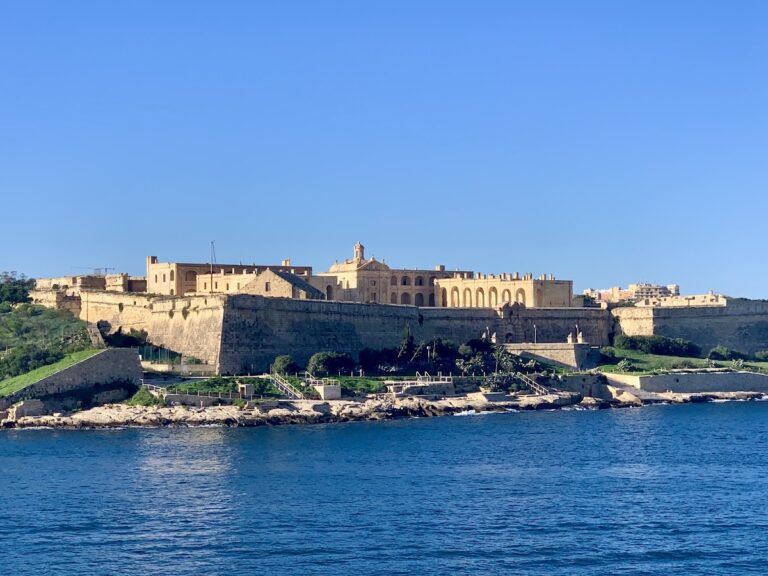
Admiralty House is built of limestone quarried at Floriana and presents a late-Baroque design that has also been described as Italianate or Rococo. The palace consists of halls arranged around a central courtyard, with two floors above ground and a basement. Its surviving form preserves the organization created when the earlier houses were rebuilt as a single residence in the eighteenth century.
A monumental free-standing staircase is one of the building’s principal architectural features. Its design may have been influenced by staircases at Auberge de Castille in Valletta, the Würzburg Residence in Bavaria, the Palais Kinsky in Vienna, and the Upper Belvedere in Vienna. The palace survives in an intact condition, while the defaced armorial decoration on the façade reflects the damage inflicted during the French occupation.
Nearby sites