Palazzo Ferreria: A Venetian Gothic Palace in Valletta

Site at a Glance
- Rating
- 4.8
- Popularity
- Very Low
- Country
- Malta
- Primary era
- Modern
- Eras represented
- Modern
- Civilizations
- British
- Site type
- Domestic
- Remains
- Elite Residence
On this page5 sections
History
Palazzo Ferreria, officially Palazzo Buttiġieġ-Francia, is a Venetian Gothic palace in Valletta, Malta, built by Maltese architect Giuseppe Bonavia and completed in 1876. Located near the entrance to the city, it is the second-largest palace in Valletta after the Grandmaster’s Palace.
From Order Foundry to Family Palace
The site previously held a foundry belonging to the Order of St John, a Catholic military order that governed Malta and maintained military, administrative, and charitable institutions on the islands. The foundry manufactured armaments for the order’s knights. Giuseppe Buttigieg and his wife, Giovanna Camilleri, acquired the land from the government and built the palace in the late nineteenth century.
The building became part of their daughter Teresa Buttigieg’s dowry. After her marriage to Colonel John Louis Francia, a Spanish citizen from Gibraltar who served in the British Army, it was known for a period as Palazzo Francia. The Francia family continued to live there until 1947, shortly after the end of the Second World War.
Postwar Government Use
Wartime damage had destroyed or partly damaged most buildings in Valletta. The Labour government led by Dom Mintoff, a Maltese Labour politician who served as prime minister, rented part of Palazzo Ferreria from the Francia family for the Public Works Department. The department worked on rebuilding and restoring the city. The family retained a small apartment in the palace, which is now used as an office by a Maltese government ministry.
The Francia family sold the palace to the government in 1979, during Mintoff’s tenure as prime minister. Palazzo Ferreria was restored in 2017, and its lower parts are now occupied by several shops. The building is protected as a national monument.
Remains
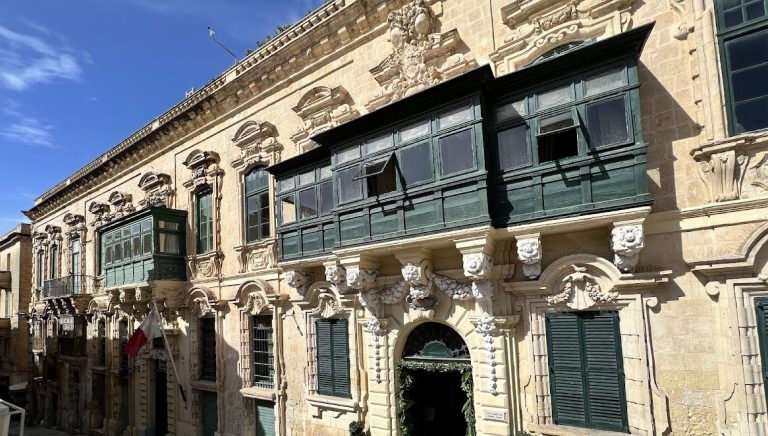
Palazzo Ferreria is constructed from limestone and presents a Venetian Gothic design, a nineteenth-century revival style drawing on the Gothic architecture associated with Venice. Its architectural treatment combines Italian-inspired elements with local timber balconies. The palace is identified as the first building in Malta to introduce wooden balconies on its façades, a feature that later influenced other architects and became widespread across the island.
Façades and Decorative Features
The façades carry the coats of arms of the Buttigieg and Camilleri families. Four statues associated with the palace represent Africa, America, Asia, and Europe. Bonavia also designed the Lija Belvedere Tower and La Borsa. He developed Palazzo Ferreria after losing the commission for the Royal Opera House opposite the palace, intending it to demonstrate what he could have built had his proposal been chosen instead of Edward Middleton Barry’s design.
Nearby sites