Fort Libéria: Vauban’s Mountain Fortress in France


Site at a Glance
- Rating
- 4.6
- Popularity
- Medium
- Country
- France
- Primary era
- Early Modern
- External website
- Open
- Eras represented
- Early Modern, Modern
- Civilizations
- French
- Site type
- Military
- Remains
- Fort
On this page12 sections
History
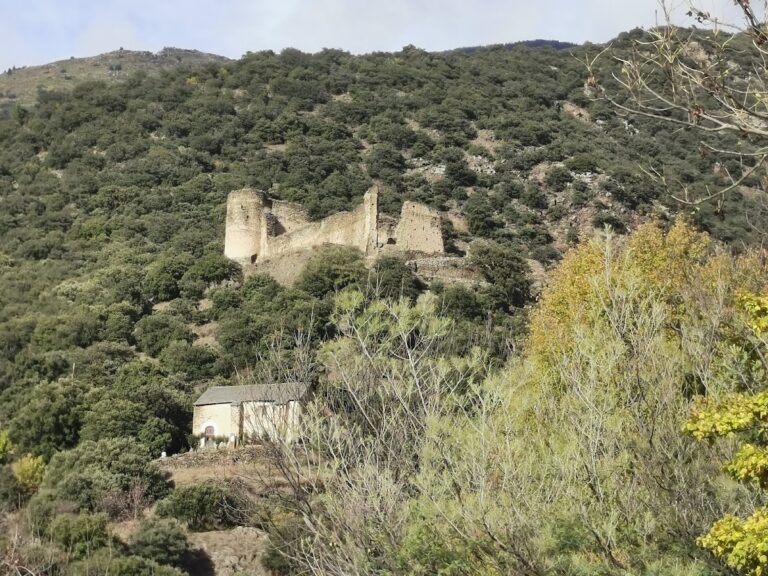
Fort Libéria is a former French military installation above Villefranche-de-Conflent, France, built under the direction of Sébastien Le Prestre de Vauban between 1681 and 1683. Created after the Treaty of the Pyrenees transferred Roussillon and part of Cerdanya from Spain to France, it strengthened the defense of the Conflent and guarded access to the Têt and Segre valleys.
Construction and frontier defense
The medieval defenses of Villefranche-de-Conflent were considered inadequate against increasingly powerful artillery. Vauban, the principal military engineer of Louis XIV, proposed a fort on Belloc hill above the town. From this position, French forces could observe and engage approaches through the three surrounding valleys at long range.
Vauban received the commission in 1681, and the fort was operating by 1687. Its construction formed part of a wider defensive system in the eastern Pyrenees, developed alongside the fortified town and the citadel of Mont-Louis. The new installation supplemented the town’s defenses by occupying the steep mountain flank above it.
Prison and political history
Fort Libéria also became a state prison, including a place of confinement for women. Inès de Llar, a member of a Catalan family involved in the Villefranche Conspiracy, was detained there before being transferred to a convent. Her family had plotted against the French garrison, but she warned a French officer about the plan.
During the Affair of the Poisons, a seventeenth-century French scandal involving accusations of poisoning and illicit substances, Louis XIV ordered Anne Guesdon and Magdelaine Chapelain to be imprisoned at the fort. Guesdon, who had served as chambermaid to the marquise de Brinvilliers, died there in 1717 after 36 years of confinement. Chapelain died in 1724 after approximately 43 to 44 years. Eight women were imprisoned at the fort over time, and some occupied themselves by weaving. Royal orders known as lettres de cachet could authorize imprisonment without a public trial.
War and military decline
The fort experienced military conflict once, in August 1793 during the War of the Pyrenees, a conflict between revolutionary France and Spain. Spanish troops placed artillery on the heights behind the fort and forced its surrender. French forces under Luc Siméon Auguste Dagobert soon recaptured it, while troops commanded by the Spanish general Antonio Ricardos withdrew after their defeat at Peyrestortes. Cannon fire damaged sections of the ramparts and sentry boxes, which were later repaired.
Its military role declined during the nineteenth century. The French army abandoned Villefranche-de-Conflent as a garrison in 1890, and the last army detachment left the fort in 1918. During the First World War, the former soldiers’ barracks housed 12 German officers as prisoners. From 1940 to 1944, reservists used the fort as an air-observation base.
Private ownership and preservation
The state sold the fort to Julien Laurens in the 1920s. He renamed it Fort Libéria after Villefranche’s original name, “Villa Liberia,” meaning “free city,” and tried to convert it into a retirement home for sailors. The plan failed because access was difficult and the fort was far from the sea. The first-level officers’ barracks was demolished to make a courtyard.
Marcel Puy acquired the property in the mid-1950s. In 1984, he granted a 99-year emphyteutic lease, a long-term arrangement giving extensive rights of use and maintenance while ownership remains with the lessor, to four local business couples. A three-year restoration campaign added infrastructure and safety measures, and the fort opened to the public in 1987. It forms part of the UNESCO World Heritage property “Fortifications of Vauban,” inscribed in 2008, and was classified as a French monument historique in April 2009. It remains privately owned.
Remains
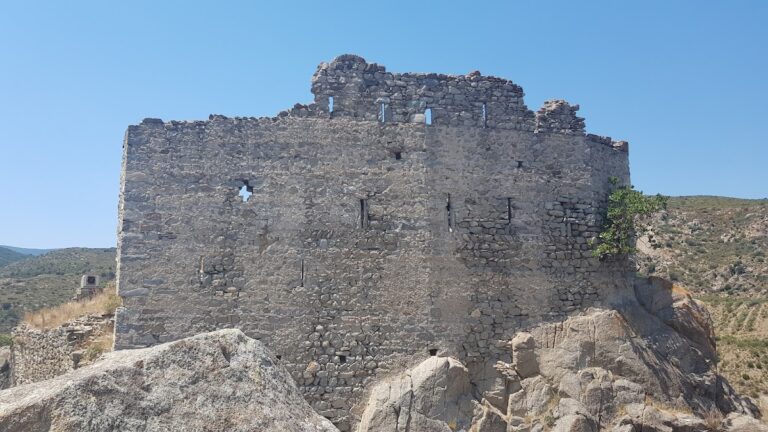
Fort Libéria occupies the steep flank of Belloc above Villefranche-de-Conflent, at the confluence of the Têt, Rotjà, and Cady valleys. The terrain makes the fort practically inaccessible from three sides, while additional works defend the mountain side. Its plan consists of two nested hexagons adapted closely to the slope. A triangular donjon projects south toward the town, and a counterscarp, the outer defensive slope or wall beyond a ditch, protects the opposite side.
Outer defenses and underground works
Walls, ditch, and fighting passage
On the upper, mountain-facing side, the walls converge into a pointed triangle designed to deflect artillery projectiles. Loopholes allowed defenders to fire through the masonry, while a large ditch strengthened close defense. The parapet forms a continuous circuit around the fort and is linked by stairways. Iron railings protect the inner sides of the stairs. They were made from Canigou iron ore using the Catalan process and remain in notably good condition after more than three centuries outdoors without paint.
A covered fighting passage was cut into the mountain and joined the fort through underground passages. It contained loopholes and small chimney-like vents for releasing gunpowder smoke. Lockable sections and entrances from two sides allowed the passage to remain defensible even if attackers entered it.
Souterrain of the 1,000 Steps
Between 1850 and 1853, during Napoleon III’s reinforcement campaign, an underground passage known as the “Souterrain of the 1,000 Steps” connected the fort with the town, approximately 180 metres below. Its 734 steps rise through the mountain, roughly equivalent to 42 stories, and a window opens at the midpoint. At least 22 people died during its construction.
The passage and its associated platforms allowed observation and defense of the area between the fort and the town. The modernization also added an outer advanced work below the fort, fortified platforms projecting from the underground passage, and a battery of five casemates, enclosed gun positions protecting artillery and its crew. These works could cover the three approaches to Villefranche. The entrance was moved to the northeast and protected by a round tower against fire from the Plateau d’Ambulla to the south.
Buildings and water systems
Barracks and prison
The fort was built on three levels. Level 3 contained the non-commissioned officers’ barracks and was most exposed to bombardment from above. Beneath it, a dungeon was converted into a women’s prison. Level 2 held Vauban’s large soldiers’ barracks, which accommodated approximately 100 men and their officers. A thick wall between levels 1 and 2 protected the barracks and other rooms from artillery fire arriving from the mountain side.
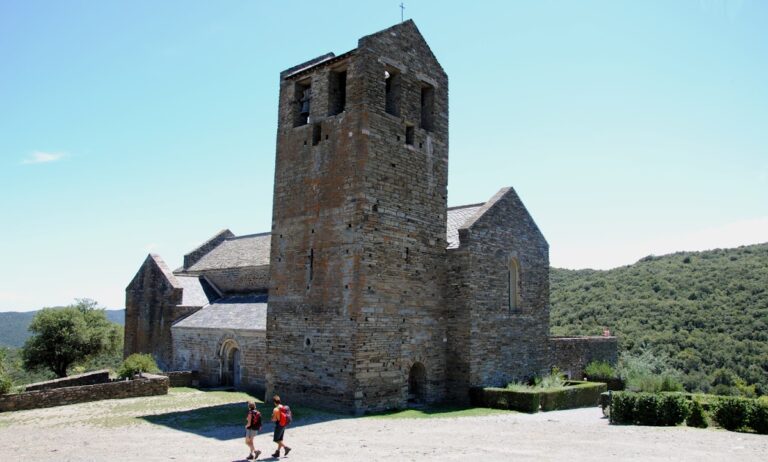
The ground floor of the non-commissioned officers’ barracks contained a bakery. Level 1 included an officers’ residence, which no longer survives, together with a chapel and crypt. The chapel’s small bell tower was built in 1930 as a Romanesque architectural copy and is the newest structure in the fort. The demolition of the first-level officers’ barracks during the twentieth-century sailors’ retirement-home project left a courtyard.
Cisterns and artillery
A spring discovered during construction supplied water, but its position outside the fort made it vulnerable to sabotage or poisoning. A second-level catchment system therefore collected rainwater from the gutters. Gravel, sand, and charcoal filtered the water before it entered a 70,000-litre underground cistern. A second cistern beneath level 1 held 50,000 litres as an overflow reservoir, giving the fort total storage capacity of 120,000 litres.
The original artillery comprised two 12-pounder, two 8-pounder, and six 4-pounder cannons. Each gun had 200 rounds and an approximate range of 4 kilometres, and a crane helped place the pieces on their carriages. The cannons fired through large loopholes closed with wooden doors when not in use. Smaller loopholes accommodated muskets, and approximately 36 fixed large-calibre wall muskets supplemented the artillery. The powder magazine held about 6 tonnes of gunpowder, along with stocks of shot, balls, and pitch or tar.
Nearby sites