Schloss Halbturn: A Baroque Habsburg Palace in Austria


Site at a Glance
- Rating
- 4.5
- Popularity
- Medium
- Country
- Austria
- Primary era
- Early Modern
- External website
- Open
- Eras represented
- Early Modern, Modern
- Civilizations
- Habsburg
- Site type
- Domestic
- Remains
- Palace
On this page9 sections
History
Schloss Halbturn is a Baroque palace complex in Halbturn, Austria, built for the Habsburg court between 1701 and 1711 as a hunting lodge under the supervision of the architect Johann Lucas von Hildebrandt. Located in Burgenland, east of Lake Neusiedl and near the modern Austrian-Hungarian border, it belonged for much of its history to the Teschen branch of the Habsburg family.
Imperial hunting lodge
Construction was commissioned by Emperor Charles VI, a Habsburg ruler of the Holy Roman Empire whose court developed numerous residences and hunting establishments. The lodge’s horse stud was destroyed during the first Ottoman siege, an episode that affected the estate during its early history.
Maria Christina and Albert
During the reign of Charles VI’s daughter Maria Theresa, who governed the Habsburg monarchy from 1740 to 1780, Halbturn’s administrative position changed in 1765 when the province of Altenburg was removed from the influence of the Hungarian Crown. Maria Theresa then gave Halbturn to her daughter Maria Christina for her marriage to Albert of Saxony-Teschen, Duke of Saxony and Teschen.
Maria Christina and Albert rebuilt the hunting lodge as a palace. It became their summer residence while Albert served as governor of Hungary. The couple had no children and adopted Maria Christina’s nephew, Archduke Charles Louis, the son of Emperor Leopold II. The palace reached particular prominence in the mid-eighteenth century, when it was frequently represented in paintings.
Dynastic inheritance
Archduke Charles Louis inherited Halbturn in 1822, and his son, Archduke Albert Frederick, succeeded him in 1847. After Albert Frederick’s only male heir died in infancy, he adopted his nephew. In 1895 the palace passed to Archduke Frederick of Austria, a senior military figure in Austria-Hungary. Frederick later transferred it to his son, Albert II of Austria-Teschen, the last titular Duke of Teschen, who died in Buenos Aires.
Franz Ferdinand and twentieth-century change
In 1898, Archduke Franz Ferdinand left his watch on the palace tennis court. A photograph of Sophie Chotek was found inside it, and Franz Ferdinand later married her in 1900 after a prolonged dispute with Emperor Franz Joseph. Their marriage was morganatic, meaning that Sophie did not receive the same dynastic status as her husband.
Soviet occupation troops plundered the palace in 1945. Much of it then burned in 1949, although the central part of the main building survived. The side wings were reconstructed progressively. After Albert II’s death, Baron Paul Waldbott-Bassenheim became associated with the estate in 1955 through an inheritance and lease arrangement involving the Austrian state. Expanded viticulture and wine production subsequently established the Schloss Halbturn winery.
Since Waldbott-Bassenheim’s death in 2008, the estate has been held and operated by his adopted son and nephew, Count Markus zu Königsegg-Aulendorf, together with his wife Philippa, née Waldburg-Zeil-Hohenems. The privately owned palace is protected as a historic monument and included in Austria’s cultural-property inventory. Its rooms are used for exhibitions and concerts, while the winery remains operated by the Königsegg-Aulendorf family. The park has separate protection as one of Austria’s important historic garden monuments.
Remains
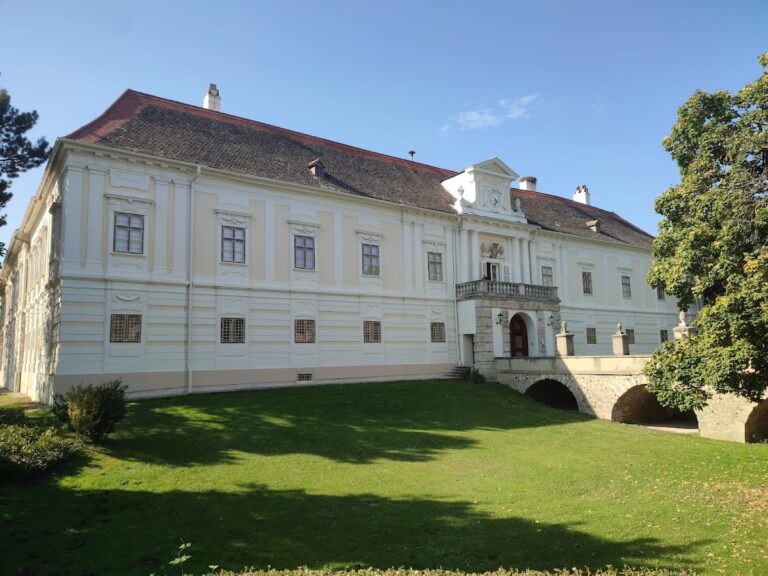
Schloss Halbturn survives as a substantially preserved Baroque palace ensemble with a main building, side wings, formal garden remains, a later landscape park, a western entrance gate, and an associated winery and cellar complex. The central section of the palace endured the 1949 fire, while the side wings were rebuilt in later stages.
Palace and decoration
The palace was designed under Johann Lucas von Hildebrandt during the 1701 to 1711 building period. Its transformation from hunting lodge to palace was carried out during Maria Theresa’s reign by the court architect Franz Anton Hillebrandt. Franz Anton Maulbertsch decorated the interiors with frescoes for the 1765 wedding of Maria Christina and Albert. A ceiling fresco in the central hall is titled Allegory of Time and Light.
Park and grounds
The park began as a Baroque garden created during the palace’s building phase under Charles VI. Its formal arrangement remained largely unchanged until the nineteenth century, and remnants survive in the broderie parterre, a formal ornamental bed whose clipped hedges form patterned designs, in front of the southern façade. The hedges there have been reconstructed. Around 1900, under Archduke Frederick, Anton Umlauft, then garden director of Schönbrunn Palace, substantially laid out the park in the English landscape-garden style.
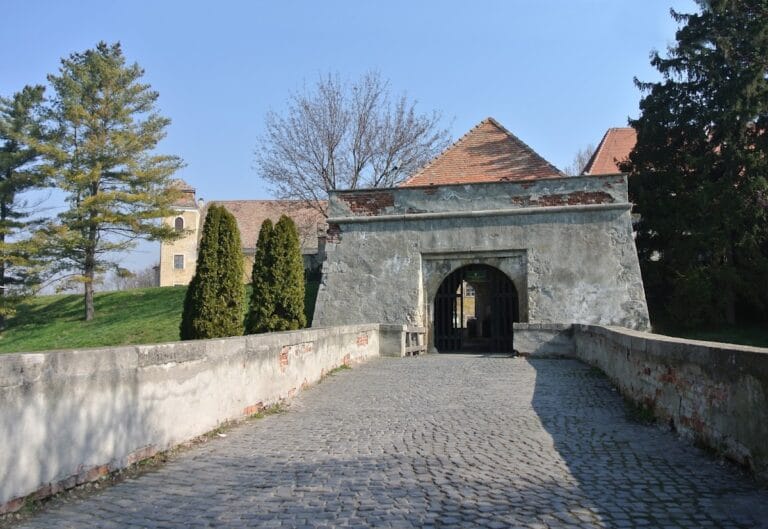
A western entrance gate forms part of the palace grounds, and the parish church of Halbturn stands at the edge of the park.
Winery and cellar complex
The grounds also contain a winery and cellar complex connected with the estate’s expanded viticulture and wine production. These facilities form part of the continuing agricultural use of the Halbturn estate.