Charles Fort: A Cannon-Resistant Bastion Fort at Kinsale


Site at a Glance
- Rating
- 4.7
- Popularity
- Medium
- Country
- Ireland
- Primary era
- Early Modern
- External website
- Open
- Eras represented
- Early Modern, Modern
- Civilizations
- British, English, Irish
- Site type
- Military
- Remains
- Fort
On this page7 sections
History
Charles Fort is a seventeenth-century trace italienne, or cannon-resistant bastion fort, at Kinsale in Ireland, built between 1677 and 1682. Named after Charles II, the fort was designed as the “new fort” in contrast to James’ Fort, the “old fort,” on the opposite side of Kinsale harbour. Its position and defenses made it an important part of the military landscape guarding the harbour.
Earlier stronghold and construction
Charles Fort occupies the site of Barry Óg Castle at Rincurran, an earlier stronghold whose defenses played an important role during the Siege of Kinsale in 1601. The new fort was designed by Sir William Robinson, Surveyor-General and architect of the Royal Hospital Kilmainham. Additional structures are attributed to engineer Captain Thomas Philips. Construction took place from 1677 to 1682, during a period when James’ Fort had already served as the older counterpart across the harbour, having been built between 1602 and 1607.
An early lighthouse was established at the fort in the seventeenth century by Robert Reading. The complex was later strengthened through further works, including internal citadel defenses added during the eighteenth and nineteenth centuries.
The Williamite War and British occupation
In 1690, during the Williamite War in Ireland, the conflict between supporters of the deposed James II and those of William III and Mary II, Charles Fort endured a thirteen-day siege. John Churchill, then 1st Earl of Marlborough, led the operation while besieging Cork and capturing Kinsale and its forts. The fort was repaired after the siege, although its landward and inland defenses had been overlooked by higher ground, a weakness that had shaped the attack.
Charles Fort then served as a British Army barracks for approximately two centuries. British forces relinquished the fort after the Anglo-Irish Treaty of 1921, which established the Irish Free State and led to their withdrawal. The complex fell out of use after retreating anti-Treaty forces burned it during the Irish Civil War in 1922.
Abandonment and conservation
The remaining complex was designated a National Monument in 1971 and was subsequently partially restored by Dúchas, the Irish state body responsible for cultural heritage conservation. Charles Fort is now operated as a heritage site by the Heritage Ireland division of the Office of Public Works.
Remains
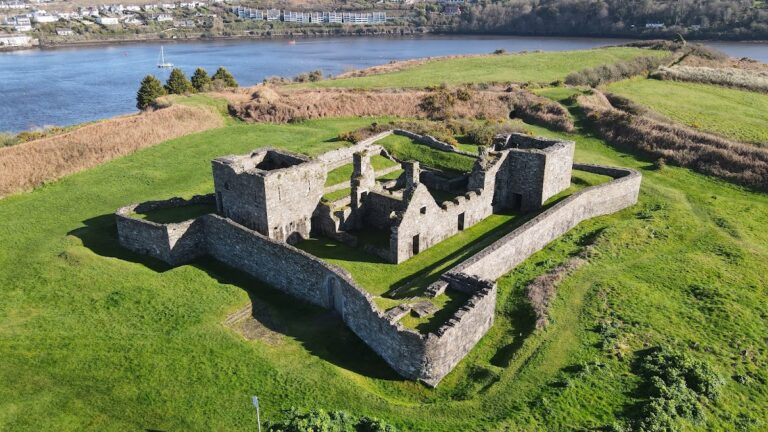
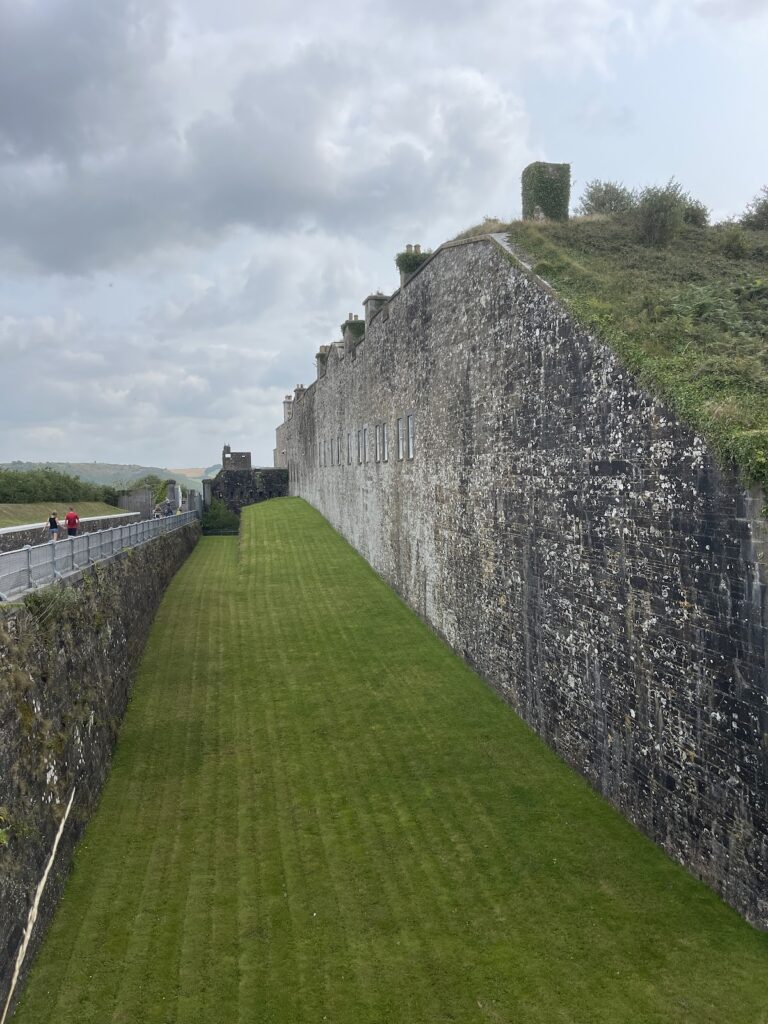
Charles Fort stands at the southern end of Summer Cove on Kinsale harbour, opposite James’ Fort. Its pentagonal plan follows the principles of the trace italienne, an early-modern design using low, thick defenses and projecting bastions to resist cannon fire and create overlapping fields of fire. A section of the outer wall is arranged in a star pattern, while the surviving complex retains substantial fabric despite its abandonment, twentieth-century fire, and partial restoration.
Plan and bastions
Five bastions project from the fortifications: Kinsale, also called the Devil’s Bastion, Charles, Cockpit, Flagstaff, and North. The seaward Kinsale and Charles bastions are larger and more substantial than the other three because the design anticipated an attack from the sea. The landward and inland bastions are overlooked by higher ground, placing those defenses at a disadvantage during the 1690 siege.
Citadel and later defenses
An internal citadel was added during the eighteenth and nineteenth centuries as part of later improvements. Together with the pentagonal enclosure and its bastions, it forms the principal surviving defensive arrangement of the fort. The remaining structures preserve the changes made after the siege and during the long period when Charles Fort served as a British Army barracks.
Nearby sites