Timoleague Friary: A Franciscan Monastery in County Cork


Site at a Glance
- Rating
- 4.5
- Popularity
- Medium
- Country
- Ireland
- Primary era
- Medieval
- Eras represented
- Medieval, Early Modern
- Civilizations
- Unclassified
- Site type
- Religious
- Remains
- Monastery
On this page19 sections
History
Timoleague Friary is a former Franciscan monastery in Ireland, built by the Franciscan order during the early fourteenth century in the Early English Gothic style. It stands beside the Argideen River overlooking Courtmacsherry Bay, on the site of an early Christian settlement associated with Saint Molaga and conventionally dated to the sixth or seventh century. The friars made Timoleague an important centre of worship, learning, trade, and religious training in West Cork.
Saint Molaga and the early settlement
Timoleague’s origins are traditionally linked to Saint Molaga, an early Irish Christian saint. According to local tradition, Molaga first tried to establish his community about a mile west of the present town, but the work collapsed each night. He then placed a blessed candle on a sheaf of corn and set it on the Argideen River. The candle came ashore at the place where the settlement was eventually built. The Irish name for Timoleague, meaning “Molaga’s House,” is derived from this association.
The Franciscan monastery occupied the site of this earlier religious community. Its foundation date and patronage remain uncertain. Documentary evidence places the foundation between 1307 and 1316, while parts of the surviving church indicate that the friars incorporated an existing thirteenth-century building. The Annals of the Four Masters assign the foundation to 1240 and to the MacCarthy Reagh family, but that date has generally been regarded as too early.
The Franciscan foundation
Several patrons have been associated with the foundation. They include Domhnall Got MacCarthy, his grandson Domhnall Glas MacCarthy, and members of the Anglo-Norman de Barry family, including William de Barry and Margery de Courcy. Another tradition says that Got MacCarthy expanded an existing friary between 1312 and 1366, while Samuel Lewis gave 1312 as the foundation date. The friars were firmly established at Timoleague by 1320. They may have occupied Timoleague Castle before the monastery was constructed, although the earliest surviving parts of the ruins belong to the later fourteenth century.
By the fifteenth century, Timoleague had become an ecclesiastical centre and a place of learning. In 1460 it was among the first Franciscan houses in Ireland to adopt the Observant reform, which sought stricter adherence to the order’s original ideals. Tadhg Mac Cárthaigh, later known as Blessed Thaddeus, was reportedly educated by the friars. Patrick Ó Feidhil, a noted preacher, was buried at the friary in 1505.
Expansion and sixteenth-century change
Bishop John Edmond de Courcy and his nephew James, 8th Baron Kingsale, became major patrons of the monastery. They financed the Gothic bell tower, infirmary, library, and one dormitory, and contributed to the friary’s liturgical plate. De Courcy had himself been a friar at Timoleague before becoming a bishop. Their support formed part of a substantial rebuilding and enlargement of the complex.
The friary was extensively altered in the early sixteenth century, including the construction of the bell tower between 1510 and 1518. John de Courcy was buried in the transept, but his grave was desecrated during the Cromwellian period, the mid-seventeenth-century campaigns and government associated with Oliver Cromwell and the English Commonwealth in Ireland. His remains were thrown into the estuary.
Henry VIII’s government dissolved religious houses in 1540, but the Franciscans remained at Timoleague. Crown forces seized the friary in 1568, and James de Barry, 4th Viscount Buttevant, received it as a grant in 1577. The monastery nevertheless continued to train novices until the late 1580s.
Further damage followed. In 1590, the Protestant Bishop of Cork ordered material from the friary mill to be used in building another mill, but flooding destroyed the work. In 1596, the friary’s wooden cells were dismantled for shipment by sea. The vessel carrying them sank in a storm.
Recovery, learning, and decline
After James I came to the throne, Catholics reclaimed Timoleague Friary in 1603 and repaired it completely by the end of 1604. These works substantially changed the buildings. Bishop Lyons attempted to disperse the friars in 1612, but an Irish force led by Daniel O’Sullivan drove him back. The friary was reportedly re-edified by 1613, yet Donatus Mooney, a Franciscan chronicler, found it no longer genuinely inhabited when he visited in 1616.
Pressure increased after Richard Boyle became Lord Justice in 1629. He promoted the closure of religious houses in County Cork, and the Franciscan community at Timoleague was probably already greatly reduced. The appointed guardian, Eugenius Fildaeus, took refuge in Limerick. Protestant settlers had largely plundered the complex by 1631.
Timoleague retained its intellectual reputation during this period. A School of Philosophy was established in 1620 under Owen O’Fihelly, a Franciscan scholar, and was associated with the friary. In 1629, Mícheál Ó Cléirigh, an Irish Franciscan scribe, transcribed material from the Book of Lismore in the friary library. This fifteenth-century Irish manuscript contains religious, historical, and literary material and was also known as the Book of MacCarthy Reagh. Claims that it was written or partly written at Timoleague remain disputed; manuscript specialist Pádraig Ó Macháin stated that this was not the case.
Destruction and the end of the community
In July 1642, Crown forces burned the friary and much of Timoleague after a force led by Lord Kinelmeaky failed to capture Timoleague Castle. Before the fire, the friary had been an important ecclesiastical and trading centre with commercial connections to France and especially Spain. The friars probably exchanged hides, butter, timber, and grain for wine. An account of the burning refers to thousands of barrels of wine in the abbey. The destruction contributed to a marked decline in the town’s financial development.
After the fire, local families began burying their dead throughout the friary, regardless of social status. Earlier burial there had been mainly associated with prominent local families. The Franciscan community survived among the ruins for almost two centuries. Four friars were reportedly living there in 1696, but the community had dispersed by the middle of the eighteenth century, although individual friars remained in the district for several decades.
Father Edmund Tobin, also called Bonaventure Tobin, was the last Franciscan working in the area. He died around 1822. Franciscans continued to appoint titular guardians, meaning formal or nominal superiors after the effective decline of the community, until 1872. Patrick Carey was the last guardian.
Memory, damage, and preservation
Interest in the ruins revived during the Romantic era of the early nineteenth century, when artists represented them in many paintings and drawings. Around 1812, Seán Ó Coileáin wrote the poem Machtnadh an Duine Dhoilghiosaich about Timoleague. It was later translated into English under titles including The Mourner’s Soliloquy in the Ruined Abbey of Timoleague and Lament over the Ruins of the Abbey of Teach Molaga. A bronze cast bearing a verse from the original poem stands at the entrance gate.
In 1848, concern arose that tides were undermining the walls and causing breaches in the burial ground. Soon afterward, Colonel Robert Travers paid for repairs to the friary walls and for a road between the ruins and the sea. Mass was celebrated in the friary in 1891 for the first time since its destruction, using the Dale-Browne Chalice.
In 1920, British soldiers desecrated the burial ground in response to the killing of three police officers by Irish nationalists. Burial vaults and coffins were opened, flags were removed from coffins, and human remains were left exposed in some cases. Máire Ní Shíthe, an Irish-language writer, was buried in an unmarked grave at the friary in 1955. The position of the grave was identified in 2016, and a commemorative stone was placed over it.
Remains
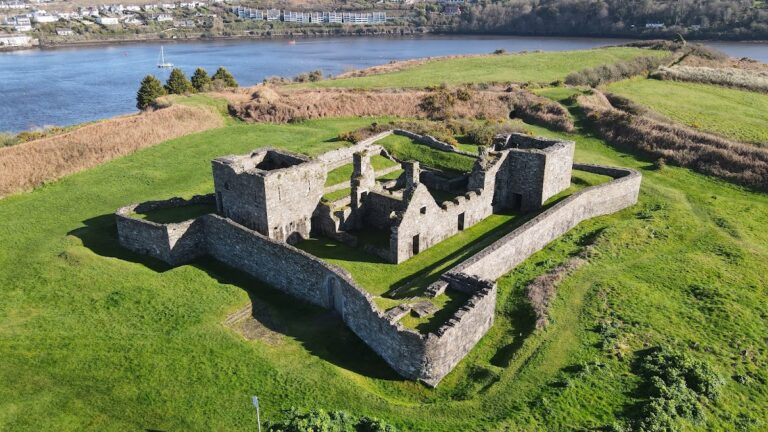
Timoleague Friary survives as a large claustral complex, meaning that its principal buildings were arranged around a covered cloister walkway and an open courtyard. The ruins are built mainly of locally quarried slate from near Borleigh. Their generally plain Early English Gothic detailing reflects Franciscan building practice, while the church tower and several internal arrangements give the complex distinctive features. The medieval monastery occupied about 4.5 acres, roughly four times the area of the surviving grounds. The present floor level is considerably higher than the medieval one, largely because of burials made after the friary fell into ruin.
The church
Nave and west entrance
The church’s nave was originally smaller than the surviving structure. Its arcade contains six arches, of which three are original. The church was an asymmetrical, two-aisled, unvaulted pseudobasilica, a church with a raised central space and lower side aisles but without the full upper window arrangement of a true basilica. The south aisle had a lean-to roof descending from the arcade toward the side wall, and continued around the west side of the south transept after turning at a right angle.
The present principal entrance is at the west end of the nave. A carved fleur-de-lis appears on the left doorjamb, while the doorway has simple mouldings associated with Perpendicular Gothic, a later phase of English Gothic architecture known for rectilinear forms and moulded detail. A small recess above the entrance probably held a sculpture or another religious image. The fleur-de-lis may have helped the probably French-speaking friars explain the Holy Trinity.
Choir and tower
The choir is the oldest part of the friary. It may originally have belonged to a thirteenth-century castle or church and was later incorporated into the Franciscan complex. It is notably tall, with long arches, triforium wall passages, and four widely splayed arched recesses in its north and south walls. A triforium is an upper passage or gallery within a church wall. Piers separate the recesses, and the tower base now occupies one of them.
The recess closest to the east gable contained sedilia, recessed seats traditionally used by clergy near the altar. A niche in the north wall held an altar commemorating the de Courcy family. The large east window once contained elaborate stained glass, and graves associated with the MacCarthy Reagh family remain in the choir.
A central tower rises above the triumphal arch between the nave and choir. The south transept joins the church west of the tower through an arch, forming an unusual arrangement around the church’s principal spaces. The transept window known as the “Leper’s Hole,” or “Leper’s Window,” is a narrow opening through the wall. People with leprosy from the nearby leprosarium at Spittal could see and hear the service through it and receive the Blessed Sacrament. The opening is narrower on the outside than on the inside, and the Eucharist was probably passed through it on a spoon to avoid physical contact.
Monastic buildings
Cloister and courtyard
The cloister and the friars’ living quarters stood north of the church, following the arrangement common in Irish Franciscan friaries. Only sections of the cloister walls remain standing, but the quadrangle measured approximately 9.8 metres from east to west and 9.3 metres from north to south. A large outdoor courtyard stood beside it, an unusual feature at Timoleague.
The cloister had exterior access to rooms on the upper floor, another unusual arrangement. The stairs have not survived. The evidence suggests that the position normally occupied by the chapter room may have been used as cellarage, while the chapter room itself was placed above. An intramural space in the south cloister wall is locally called the “Fairy Cupboard.” A nineteenth-century tradition says that children found a parchment manuscript beneath one of its flagstones and used it as a football until pigs consumed the remains.
Library and refectory
A room generally identified as the library is the only part of the friary used neither for burial nor as an open burial area. It may have housed friars who stayed at Timoleague after the 1642 destruction. Its surviving ground-floor windows would have supplied too little light for literary work, so the library was more likely located on the upper floor. The chapter room may also have served as the library before being converted to storage.
The room identified as the refectory, or communal dining room, retains evidence of a reader’s seat and one of the five windows that lit the space. Donatus Mooney described carved-oak beams supporting the ceilings over both the refectory and chapter room. These details preserve evidence of the friary’s communal and intellectual life alongside its religious functions.
Bell tower
The bell tower is one of fourteen surviving pre-Reformation Franciscan monastery towers. Added between 1510 and 1518, it is broader from north to south than from west to east, measuring approximately 4.6 metres north-south and 4.0 metres west-east. Its cross-walls narrow abruptly at the tower’s beginning. The structure has a pronounced battered profile, battlements, and three merlons at each of its four corners.
Earlier and associated features
Sacristy and bullaun stone
The sacristy, the room used for sacred vessels and vestments, contains a bullaun stone. This prehistoric or early medieval stone has a hollow or basin, and is locally called a “wart well.” Water collected in the hollow was traditionally believed to cure warts. The stone is much older than the surviving friary buildings and may have belonged to the sixth- or seventh-century monastic settlement associated with Saint Molaga.
St Molaga’s Head
A projecting stone in the exterior wall is known as “St Molaga’s Head.” It was reportedly given by French sailors in thanksgiving for safe harbour after a storm. The piece was originally a sculpture of the saint’s head, but severe erosion has worn away its facial features.
Manuscripts, chalices, and burial evidence
The friary’s material associations extend beyond its standing walls. The Book of Lismore, a fifteenth-century manuscript also called the Book of MacCarthy Reagh, was held at Timoleague at times. Mícheál Ó Cléirigh copied material from it in the library in 1629. The manuscript’s presence helps explain the friary’s continuing connection with scholarship during its later years.
Two seventeenth-century chalices are associated with Timoleague. The earlier Dale-Browne, or Dale, Chalice is a gilt-silver vessel dating from around 1600. It stands 8.5 inches high, with a tulip-shaped bowl 3.25 inches wide and 3 inches deep. Its tall hexagonal foot bears the Instruments of the Passion, including a central cross, a spear, and a sponge-bearing stick. The cross is represented as a tree of life with branches and shamrocks.
An inscription on the chalice prays for the souls of Charles Daly and Elizabeth Browne of Timoleague. The vessel was probably given to the friars by the Daly family when they returned to the friary after its seizure in 1568. It is now held at the Collins Barracks branch of the National Museum of Ireland and was used for the 1891 Mass in the ruins.
The later Timoleague Franciscan Chalice is made of gold and may date from around 1633. Tradition says that a friar carried it away by boat during the 1642 destruction and entrusted it to fishermen from Cape Clear Island. When its box was opened in 1860, it contained badly deteriorated vestments and a chalice blackened by age. The vessel bears the inscription “Friars Minor Convent of Timoleague.” It was returned to the parish priest of Timoleague in 1892 and remains in the safekeeping of successive parish priests. An exact replica is permanently displayed in the local Catholic church.
Nearby sites