Nothe Fort: A Victorian Coastal-Defence Fortification in Weymouth


Site at a Glance
- Rating
- 4.7
- Popularity
- Medium
- Country
- United Kingdom
- Primary era
- Modern
- External website
- Open
- Eras represented
- Modern
- Civilizations
- British
- Site type
- Military
- Remains
- Fort
On this page10 sections
History
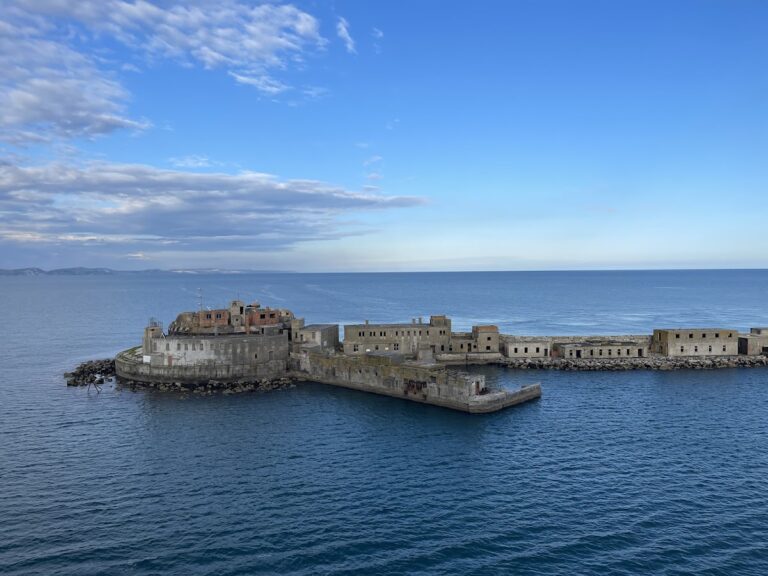
Nothe Fort is a Victorian coastal-defence fortification in Weymouth, United Kingdom, built to protect Weymouth and Portland Harbours. Construction began in 1860, while Portland was developing as an important Royal Navy base, and the fort was fully commissioned in 1872.
Construction and Victorian armament
The first phase involved levelling the end of the Nothe Peninsula and building a sea wall. A civil engineering contractor began the work, but financial difficulties led the 26 Company of the Royal Engineers, the British Army corps responsible for military engineering and fortification, to take over in 1862. The upper earthen parapet was complete by 1869, and the finished fort cost £117,049.
No. 2 Battery Royal Artillery, also known as Tatton-Browns, formed the first garrison. The Royal Artillery operated the fort’s original armament, which comprised two 64-pounder guns, four 9-inch rifled muzzle-loaders, and six 10-inch guns. A rifled muzzle-loader was loaded through the barrel, with internal grooves that improved the accuracy of its projectile.
Changes to the guns
During the 1890s, seven of the fort’s guns were replaced by 12.5-inch rifled muzzle-loaders. In the early twentieth century, these were removed and replaced by three 6-inch Mark VII breech-loading naval guns on the ramparts. Breech-loading guns were loaded from the rear, allowing faster operation than weapons loaded through the barrel.
Second World War service
Alterations made in 1938 allowed Nothe Fort to become the central anti-aircraft ammunition depot for the south-western region. During the Second World War, four Vickers QF 3.7-inch anti-aircraft guns were installed, later giving way to a Bofors 40 mm gun. The fort fired its first wartime warning in July 1940, when two unidentified ships entered the area. The ships switched on their lights and proved to be refugees from the Channel Islands.
Post-war use and restoration
Nothe Fort ceased to serve as a coastal defence in 1956. The Royal Navy subsequently used it to store supplies and degaussing equipment, which reduced a ship’s magnetic signature and helped protect vessels from magnetic mines. By 1961, the Navy had no further use for the fort and sold it to Weymouth and Melcombe Regis Borough Council.
The council-owned fort remained unoccupied, suffered vandalism, and began to deteriorate. Work on a proposed luxury hotel conversion started in 1971 but was abandoned soon afterward. In 1980, the Weymouth Civic Society took responsibility through a lease from the borough council, enabling restoration to begin with help from the Manpower Services Scheme. Part of the magazine level was later adapted during the 1980s as a Cold War nuclear shelter for civil administration, with command and accommodation areas and heavy blast doors.
The fort was gradually restored and converted into a museum. It is operated by paid staff and more than 100 volunteers, and remains one of the best-preserved forts of its type in the country. The fort and its outer gateway have been Grade II* listed since 1974, a high level of protection for a particularly important building or structure. In 1978, Nothe Fort, its tramway, and the searchlight battery at The Nothe were scheduled under the Ancient Monuments and Archaeological Areas Act 1979. The fusee steps in Nothe Gardens received Grade II listing in 2000.
Remains
Peninsula setting and defensive layout
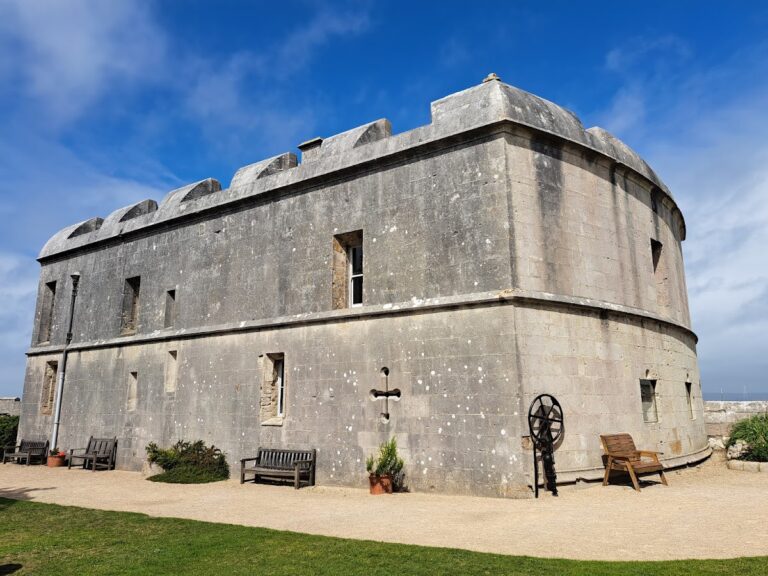
Nothe Fort occupies the eastern end of the Nothe Peninsula, which projects into the sea from Weymouth and Weymouth Harbour. It stands north of Portland Harbour beside Nothe Gardens. The fort has a D-shaped plan and is arranged on three levels, with bomb-proof casemates and deep magazines. Casemates are fortified chambers protected by thick masonry or earth, while magazines are secure military stores for ammunition.
Gun positions and ammunition system
The magazine level stored ammunition, and a series of hoists carried 100-pound shells from the magazines to the gun positions. On the ground level, casemates housed heavy muzzle-loading guns and the soldiers who operated them. The ramparts included a raised firing platform for muskets and light muzzle-loading guns during attacks. These levels brought storage, gun crews, and defensive positions together within the fort’s compact plan.
Anti-aircraft installations
The anti-aircraft guns used during the Second World War stood on a purpose-built platform in the north-west corner of the fort. The 1938 conversion also added a loading platform and an electrically operated hoist for the ammunition depot. These installations remain part of the physical evidence for the fort’s adaptation from coastal artillery defence to wartime anti-aircraft service.
Tramway and surviving collections
The fusee steps in Nothe Gardens formed part of the ammunition tramway. Trolleys used the tramway to haul ammunition, spare parts, and stores from the quay to Nothe Fort. Within the restored fort, the museum retains original cannons and guns and displays models, Second World War memorabilia, and American and British vehicles used during the war.
Nearby sites