Schloss Windern: A Historic Castle in Austria


Site at a Glance
- Rating
- 5
- Popularity
- Very Low
- Country
- Austria
- Primary era
- Early Modern
- Eras represented
- Early Modern
- Civilizations
- Habsburg, Holy Roman Empire
- Site type
- Military
- Remains
- Castle
On this page8 sections
History
Schloss Windern is a historic castle in Austria, located in the settlement of Windern in the municipality of Desselbrunn, Upper Austria. Its lordship developed from a medieval estate, while the principal castle building was commissioned by the Polheim family in 1594.
Medieval lordship
The settlement appears under the name Windarin in 1185, when it was held by Gerhoch von Viecht, a ministerial, meaning a medieval service noble who could exercise landholding or administrative authority for a higher-ranking lord. Gerhoch donated Windern to Admont Abbey, a Benedictine monastery in Styria. In 1261, the estate passed from the abbey to Hedwig von Weng and Heinrich Aistersheimer.
Around 1300, Konrad von Haag held Windern. Ulrich von Windern became the first recorded owner to use the estate’s name in 1315, and Purkhart von Windern followed him in 1379. By 1395, the lordship had become a princely fief, meaning land held from a territorial prince in return for service or allegiance. It then passed to Koloman der Windner and his wife Agnes. In 1419, Margarete, the daughter of Hans Windern, brought the estate into her marriage with Kolomann von Grienthal as her dowry.
Early modern ownership
Sigmund Moser held the Windern estate in 1455, and his son Clemens retained it until 1523. The Polheim family acquired the estate in 1594 and commissioned the principal castle building. In 1628, during the period when Upper Austria was pledged to Bavaria, Count Adam von Herberstorff bought Windern from Siegmund Ludwig von Pollheim with a right of repurchase. Herberstorff’s widow, Salome, sold it back to the Pollheim family the following year.
By 1630, the lordship of Windern, together with Dorff and Lindach, belonged to the Hayden family under Karl von Hayden. Georg Erasmus von Zetlitz purchased the castle in 1654, and his son Georg Christoph inherited it in 1657. Through the marriage of Sara Sophia von Zedlitz, Windern passed to Hanns Kaspar Höritzer in 1742. It then came to Franz Xaver Pochsteiner von Wolfenbach in 1750, or possibly as early as 1745. After his death in 1798, his son Peter inherited the estate.
Chapel, warfare, and rebuilding
The Pochsteiner family had the castle chapel built in 1769. Windern was heavily fortified during the French Wars, the conflicts associated with Revolutionary and Napoleonic France from the 1790s through the early nineteenth century. The related earthworks were later levelled. A fire in 1817 led to rebuilding, and a further fire may have occurred in 1866.
After Peter’s death, his sister Rosa married Baron Kaspar von Lempruch. Their son Karl Ludwig inherited the lordship in 1835. Ownership then changed rapidly, passing to Karl Baron von Mladota in 1851; Michael and Therese Bruckmüller and Anton von Lansa in 1867; Count Ludwig Folliot-Creneville in 1877; and Baron Eduard von Lago in 1884.
The Gagern family and the twentieth century
Legation Councillor Karl Baron von Gagern acquired Windern in 1888. His family made substantial efforts to preserve the castle, and the writer Friedrich von Gagern frequently stayed there. In 1944, during the National Socialist period, the National Socialist People’s Welfare established a care facility for children of foreign nationality in the castle. The institution housed children of forced laborers, and deaths occurred there.
Maria Gagern, the family widow, died in Linz in 1960. Windern had passed to Otto Baron von Buttlar-Brandenfels the previous year, and the subsequent owner, Maximilian Garber, commissioned renovations. In 1988, Werner Frey of Basel acquired the castle and intended to convert it into a residence for senior citizens, but the plan was not carried out. Since 2006, Schloss Windern has been owned by Franziska Pranckh and Vikas Thapar, and extensive renovation work has been underway since that year.
Remains
Castle complex
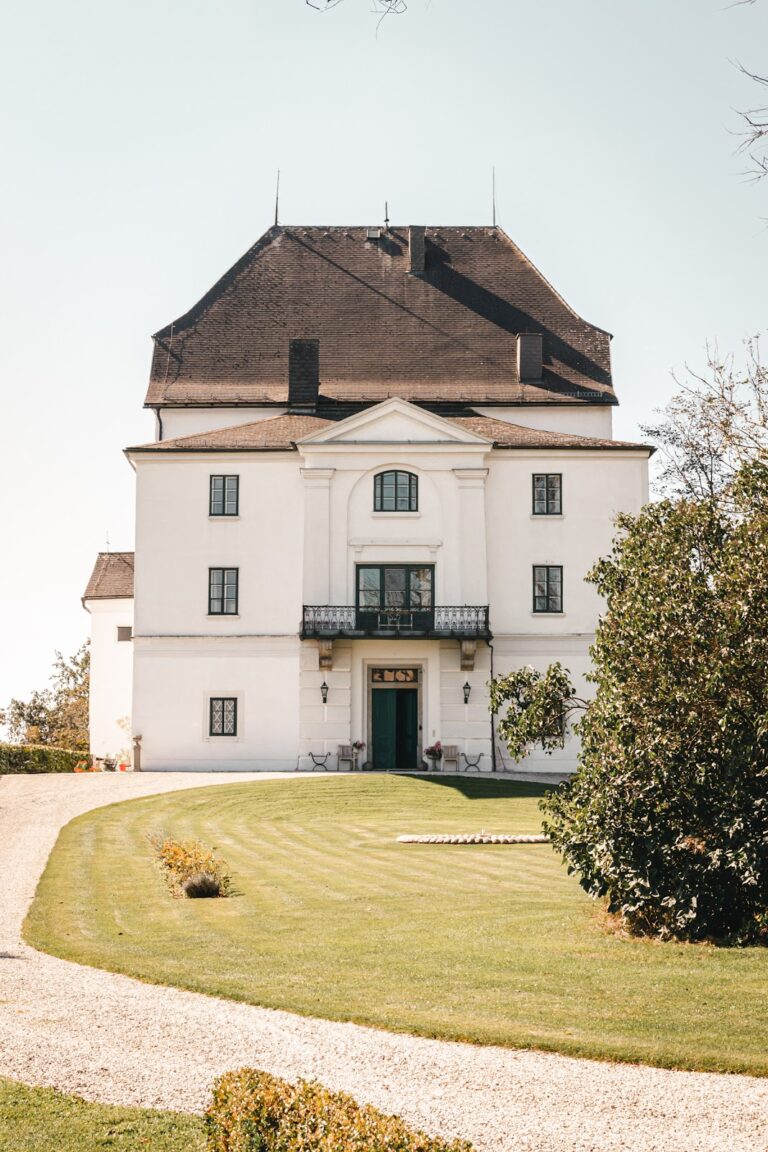
Schloss Windern consists of an almost square central block with four small square corner turrets. Each turret has a steep pyramidal roof. A high enclosing wall surrounds the four-towered complex and includes two round defensive towers. The entrance is formed by a columned portal, with columns flanking the gateway.
A residential building adjoins the right-hand tower. On the left, a low house connects the left-hand tower with the chapel. A covered passage leads from the castle to the chapel, linking the principal residential complex with the separate religious building.
Castle Chapel of Saint John of Nepomuk
The Castle Chapel of Saint John of Nepomuk was built in 1769 and retains furnishings from the period of its construction. Saint John of Nepomuk was a fourteenth-century Bohemian Catholic priest and martyr who was widely venerated in Central Europe. The chapel contains paintings by Bartolomeo Altomonte, an eighteenth-century painter known for religious frescoes and ceiling paintings, as well as three Rococo altars. Rococo is an eighteenth-century style associated with delicate ornament and light, decorative forms.
At the rear of the chapel, a curved exterior staircase leads to a columned portal. Four small turrets carry sheet-metal figures of the Evangelists, Matthew, Mark, Luke, and John, traditionally associated with the four canonical Gospels. The chapel was renovated in 1969.
Nearby sites