Château d’Angeville: A Former Fortified Castle in France


Site at a Glance
- Rating
- 3.2
- Popularity
- Very Low
- Country
- France
- Primary era
- Early Modern
- External website
- Open
- Eras represented
- Medieval, Early Modern
- Civilizations
- Duchy of Savoy, Holy Roman Empire
- Site type
- Military
- Remains
- Castle
On this page8 sections
History
Château d’Angeville, also called Château de Lompnes, is a former fortified castle in France whose origins date to the twelfth century. Built under the Counts of Savoy as a seigneurial residence, it occupied a strategic place in the administration of Lompnes and later passed among Savoyard, Beaujeu, and noble families.
Under Savoy and Beaujeu
During the twelfth century, Savoy maintained castellans and receivers at Lompnes. These officials rendered annual accounts to the Chamber of Accounts of Savoy, the dynasty’s financial institution. The castle and Valromey were probably included in the dowry of Alix of Savoy, daughter of Amadeus III of Savoy and Mahaut d’Albon, when she married Humbert III of Beaujeu. At the beginning of the thirteenth century, Lompnes was held by the lords of Beaujeu, a powerful family based in Beaujolais.
In 1228, the knight Humbert de Luyrieux received the freehold property held by Humbert V of Beaujeu at Châtelard of Lompnes as an increase of his fief, land or jurisdiction held from a superior lord in return for acknowledged obligations. The lordship returned to the Counts of Savoy soon afterward. In 1230, Savoy transferred Lompnes, along with Cordon, Châteauneuf, Virieu, and other lands in Bugey and Valromey, to Louis I of Beaujeu as the dowry of his wife, Éléonore of Savoy, daughter of Thomas II of Savoy.
Thirteenth- and fourteenth-century transfers
Count Peter II of Savoy bequeathed the castle to his daughter Béatrix in a testament dated 7 May 1268. On 30 July 1286, she transferred it by treaty to her daughter Anne and son-in-law Humbert, Dauphin of Viennois. The Dauphin was the hereditary ruler of the Dauphiné, a principality in southeastern France. This transfer probably did not take effect, since Lompnes returned again to the Counts of Savoy.
In 1300, Savoy granted the lordship as a fief to the knight Humbert de Luyrieux, who thereafter styled himself lord of Lompnes. The land was later withdrawn from him and restored to the Duke of Savoy. On 16 April 1319, Jean de Luyrieux, lord of Culoz, exchanged the castle with Count Amadeus V of Savoy for jurisdiction over Champdor. In the same year, the lord of Thoire-Villars threatened Lompnes Castle, Saint-Rambert Castle, and the fortified settlement of Luisandre from his mountain territories.
Bonivard and later noble ownership
In 1440, Louis, Duke of Savoy, granted Aymon de Beauvoir, knight and lord of La Palu, the usufruct of Lompnes. Usufruct was the right to use property and receive its benefits without necessarily owning it. Aymon used the title usufructuary lord of Lompnes in 1445. After this arrangement ended, the duke granted the lordship and its high, middle, and low jurisdiction to François de Bonivard in 1457 as a reward for his services. These three levels covered the principal grades of seigneurial justice, from serious criminal cases to lesser civil and local matters.
The castle was reconstructed in the sixteenth century by Urbain Bonivard, bishop of Verceil, a senior Christian officeholder responsible for a diocese. During the conquest of Bresse and Bugey, Biron’s troops captured and dismantled it. The castle was restored in 1640. In 1592, after the Bonivard line continued through Amblard de Bonivard’s daughters, Bernarde transferred the property to her nephew Jacques de Mareste on 11 December, requiring him to adopt the Bonivard name and arms.
Jacques de Mareste sold the castle, probably with a redemption clause, to Laurent du Luyset of Belley. Such a clause allowed a seller to recover property under specified conditions. Du Luyset resumed the fief on 22 May 1602 and pledged it for several years to Bertrand de Grenaud, squire and lord of Rougemont. René de Lucinge de Geres, lord of La Motte and Les Allymes, bought the castle on 18 July 1635 and retained its enjoyment until March 1651. The lordship was then judicially adjudicated to Melchior Bernard de Montessus, lord of Balon and governor of Beaune.
The Angeville period and present function
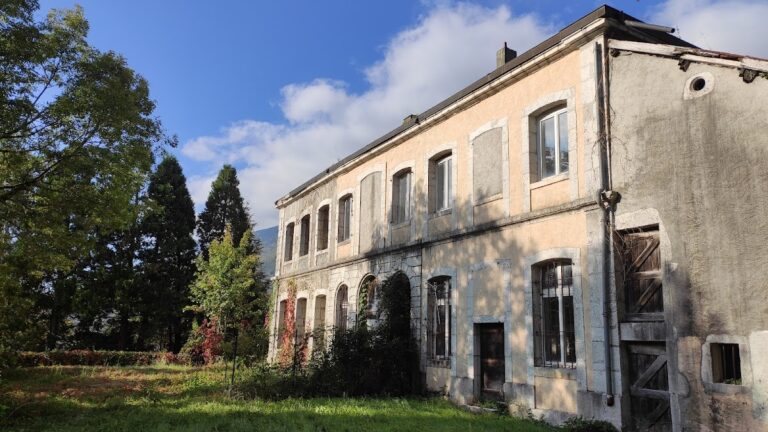
On 28 October 1657, Melchior Bernard de Montessus sold the lordship to Guillaume-Philibert d’Angeville and his wife, Antoinette de Massenay du Lac. The property has belonged to the French Red Cross for more than a century. It now accommodates a functional rehabilitation centre with 30 places and a residential care facility for dependent older people with 50 beds.
Remains
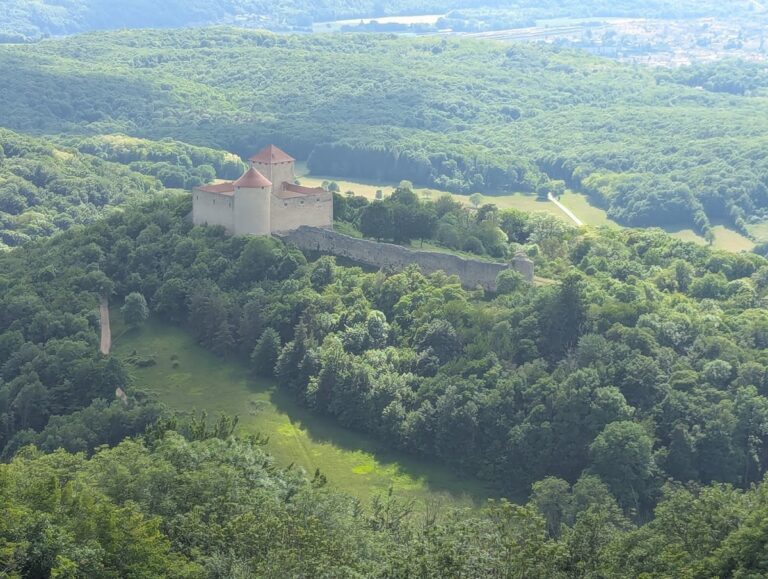
Château d’Angeville stands on a hillside in the village of Lompnes, within the commune of Hauteville-Lompnes, at an elevation of 890 metres. The surviving site is the remnant of a medieval fortified castle dating from the twelfth century and reconstructed in the sixteenth century. Its present form also reflects the dismantling carried out during the conquest of Bresse and Bugey and the restoration undertaken in 1640.
Castle enclosure
The castle enclosure preserves the physical setting of the former seigneurial residence on the hillside. Its construction history combines the medieval fortified foundation with the sixteenth-century rebuilding associated with Urbain Bonivard. Later restoration followed the damage inflicted by Biron’s troops, while the complex’s current institutional use has given the historic property a continuing function.
Chapel of Saint Bernard of Menthon
A chapel stood within the castle enclosure under the dedication of Saint Bernard of Menthon. Its endowment included landed property at Courchevache, Béligneux, and Culoz, in a place called Curléaz. The chapel formed part of the religious and landed organization of the castle estate.