Château de Luisandre: A Medieval Savoyard Frontier Fortress in France


Site at a Glance
- Rating
- 4.3
- Popularity
- Very Low
- Country
- France
- Primary era
- Medieval
- Eras represented
- Medieval
- Civilizations
- Holy Roman Empire
- Site type
- Military
- Remains
- Castle
On this page6 sections
History
Château de Luisandre is a medieval Savoyard fortified site in France, above Saint-Rambert-en-Bugey. It began as the Bâtie de Luisandre, a fortified outpost built in 1304–1305 by Amédée V, Count of Savoy, during the territorial rivalry between Savoy and Dauphiné. Its purpose was to protect the Savoyard frontier and the route connecting Saint-Rambert-en-Bugey with Ambronay, Pont-d’Ain, and Bresse.
A frontier outpost between Savoy and Dauphiné
At the beginning of the fourteenth century, this borderland lay between the Savoyard lands of Saint-Rambert-en-Bugey and the Dauphinois territory of Saint-Germain. Dauphiné was a neighboring principality whose competition with Savoy shaped the military landscape of the region. The original bâtie, a small fortified defensive work, was made of earth and timber. Around 1312, the Count of Savoy replaced it with a stone castle, giving the outpost a more permanent defensive form.
The Dauphin first tried to intimidate the workers engaged in the construction. He then established Château des Allymes nearby, about 800 metres from Luisandre in a straight line and 150 metres lower. The regional conflict ended with the Treaty of Chapareillan in 1334, while the wider war between the two powers concluded with the Treaty of Paris in 1355.
The lordship and its succession
The name Luisandre was already in use in 1169. At the beginning of the fourteenth century, the Count of Savoy granted the land, its judicial rights, and an annual ground rent of ten livres viennoises to Amé Roux, a gentleman from Saint-Germain-d’Ambérieu. The grant required Roux and his descendants to receive the counts of Savoy, as well as anyone appointed to command the place during war or other emergencies.
The lordship later passed by purchase from Roux’s heirs to Humbert Guyot of the noble Guyot family of Bourg, and then to his son Pierre Guyot. Pierre initially encountered difficulty securing formal possession. Amédée VIII, Duke of Savoy, argued that the lordship had returned to him because Humbert Guyot had failed to render homage and because the fortress had deteriorated. Homage was the ceremony and continuing obligation by which a vassal acknowledged a superior lord.
On 14 November 1416, after Pierre Guyot rendered faith and homage, Amédée VIII granted him the lordship outright and formally confirmed his possession through letters issued at Chambéry. Pierre’s only daughter later brought the lordship to Antoine de Monspey, lord of the Tour de Replonges, as her dowry. The property remained with the Monspey family until Jean de Monspey sold it in the early seventeenth century to René de Lucinge, lord of Allymes and Montrosat, a Savoyard councillor and chief steward.
Later owners and decline
After René de Lucinge’s death, legal proceedings concerned his property. His nephew, René de Lucinge de Gères, acquired the lordship and left it to his heirs. Toward the end of the seventeenth century, it passed to François de Suduyrand and his wife, Jeanne Sivelle. On 6 July 1731, they gave it to Jacques Estienne, a squire. The lordship subsequently passed to the Dujast family of Ambérieu, who held it in 1789.
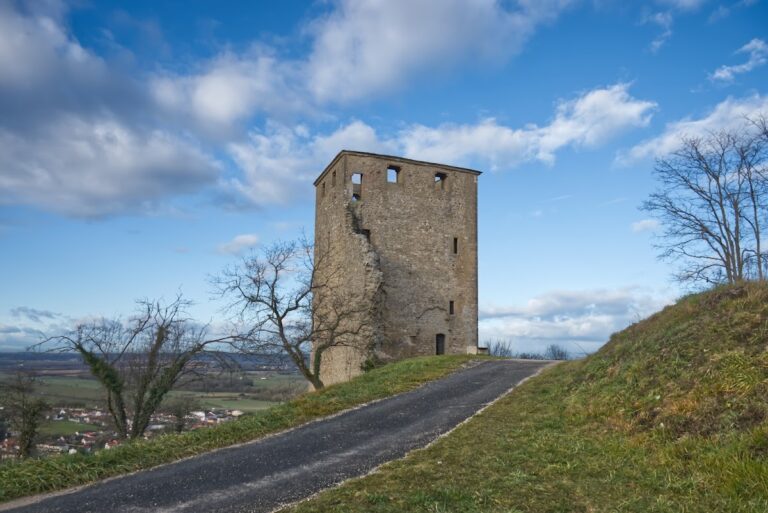
By 1650, only an old tower remained of Château de Luisandre. The site was thereafter treated as a ruin. An archaeological recording campaign later produced a topographic plan of the surviving structures within their setting, a condition survey, and a historical synthesis.
Remains
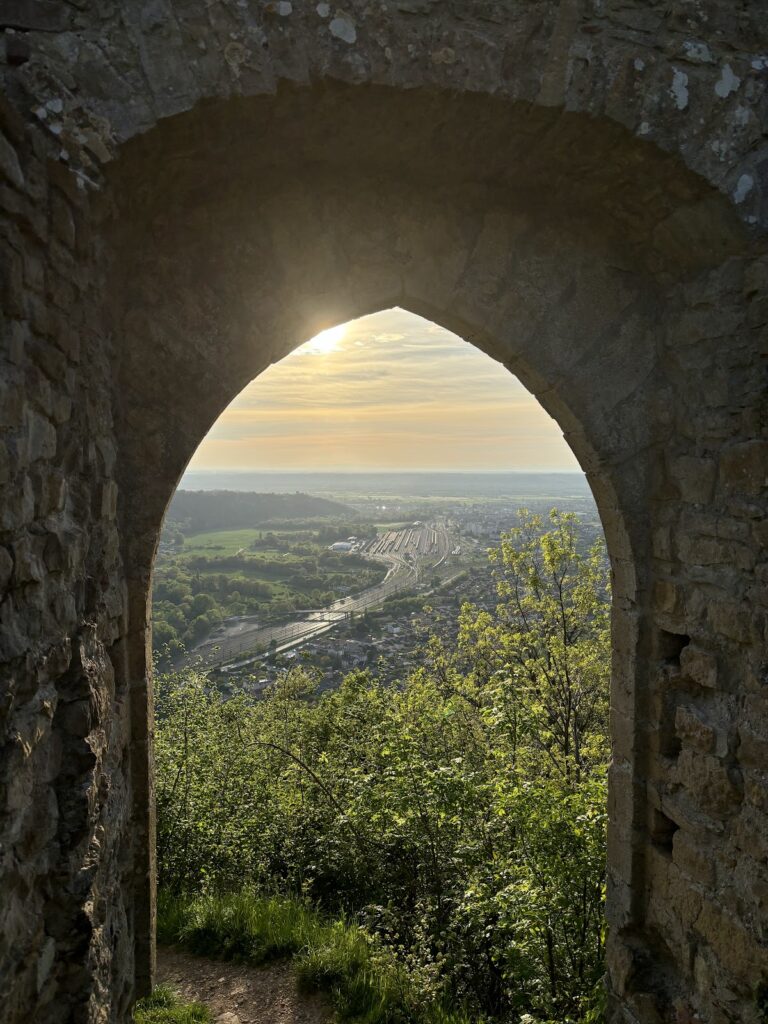
The ruins occupy the summit of Mont Luisandre in the Jura, at an altitude of 805 metres, within the territory of Saint-Rambert-en-Bugey in the Bugey region. The site lies in the Bas-Bugey sector of the Jura massif, about 5 kilometres north of the town. Its position supported the original lookout function of the fortified work and later accommodated a stone castle.
The summit fortress
The surviving remains are concentrated around the ruined keep at the summit. The castle succeeded an earlier earth-and-timber defensive work and was later built in stone. By 1650, the surviving structure had been reduced to an old tower, and the site now remains ruinous. A topographic survey recorded the structures still conserved on the summit together with their surrounding environment, clarifying the physical setting of the remains.
Château de Luisandre’s physical history therefore follows the change from a lookout post to a fortified castle and finally to a ruin. Its remains are associated with the nearby Château des Allymes, positioned approximately 800 metres away in a straight line and 150 metres lower, within the same contested frontier landscape.
Nearby sites