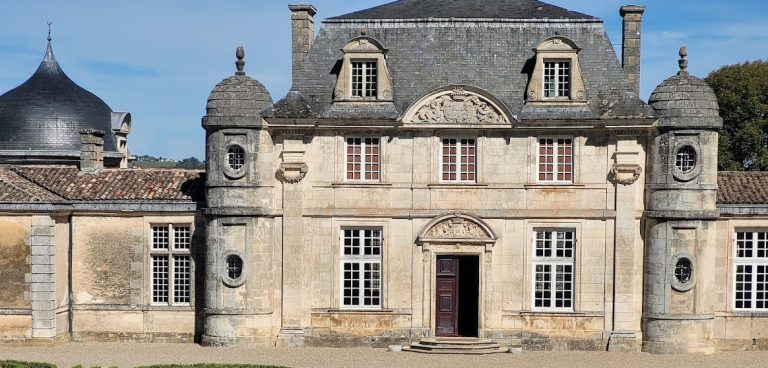
Château Nairac: An Eighteenth-Century Wine Estate in Barsac, France


Site at a Glance
- Rating
- 4.7
- Popularity
- Very Low
- Country
- France
- Primary era
- Early Modern
- Eras represented
- Early Modern
- Civilizations
- French
- Site type
- Domestic
- Remains
- Elite Residence
On this page8 sections
History
Château Nairac is an eighteenth-century château and wine estate in Barsac, France, whose late-eighteenth-century building and ordered gardens developed beside the former road from Bordeaux to Toulouse. Its vineyard began in the mid-seventeenth century, when André Duranceau founded the estate then known as the Bourdieu de Durancau.
Formation of the Nairac estate
Elizabeth Prost, the daughter of a planter from Saint-Domingue, acquired the property in 1759. She sold it in 1777 to Élysée Nairac, a Bordeaux wine merchant from a Bordeaux shipowning family involved in the slave trade. Nairac commissioned the architect André Mollié to create the château and garden at the entrance to Barsac. Mollié had trained and worked with Victor Louis, the architect associated with Bordeaux’s Grand Théâtre.
Élysée Nairac died in 1791. His unmarried daughters, Henriette and Émilie, inherited the estate and managed it until their deaths. In 1837, the Nairac heirs sold the property to Bernard Capdeville, who also owned Château Broustet, about 500 metres away. The two vineyards were combined as Château Broustet-Nairac, and the resulting wine received the status of a Deuxième Cru, or Second Growth, in the 1855 Official Classification of Bordeaux Wines.
Division and modern ownership
The combined property was later divided again. Broustet became separate at the end of the nineteenth century, while Nairac was separated in 1906 and sold to Perpezat, a wine merchant from Lorraine. Further ownership changes and a period of neglect threatened the château with deterioration. The property was sold in 1966 to a Bordeaux municipal councillor and then resold in 1971 to the American couple Thomas Heeter and Nicole Tari, whose family owned Château Giscours.
After the couple divorced in 1986, Nicole Tari-Heeter became sole owner in 1987. Her children Nicolas and Éloïse Heeter-Tari have managed the estate since 1993, with Nicolas also identified as taking on management after 1986. Frost in February 1956 damaged the vines and led to their replanting. Following the 1971 acquisition, the vineyard and cellar equipment were modernized with advice from the oenologist Émile Peynaud, and the estate thereafter renewed its oak barrels each year.
Restoration and classification
From the early 1990s, Nicole Tari-Heeter undertook the restoration of the grounds. The work changed the gardens back from an English-garden phase to the regular French garden associated with Mollié’s original plan, using surviving county-archive documentation. The landscape architect Anouck Debarre directed the restoration, while the orchard was remodeled from 2002.
Château Nairac produces sweet white wine under the AOC Barsac appellation, the French designation governing wines from the Barsac area. It remains classified as a Deuxième Cru in the 1855 Bordeaux classification, although that status originally applied to the combined Broustet-Nairac estate. The property was entered on the French register of historic monuments by decree dated 13 September 2017. Its vineyard covers about 16 hectares and produces approximately 20,000 bottles each year. The wine is matured for three years in entirely new oak barrels, and the estate’s second wine is Esquisse de Nairac.
Remains
Château and estate setting
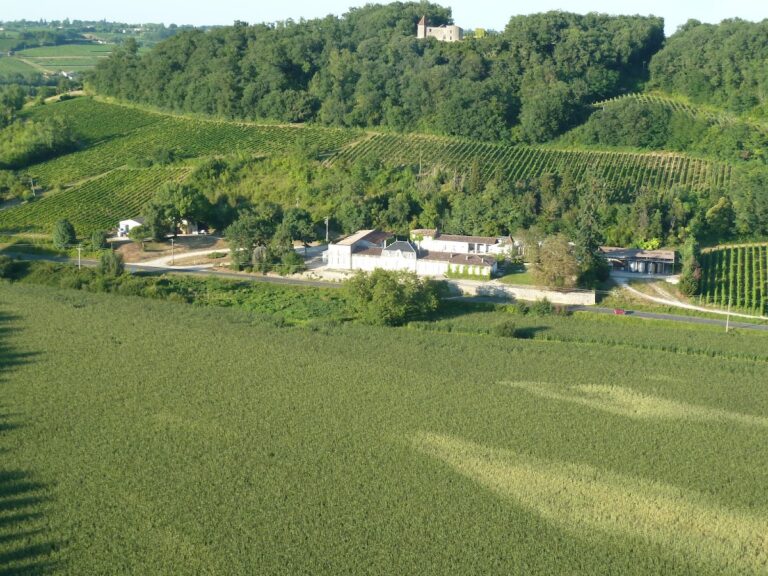
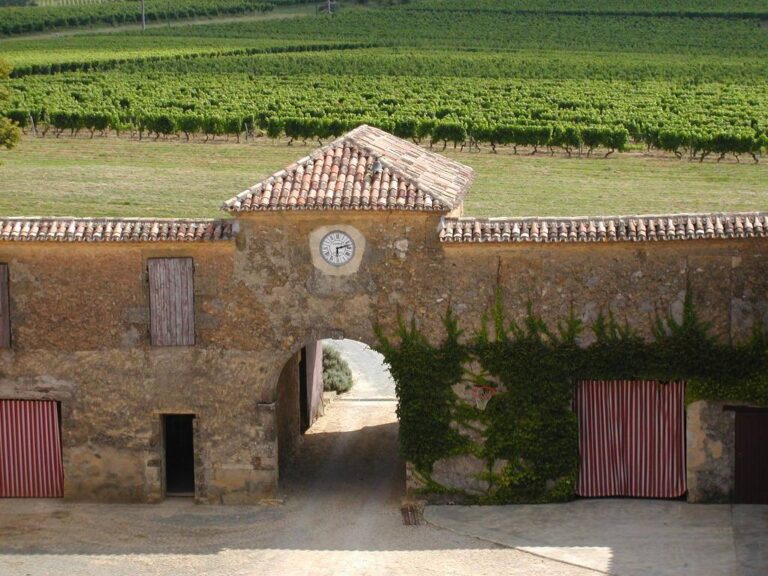
The late-eighteenth-century château stands beside the former Bordeaux to Toulouse road at the entrance to Barsac. Its elegant building forms the central architectural element of an estate that also includes cellars, vineyards, and surrounding gardens. The low-lying property lies near the Garonne and can flood during high water; flooding occurred in 1981.
Formal garden
Known historically as the “beautiful outdoors,” the garden occupies about one hectare and has an L-shaped plan divided into a large parterre, a grove, and an orchard. A parterre is a formally arranged garden bed shaped by clipped borders or ornamental planting. The large parterre has two outlines joined by substantial boxwood borders, with old roses regularly placed on ‘Graham Thomas’ standards. It was once a productive vegetable garden as well as a formal space, growing cabbages and pumpkins.
Hornbeam hedges structure the grove. Small trees beside the château were chosen to avoid competing with the building’s height, while a centuries-old sequoia was retained to preserve the impression of dense woodland. The central avenue is wider near the building than near the road, an arrangement that makes the garden appear larger when viewed from the terrace.
The remodeled orchard occupies the former orchard site opposite and parallel to the grove. Its fruit varieties were selected to evoke aromas associated with the great wines of Sauternes. They include ‘Queen of Orchards’ peaches, apricots, ‘Oullins Reine-Claude’ plums, and pears. The surviving layout reflects the geometric organization and deliberately ordered planting of a formal French garden, despite the grounds’ earlier conversion to an English garden with a circular lawn and exotic trees.
Vineyard and boundary walls
The vineyard is planted with 90 percent Semillon, 6 percent Sauvignon, and 4 percent Muscadelle. Its parcels are enclosed by dry-stone walls, built by fitting stones together without mortar. This treatment has been compared with wall construction in Tuscany. Together with the château, cellars, and gardens, these cultivated parcels form the physical setting of the Barsac wine estate.
Nearby sites