Palazzo Rosmini “al Frassem”: An Eighteenth-Century Palace in Rovereto


Site at a Glance
- Rating
- 4.5
- Popularity
- Very Low
- Country
- Italy
- Primary era
- Early Modern
- External website
- Open
- Eras represented
- Early Modern
- Civilizations
- Habsburg, Holy Roman Empire
- Site type
- Domestic
- Remains
- Elite Residence
On this page6 sections
History
Palazzo Rosmini “al Frassem” is an eighteenth-century Baroque palace in Rovereto, Italy, built between 1733 and 1737 for a branch of the prominent Rosmini family. Commissioned by Nicolò Francesco Rosmini, it was designed and constructed by Carlo and Bernardo Tacchi, architects of Lombard origin.
Construction and the Rosmini family
The palace was commissioned in 1733 as Palazzo Rosmini “al Frassem.” The name referred to an older description of the area, which lay along the route from the former San Marco Gate through the Santa Caterina district toward the river port of Borgo Sacco. The district later became known as Contrada Frassini, while the older name remained in oral use until the postwar period of the twentieth century.
In 1741 and 1742, Carlo and Bernardo Tacchi also built a Salesian convent a short distance from the palace. That convent was demolished in the early twentieth century to make way for a new post-office building. During the second half of the eighteenth century, Giuseppe Balsamo, the Italian adventurer and occultist better known as the Count of Cagliostro, probably stayed at the palace while visiting Rovereto. His identity and activities later became the subject of widespread legend.
Changes of ownership and later use
After a member of one branch of the Rosmini family married into the Balista family, the palace acquired the name Palazzo Balista, although its older name continued in use. Ownership subsequently passed from the Rosmini family to the Balista family, then to the municipality of Rovereto, and finally to the assets of the Rovereto Rural Bank, identified as the current owner.
Until its renovation, the building served as the institutional headquarters of the Rovereto Academy of Early Music. After years of closure, it reopened to the public at the end of 2022. An inscription on the palace commemorates the birth there of Giovanni Carlo Giulio Rosmini, a historian associated with Rovereto.
Remains
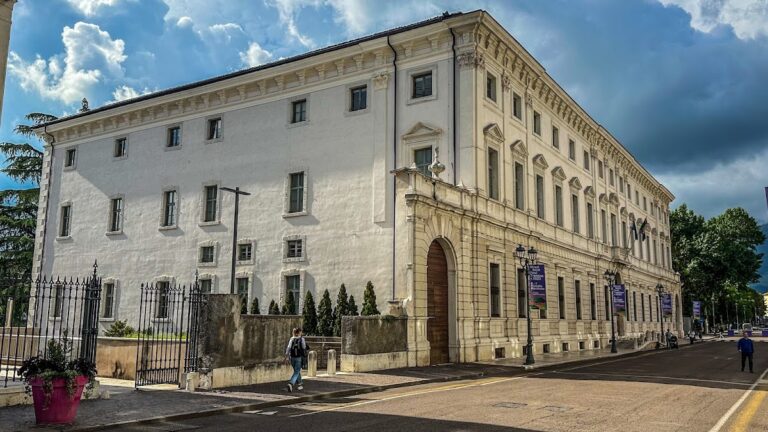
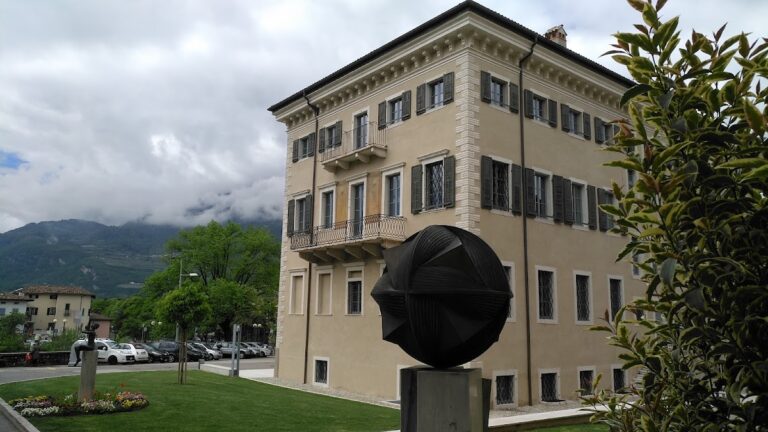
Palazzo Rosmini “al Frassem” remains an eighteenth-century building in use. Its principal façade faces Corso Rosmini, while the rear of the palace extends around an enclosed internal courtyard. The surviving arrangement combines a formally emphasized Baroque entrance with a larger residential complex organized around wings and high enclosing walls.
Principal façade
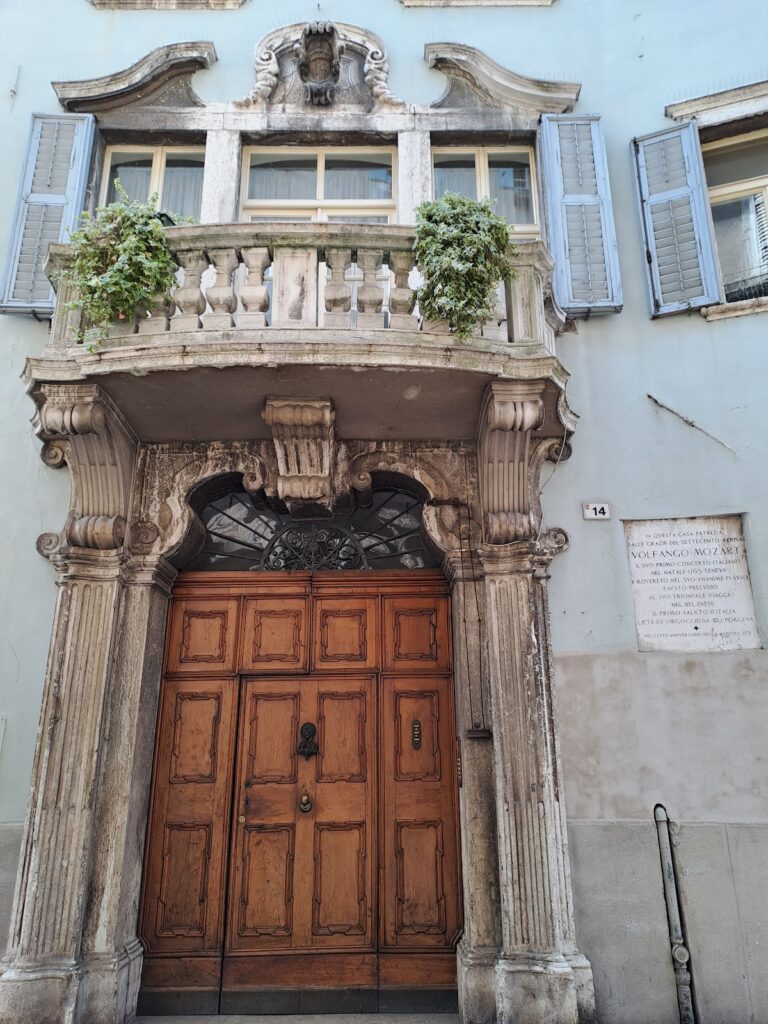
The façade on Corso Rosmini is centered on a Baroque portal, an elaborately framed entrance characteristic of a style known for dramatic forms and strong visual emphasis. The portal supports a balcony on the piano nobile, the principal and formally important upper floor above the ground level. The former civic number 100 remains positioned at the center of the arch above the doorway. A small space containing several palm trees lies in front of the building.
Rear wings and courtyard
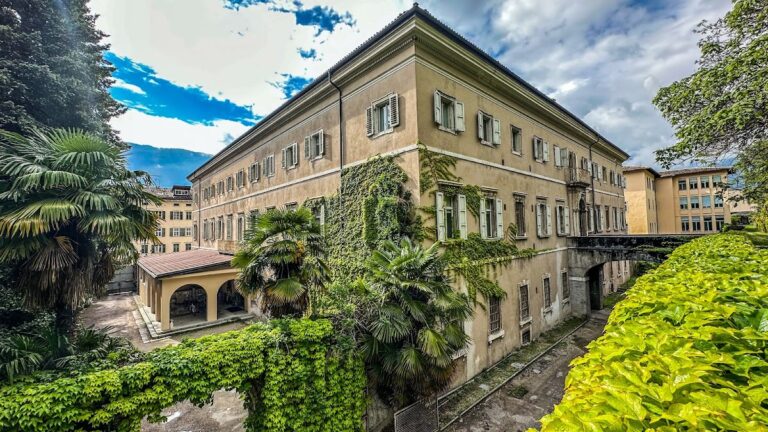
On the north-facing rear side, two large wings flank the main body of the palace and enclose an internal courtyard. High walls surround the courtyard, which is closed by a gate. This rear arrangement preserves the palace’s relationship between its central block, flanking wings, and enclosed open space.
Nearby sites