Saint Mark church: Rovereto’s Principal Catholic Church


Site at a Glance
- Rating
- 4.5
- Popularity
- Low
- Country
- Italy
- Primary era
- Early Modern
- External website
- Open
- Eras represented
- Medieval, Early Modern, Modern
- Civilizations
- Habsburg, Holy Roman Empire, Venetian
- Site type
- Religious
- Remains
- Church
On this page16 sections
History
Saint Mark church is the principal Catholic church of Rovereto, Italy, built under Venetian rule in the fifteenth century and later reshaped with Baroque and neoclassical elements. Dedicated to Saint Mark the Evangelist, the patron saint of Venice, it was created as a large place of worship within Rovereto’s city walls, replacing the older ecclesiastical center at Lizzana, which stood outside them.
Foundation under Venetian rule
Construction began in 1458, when Rovereto belonged to Venice. The main building was completed in 1461, followed by the campanile, or bell tower, in 1462. Bishop Albertino da Tridino consecrated the church in the same year. Its construction received the approval or support of Georg Hack, the prince-bishop of Trento, and Cardinal Bessarion, the papal legate responsible for Venetian territories.
Saint Mark initially remained connected to the parish church of Lizzana. In 1467, Bishop Johannes Hinderbach made it a branch church of that parish. Its position inside the walls nevertheless gave it an important role in the religious life of the growing town.
From civic church to parish center
Rovereto passed from Venetian to Habsburg rule after Venice’s defeat at Agnadello in 1509. The Habsburgs were the dynasty that governed the town thereafter. On 3 November 1510, Emperor Maximilian I granted Rovereto city rights, helping Saint Mark become the town’s principal religious center. In 1582, Bishop Giovanni Ludovico Madruzzo raised it to parish-church status and ordered an enlargement for its new responsibilities.
The Blessed Sacrament was transferred from San Tomaso to Saint Mark in 1574. A proposal made the following year to rededicate the church to Saint Thomas was never carried out, although a commemorative stone preserves the memory of the proposal.
A major rebuilding began in 1587 under the influence of the Council of Trent, the sixteenth-century Catholic reform council whose regulations affected worship and church design after the Reformation. The earlier building was not completely demolished, but incorporated into the enlarged church. The new presbytery, choir, and sacristy formed part of this transformation. The principal altar was consecrated in 1603, and the rebuilt church was consecrated that year. The principal facade was completed in 1613.
The rebuilding displaced the original cemetery, which was moved behind the city walls. It remained there until 1836, when the present San Marco cemetery was established north of the old town. Funeral slabs incorporated into the city walls continue to mark the former cemetery area.
Baroque expansion and later changes
The church was raised by approximately 2 metres in 1650, when its present barrel vault was created. The stucco decoration was added later, during the nineteenth century. The present 48-metre bell tower replaced the earlier campanile in 1658, and a new sacristy was built in 1725.
Rovereto’s prosperity from silk production helped finance the replacement of the church’s wooden altars with richly colored Baroque altars. Further works during the eighteenth and nineteenth centuries established the present ground plan. Three chapels were added along the north side between the late eighteenth and early nineteenth centuries, while a proposed group of chapels on the south side was never completed.
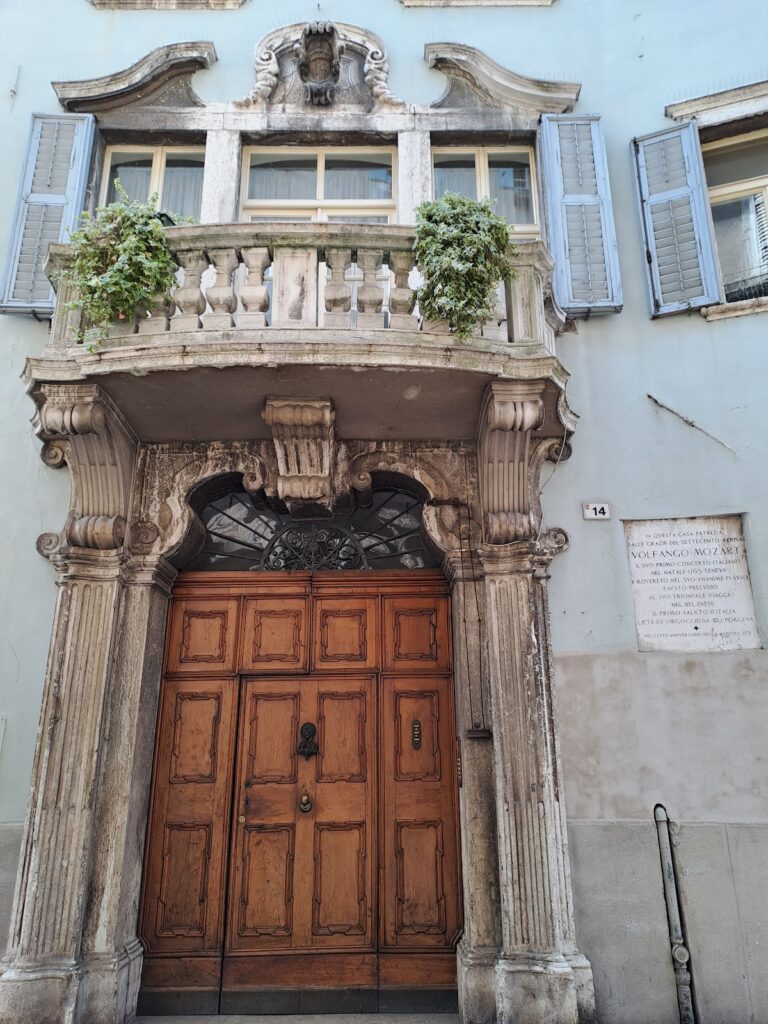
Saint Mark also became associated with important religious and cultural figures. Wolfgang Amadeus Mozart played the church’s Antegnati organ on 26 December 1769 during his first journey to Italy, giving his first Italian concert before a large public audience. Pope Pius VI celebrated Mass there in 1782 while returning from Vienna. The theologian and historian Girolamo Tartarotti was buried in the church, and Antonio Rosmini served as its archpriest from October 1834 to October 1835.
War damage, restoration, and continuing traditions
The annual procession held on 5 August originated during the War of the Spanish Succession. In August 1703, Rovereto’s inhabitants prayed to the Virgin Mary for protection as French forces advanced under General Vendôme. The procession began as an act of thanksgiving and continues annually. On that day, the mayor traditionally presents a candle to the city’s patron image of Mary Help of Christians.
Extensive restoration took place around the turn of the twentieth century. Luigi Cavenaghi decorated the vault and triumphal arch with frescoes, while Cavenaghi and Pietro Calori restored the bell tower and vault decoration between 1899 and 1902.
Italian artillery repeatedly struck and severely damaged the church during the First World War. Repairs followed in the 1920s with financial assistance from the Italian state. The facade was renewed between 1949 and 1950, following a wartime vow by Rovereto’s inhabitants to renovate it if the city escaped air attack. A further restoration campaign was carried out from 1991 to 1998.
Remains
Saint Mark church is a single-nave hall slightly more than 47 metres long, almost 17 metres wide, and slightly more than 17 metres high. The nave itself extends for over 31 metres. Its exterior reflects strong Venetian influences and is also described as neoclassical, while the interior is richly Baroque. The surviving building brings together the fifteenth-century church, the enlarged post-Tridentine structure, and later alterations.
Facade and exterior
Principal facade
The principal facade has a semicircular gable influenced by Santa Maria dei Miracoli in Venice. Three entrances are framed by two Corinthian pilasters and three portal surrounds, each topped by a form recalling the pediment of a Greek temple. Two elongated windows and a rose window complete the main design. The central portal carries a sculpture of Saint Mark by Stefano Zuech.
The tympanum contains the Lion of Saint Mark, a high relief installed in 1950 by the Rovereto sculptor Livio Fausto Sossass as a reminder of the period of Venetian rule. A broad exterior staircase, dating from the 1870s, leads from Piazza San Marco into the church. To the left of the entrance stairway stands a Carrara-marble statue of the Madonna on a column, donated by women workers from Rovereto’s tobacco factory.
Bell tower and former cemetery
The present bell tower rises 48 metres and was built in 1658 in place of the earlier campanile. The former cemetery is represented physically by funeral slabs embedded in the city walls, while traces of the earliest church were identified during the 1950 restoration.
Interior and chapels
Nave and chapels
The congregation’s area is covered by a series of cross vaults. The presbytery has a barrel vault ending in an apse, and frescoes cover the ceiling throughout. A further image of Saint Mark occupies the center of the barrel vault. Twisted columns, stucco decoration, and numerous altars give the interior its strongly Baroque character.
Three side chapels stand on the left of the entrance, creating an asymmetrical plan. They are dedicated to Saint Vigilius of Trent, Saint Jerome, and the Blessed Sacrament. Their marble altars originally stood directly in the nave and date from the late seventeenth to the late eighteenth century. On the opposite side are three multicolored marble side altars.
Altars of the side chapels
The altar of Saint Vigilius was made for Antonio Rosmini between 1835 and 1836 by Domenico Udine Nani. It was formerly dedicated to Saint Onuphrius. Its earlier altarpiece by Gasparantonio Baroni Cavalcabò is now in the sacristy. The Saint Jerome altar dates from the late seventeenth century and has an altarpiece painted in 1599 by the Veronese artist Felice Brusasorci.
The Blessed Sacrament chapel contains Tobias Pock’s 1657 painting Martyrdom of Saint Dorothy. The work was originally made for the Dorothean convent church in Vienna and reached Saint Mark after several transfers. First World War damage caused the loss of its lower-right corner.
Altars along the nave
The marble high altar in the choir was made in 1724 by the Veronese sculptor Giuseppe Antonio Schiavi. Antonio Giuseppe Sartori produced its tabernacle in 1760. The present altarpiece depicting Saint Mark was made after the First World War because the original eighteenth-century painting was destroyed during the conflict.
Beside the Blessed Sacrament chapel, below the triumphal arch, stands the altar of Saint Joseph of Nazareth. It was made in the Sartori workshop between 1738 and 1740, although its altarpiece dates from a later period. The altar of Mary Help of Christians was made between 1736 and 1741 by Teodoro Benedetti. It contains a copy of Lucas Cranach the Elder’s image of Mary Help of Christians, framed by two angels from the workshop of Dominikus Moling.
Domenico Sartori completed the Rosary altar in 1742. Together with the altar of Mary Help of Christians, it is regarded as a major example of Baroque altar construction in Trentino. Its Marian statue was carved by woodworkers from Val Gardena in the early twentieth century.
The altar of Saint Anthony of Padua dates from the 1740s and was made by an unidentified workshop from Brentonico. Gasparantonio Baroni Cavalcabò painted its altarpiece between 1740 and 1741 for Agnese Fait Wangher. Teodoro Benedetti made the altar of Saint Bernardino of Siena in 1750, while its altarpiece came from an unidentified eighteenth-century Veronese school.
Organ, memorials, and frescoes
Organ loft and instruments
The cantoria, an elevated choir or organ loft, stands above the entrance opposite the choir. It rests on two columns that incorporate holy-water basins and form a vestibule. The loft dates from the mid-eighteenth century. The organ was moved there from the choir, allowing choir stalls to occupy its earlier position.
An organ was being planned by 1509 and was built around 1518. One instrument was moved to the presbytery in 1625, and a later organ completed by Graziadio Antegnati of Brescia was transferred to the loft in 1752. The present organ was built in 1975 by the Veronese organ builder Bartolomeo Formentelli and replaced the older instrument by 1976. It has fully mechanical action, four 56-note keyboards, and a 30-note pedalboard. Its condition is poor, and its largest pipes have collapsed.
Memorials and artistic works
A memorial plaque beside the main entrance commemorates Girolamo Tartarotti, who was buried in the church. A portrait of Pope Pius VI is placed on the opposite side. Beneath the cantoria, beside the side chapels, stands a bust of Antonio Rosmini by Francesco Confalonieri. Across the nave is a 1936 bust of Bernardina Floriani, also known as Giovanna Maria della Croce, by Fausto Melotti.
The triumphal arch contains a scene of Rovereto’s inhabitants praying for protection in August 1703 and, on the opposite side, a depiction of the thanksgiving procession. The church also contains the Pala di San Marco by Vittorio Emanuele Bressanin and a statue of Saint Rose of Lima, alongside the altars dedicated to Mary Help of Christians, the Rosary, Saint Vigilius, the Blessed Sacrament, and Saint Jerome.