Château de Carles: A Medieval Château and Vineyard Estate in France

Site at a Glance
- Rating
- 4.5
- Popularity
- Very Low
- Country
- France
- Primary era
- Medieval
- External website
- Open
- Eras represented
- Medieval
- Civilizations
- Duchy of Aquitaine, English
- Site type
- Domestic
- Remains
- Castle
On this page12 sections
History
Château de Carles is a privately owned château in Saillans, France, whose present construction began in the early fourteenth century during the Hundred Years’ War, the prolonged conflict between the English and French crowns from approximately 1337 to 1453. The Carles family probably built it, and the residence later became associated with military events, prominent Bordeaux families, literary figures, and a vineyard estate. Restoration began again in the nineteenth century after the property had suffered major losses during the French Revolution.
Medieval origins and the Hundred Years’ War
The Carles family certainly owned the château by the end of the fifteenth century. They were prominent in Bordeaux. Vital Carles, a canon and cantor of Bordeaux Cathedral, founded Saint-André Hospital. Jean de Carles and François de Carles served as jurats, municipal magistrates of Bordeaux, while Lancelot de Carles became Bishop of Riez in 1560. Lancelot died in 1568 and had also served as chaplain and confessor to Charles IX.
Carles became involved in the military struggle around Bordeaux in 1451. After capturing Blaye, the French commander Jean de Dunois passed through Carles before attacking the English-held fortress of Fronsac. The English captain Strangeway surrendered after heavy fighting, exposing Bordeaux, which capitulated several weeks later. English forces under John Talbot subsequently retook Fronsac. The fortress was defended by 600 lances commanded by Captain Rouault, who found refuge at Carles.
Literary and aristocratic connections
During the sixteenth century, the château’s military role gradually declined as its intellectual and literary associations became more prominent. Family marriages connected Carles with Michel de Montaigne, the French essayist, and Étienne de La Boétie, the writer and political thinker. Two Carles sisters married La Boétie and Thomas Eyquem, Montaigne’s brother. Marguerite de Carles, La Boétie’s widow, inherited the château in 1567.
At the end of the seventeenth century, Carles passed to the d’Ayde family. During the eighteenth century it came to the Count of Saujon, and in the middle of that century it was inherited by his granddaughter, Marie-Charlotte Hippolyte de Campet de Saujon (1724–1800), later the Countess of Boufflers.
The Countess served as lady-in-waiting to the Duchess of Orléans and became a leading figure in the intellectual society that gathered at the Temple, a Parisian religious and aristocratic complex whose grand prior was the Prince of Conti. Known as the “Idol of the Temple,” she corresponded with Jean-Jacques Rousseau, David Hume, and Gustav III of Sweden. She also received or protected Mozart, Denis Diderot, Beaumarchais, and the Abbé Prévost.
Revolutionary destruction and restoration
The Countess of Boufflers was the last lord of Carles. During the French Revolution, the estate was sold as national property, meaning land confiscated and sold by the revolutionary French state, to Corneille Macy, a former prosecutor of the Parliament of Bordeaux. The ancillary buildings were demolished, and most of the remaining property was converted to vineyards. Only the oldest part of the château was retained.
At the end of the nineteenth century, Guillaume Chastenet de Castaing bought what remained of the divided estate, chiefly for its vineyards. By then the château had been reduced to the status of a barn. He began restoring its interior, arranged the southern terrace, and planted the cypresses that became a principal feature of the grounds.
Between the two world wars, the academician Jacques Chastenet continued the restoration. His son Antoine, followed by Antoine’s son-in-law Stéphane Droulers, concentrated mainly on improving the vineyard and wine production. Château de Carles has been listed as a historic monument in France since 18 December 1991.
Remains
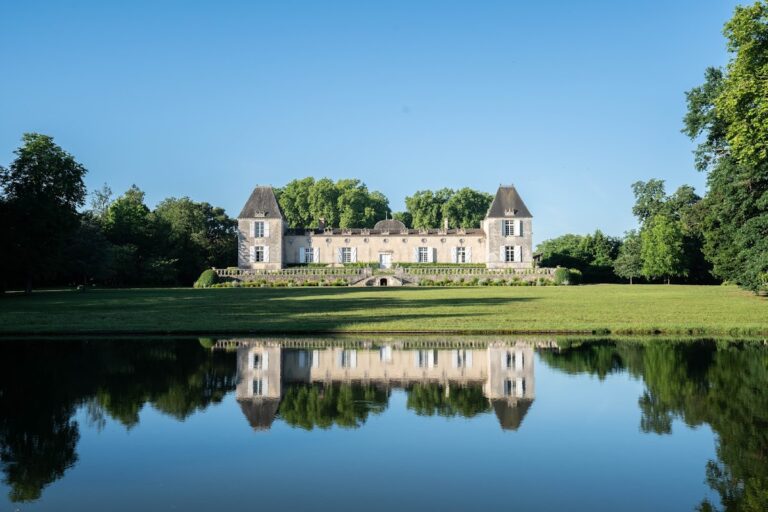
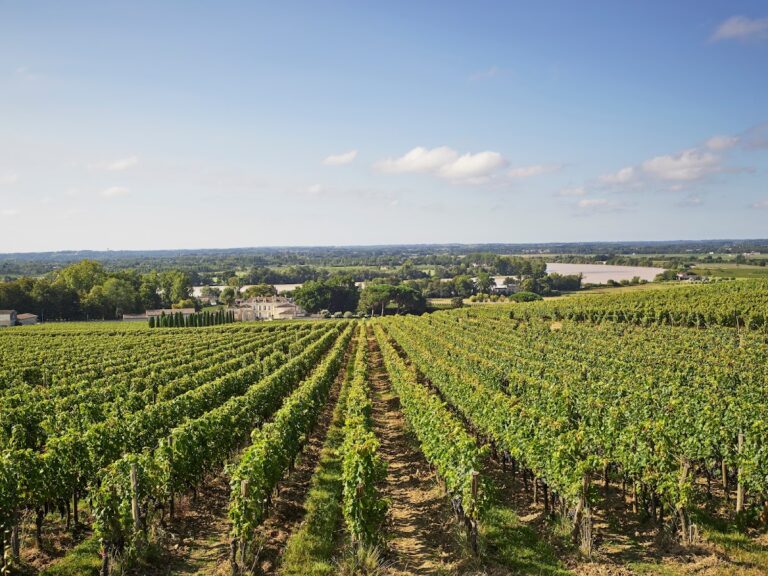
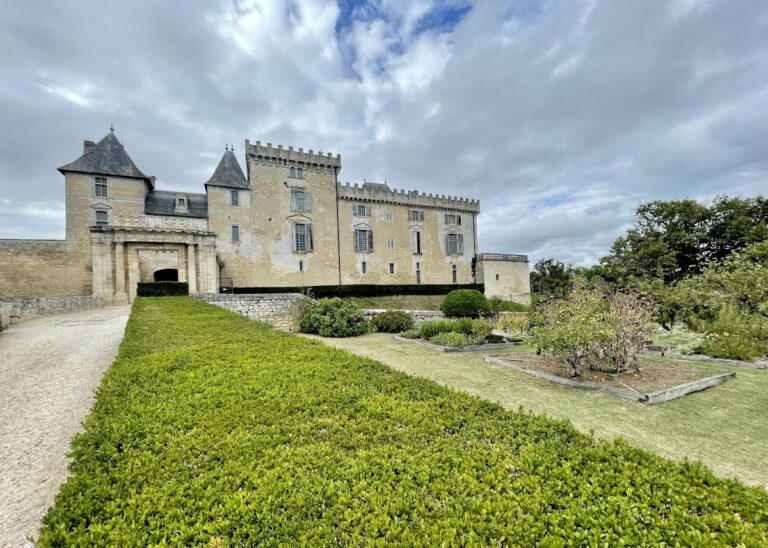
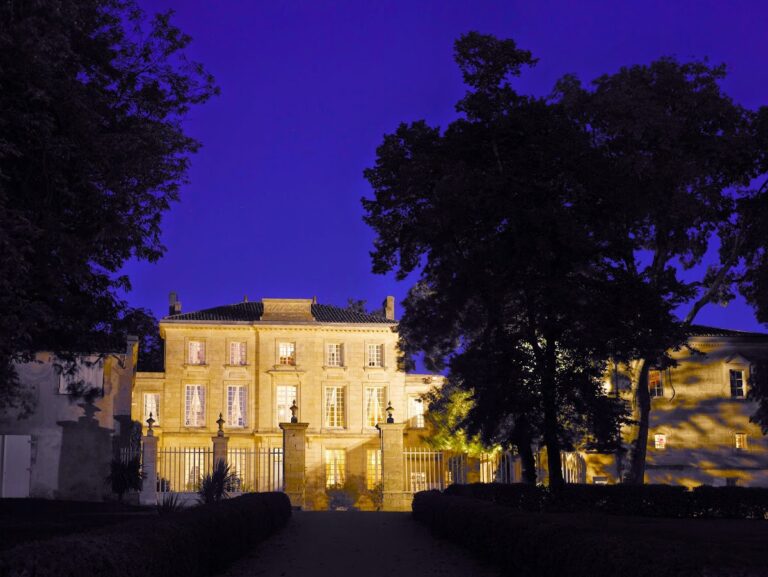
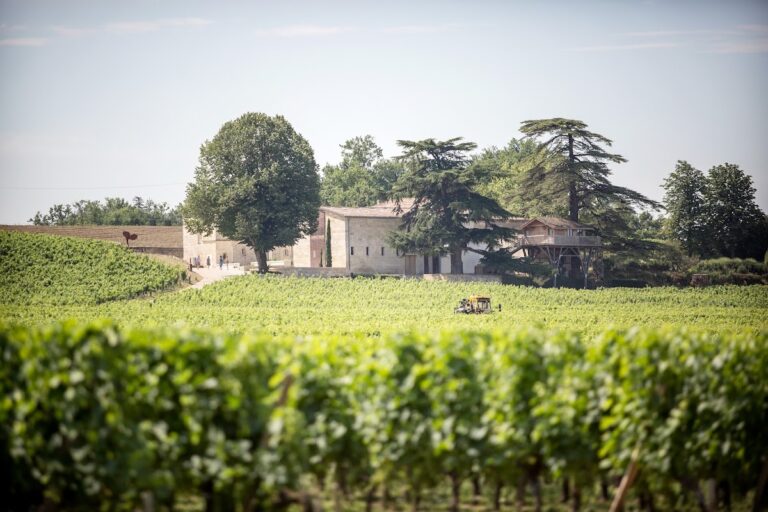
The surviving château combines defensive structures from its early construction phase with a later sculpted façade and restored interiors. Its grounds remain associated with vineyards, which became central to the estate after the revolutionary demolition of the ancillary buildings and the later reorganization of the property.
Fortified structures and façades
Southern tower
The oldest surviving part is the square southern tower. Two square towers originally stood at the château, but only this one survives. It is crowned by machicolations, projecting defensive structures with openings through which defenders could observe or attack enemies below. These support a defensive walkway along the top of the wall.
North façade
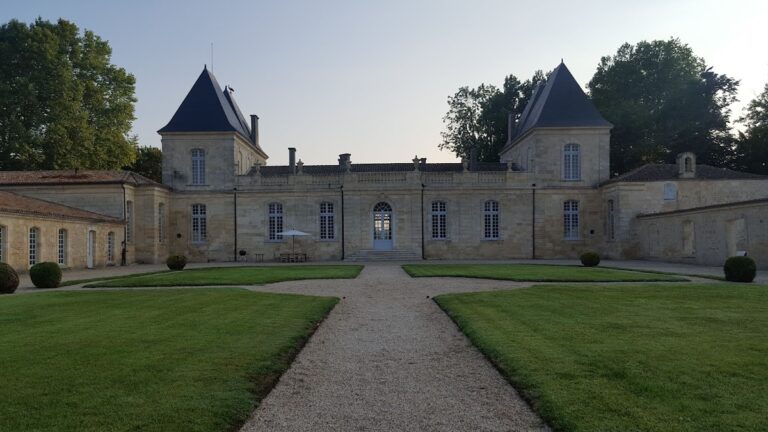
The north façade has two large round towers pierced by loopholes, narrow openings used by defenders. These towers belong to the château’s early defensive phase. The sculpted north façade was added nearly a century later, giving the surviving building a later architectural layer alongside its medieval fortifications.
Interiors and southern grounds
Restored interior rooms
Guillaume Chastenet de Castaing decorated two interior rooms with faience, a form of decorated glazed earthenware. The tiles were salvaged from houses being demolished in Tunisia and Morocco and incorporated into the nineteenth-century restoration of the château.
Terrace and cypresses
Chastenet de Castaing also created the southern terrace. From it, the view extends toward Fronsac and, beyond the Isle River, toward Pomerol, Saint-Émilion, and Libourne. Cypresses planted on the terrace form the principal ornamental feature of the landscape and give the grounds a somewhat Tuscan character.
Former courtyard buildings
In the eighteenth century, the north façade opened onto a large courtyard surrounded by numerous ancillary buildings. These included service buildings, a chapel, an orangery, a dovecote, and an icehouse. The structures were demolished during the French Revolution, leaving the retained medieval part of the château and the grounds that were later reorganized around vineyard production.
Nearby sites