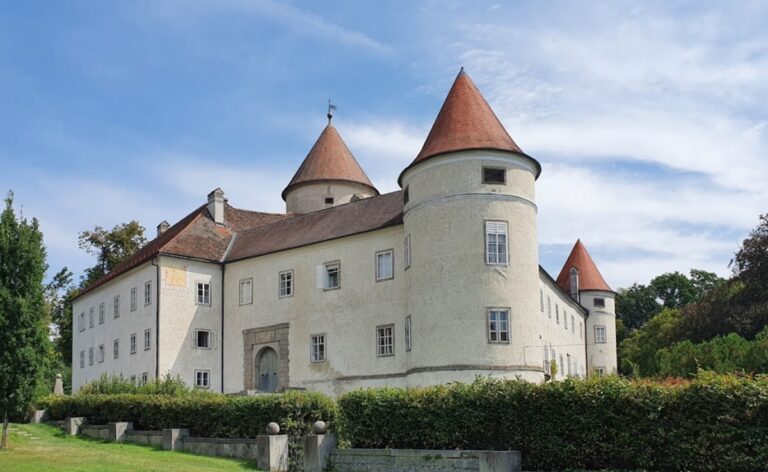
Schloss Erla St. Pantaleon: Former Benedictine Nunnery in Austria


Site at a Glance
- Rating
- 4.6
- Popularity
- Very Low
- Country
- Austria
- Primary era
- Medieval
- Eras represented
- Medieval, Early Modern
- Civilizations
- Holy Roman Empire
- Site type
- Domestic
- Remains
- Manor House
On this page9 sections
History
Schloss Erla St. Pantaleon is a historic castle complex in Austria that developed from the former Erla Benedictine nunnery, traditionally founded around 1050 during the episcopate of Bishop Egilbert. It is described as the oldest women’s monastery in Lower Austria. Another proposed foundation date is 1130, linked to Otto II von Machland, while the earlier tradition identifies Otto von Machland as founder. His sister Gisela became the community’s first prioress.
The Lords of Erla and the monastery’s foundation
The Lords of Erla appear in written records from the eleventh century. Hedinrich de Herlaha is mentioned several times between 1090 and 1104, and Wolfkerus de Herlaha was recorded as a witness in 1120 or 1130. The family later declined from noble rank to ministerial status, a position held by medieval officials who served a lord in administrative or military roles, partly through unequal marriages.
Wolfger of Erla, also called Wolfger of Passau, was the most prominent later member of the lineage. His full name was Wolfger of Ellenbrechtskirchen. He served as Bishop of Passau from 1191 to 1204 and as Patriarch of Aquileia, a major historic ecclesiastical center in northeastern Italy, from 1204 until his death in 1218. His brother Sighard, an archpriest of St. Pölten, and Wolfger were the last members of the family.
Medieval prosperity and privileges
The monastery initially occupied the ancestral castle of the Lords of Erla. Before the Danube was regulated, the community stood directly above the river and benefited from the movement of goods along the waterway. Timber and livestock were among the products handled there. In 1196, the monastery received a toll privilege, exempting its own goods transported on the Danube from toll payments.
Erla also held an important judicial privilege. Duke Frederick II confirmed it on 26 November 1239, and King Ottokar II Přemysl confirmed it again on 20 November 1262. The privilege made the monastic judge independent of the provincial judge. The provincial judge retained authority over capital offences, since ecclesiastical officials could not exercise the high court. The monastery’s properties extended across four provincial judicial districts, including areas between the Traun and Enns, on both sides of the Enns and Danube, and south toward Amstetten.
The institution prospered for about two centuries. A new church was built in the fifteenth century. At the beginning of Abbess Elisabeth von Eitzing’s tenure in 1437, an Urbar, or estate register listing dependent properties, rents, and obligations, recorded at least 160 peasant holdings and five mills belonging to the monastery. Elisabeth expanded these possessions through purchases as well as substantial donations.
Dissolution and transformation into a Schloss
Acquisitive bailiffs, secular guardians or administrators of ecclesiastical property, placed pressure on the convent, while warfare caused further difficulties. The monastery accumulated heavy debts during the Ottoman wars, particularly in 1529. Pope Gregory XIII dissolved the Benedictine nunnery in 1583.
After the dissolution, Emperor Rudolf II assigned the monastery buildings and their estate to the Queen’s Monastery in Vienna. That convent continued until the beginning of 1782. Following its dissolution, the former monastery church became the parish church, while the Erla estate was administered for fifty years by the state-estates administration on behalf of the Religious Fund, a state-managed fund for assets formerly belonging to religious institutions.
Baron Heinrich von Pereira-Arnstein acquired the Schloss and its associated properties in 1832, and the estate remained with his family for 75 years. Hermann von Goldschmidt purchased the former monastery buildings in 1907, by which time they had long been converted into a Schloss. The purchase included the Danube floodplain, several houses, and agricultural land.
Until 1939, Goldschmidt maintained a large manorial household supported by agricultural and forestry enterprises that employed many local residents. After the Second World War, his family returned to Erla from emigration. In 1970, most of the Danube floodplain was sold, while the owners retained the park, the Schloss buildings, and smaller green areas. Schloss Erla is protected as a monument, as is the former monastery church, which remains the parish church of Erla.
Remains
The complex stands on a hill above the village of Erla, about 1.3 kilometres south of St. Pantaleon. Before the Danube regulation carried out between 1823 and 1835, the site stood directly above the river. The Enns-Danube region and the Machland on the opposite bank form a natural geographical unit that belonged in the Middle Ages to the territory of the Lords of Perg and Machland.
Courtyards and principal buildings
Cloister courtyard
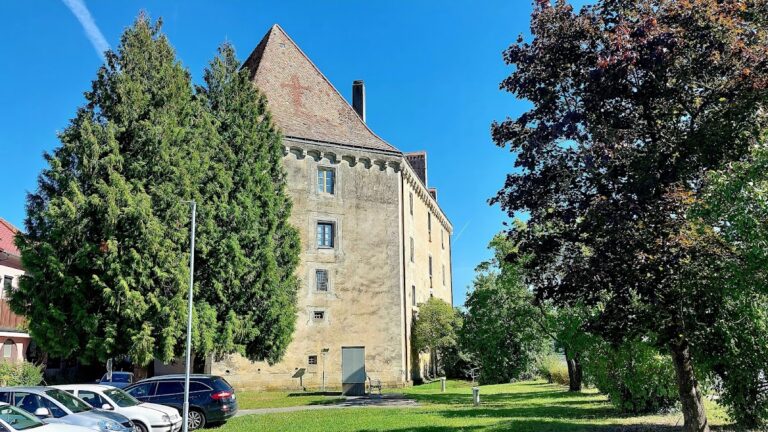
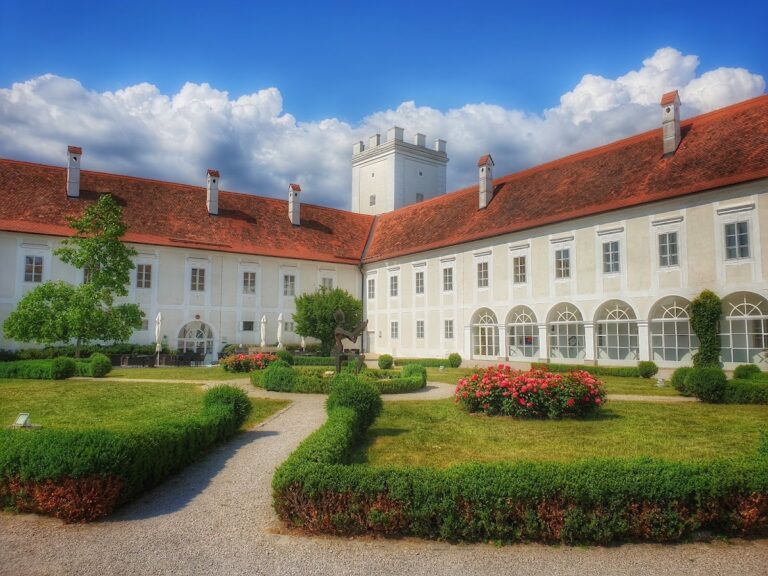
The former Benedictine nunnery is arranged around two courtyards. The oldest surviving parts date from the period of Abbess Agatha von Tannberg, from the later fifteenth century to 1516. They are grouped around the cloister courtyard west of the church, preserving the core arrangement of the former religious complex.
Fountain Courtyard
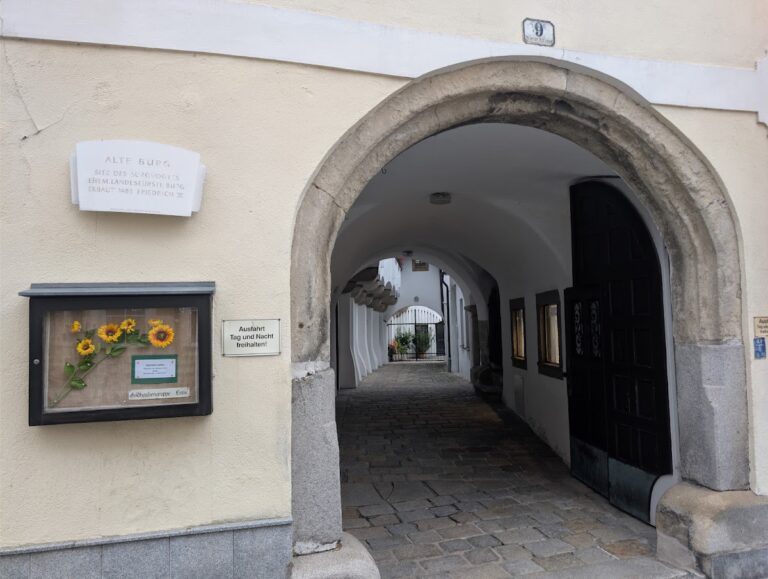
The second courtyard is known as the Fountain Courtyard. Separate barrel-vaulted entrances provide access from the northwest and northeast, giving this part of the complex its own defined approach within the larger arrangement of buildings.
Church and agricultural buildings
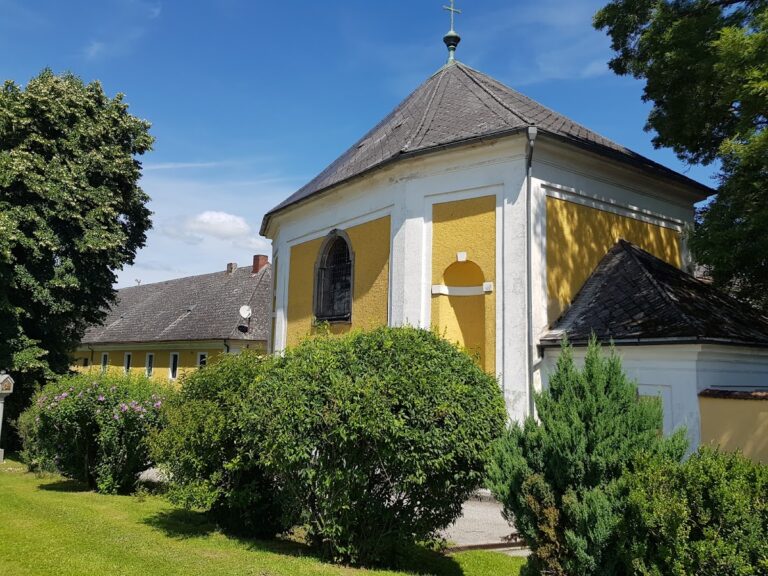
The former monastery church, now Erla parish church, forms part of the Schloss ensemble. The church stands with the two-courtyard nunnery, a large granary, and the stable building opposite it as an architectural group. The granary is a Schüttkasten, a substantial storage building especially intended for grain. Together, these structures express the former monastery’s religious and estate functions while remaining incorporated into the later Schloss complex.