Palazzo Del Bene: A Historic Residence and Civic Landmark in Rovereto, Italy


Site at a Glance
- Rating
- 4.7
- Popularity
- Very Low
- Country
- Italy
- Primary era
- Medieval
- External website
- Open
- Eras represented
- Medieval, Modern
- Civilizations
- Habsburg
- Site type
- Domestic
- Remains
- Elite Residence
On this page6 sections
History
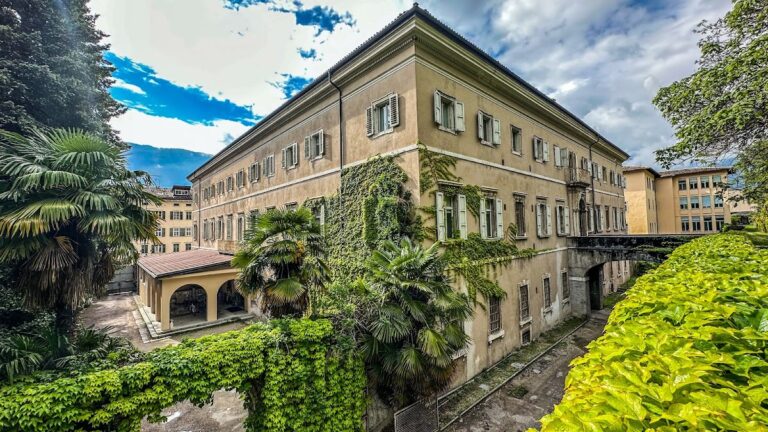
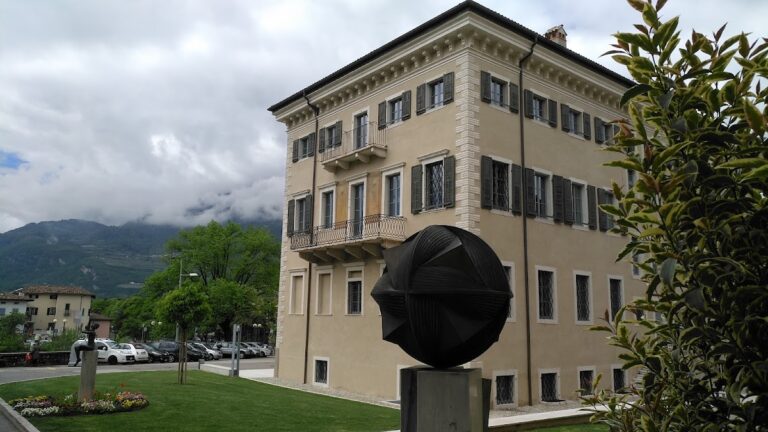
Palazzo Del Bene is a fifteenth-century residence in Rovereto, Italy, built outside the city walls for the Del Bene family. Also known as Palazzo Del Ben–Conti d’Arco, it later became associated with the Counts d’Arco and underwent important changes in ownership, use, and appearance.
From family residence to rental property
The Counts d’Arco acquired the palazzo after its construction and renovated and enlarged it. During the seventeenth century, the nuns of San Carlo Borromeo, an institution dedicated to the Italian cardinal and Catholic reformer, obtained the building and converted it into a residence for rental.
The Municipality of Rovereto later acquired Palazzo Del Bene. Between 1877 and 1904, it housed the city’s central post office, a function reflected in the former inscription on its principal façade, “IMP. REG. POSTA E TELEGRAFO.”
Bank headquarters and twentieth-century transformation
In 1904, ownership passed to the Cassa di Risparmio di Trento e Rovereto, and the building became the headquarters of the Trentino credit institution. A major restoration followed in 1906 under the architect Augusto Sezanne, who had previously worked on Rovereto’s municipal palace.
The project substantially changed the palazzo’s appearance and was interpreted at the time as a political expression of Rovereto’s affiliation with Italian culture. The later architect Mario Sandonà described the intervention as an “artistic disaster,” arguing that it removed an important testimony of local history. Palazzo Del Bene is now used as a bank and houses the Accademia Roveretana degli Agiati, a scholarly and cultural academy based in Rovereto.
The square in front of the building also carried a civic memorial. From 1879 to 1886, it held a monument to the philosopher and religious thinker Antonio Rosmini, who was born in Rovereto. The monument was later replaced by the Rosmini Fountain and moved to the garden opposite Rosmini’s birthplace, across Corso Rosmini.
Remains
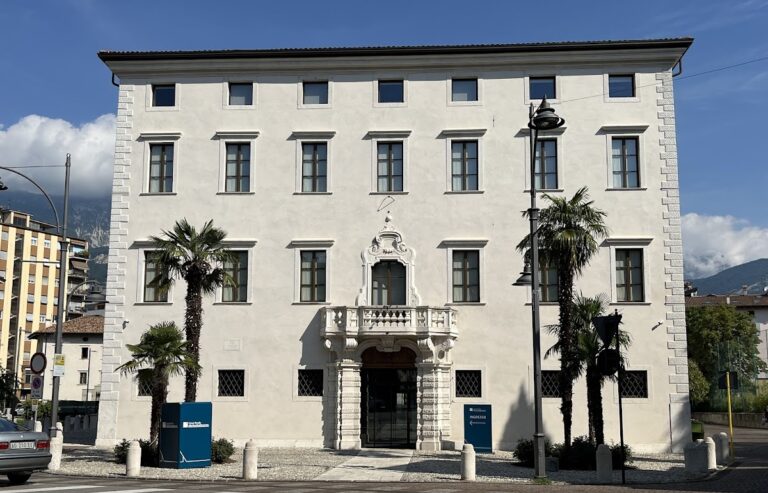
Palazzo Del Bene stands in Piazza Rosmini, and its present form reflects the richly decorated Venetian Renaissance style associated with Venice and its surrounding region. Painted exterior decoration represents the seasons and incorporates floral motifs. The building’s appearance is largely the result of the 1906 rebuilding and restoration, while individual surviving elements preserve links with its earlier history.
Earlier façade and changing surroundings
Before the early twentieth-century intervention, the principal façade had a central entrance portal and four barred ground-floor windows, arranged as two on each side. The façade also carried the post-office and telegraph inscription. Its southern side did not yet have the later column-supported portico. Walls enclosed both ends of the façade: the northern end did not open onto Viale dei Colli, while the opposite end lacked the later small square. A gate instead provided access to the private grounds of the former d’Arco residence.
Restored interiors and surviving artwork
A monumental ceremonial staircase leads to the upper floors. The staircase and the interior rooms contain elaborate coffered ceilings, which are formed from recessed decorative panels arranged in regular geometric patterns.
A Madonna and Child by Francesco Verla, an Italian Renaissance artist associated with devotional painting and sculpture, survived the near-complete rebuilding of the façades. It remains visible on the side of the façade facing the building’s small square, at the beginning of Via Orefici.
Nearby sites