Palazzo Oddo: Historic College, Library, and Roman Glass Museum in Albenga


Site at a Glance
- Rating
- 4.4
- Popularity
- Very Low
- Country
- Italy
- Primary era
- Modern
- External website
- Open
- Eras represented
- Medieval, Early Modern, Modern
- Civilizations
- Genoese, Kingdom of Sardinia
- Site type
- Civic
On this page13 sections
History
Palazzo Oddo is a historic palace and medieval tower in Albenga, Italy, whose institutional history began with the Collegio Oddi in 1623. The college was founded through the bequest of Gio Maria Oddi, a doctor of civil and canon law, to help local people attend university without leaving the city.
Foundation of the Collegio Oddi
In a notarized act received by Giovan Battista Costa on 27 December 1623, Oddi left his house and part of his property to establish a college and upper school. The institution initially provided free places for twelve local students who lacked the means to study. Before his death, Oddi had bought the adjoining house and joined it to his own, creating the first nucleus of the complex.
In 1628, the municipality of Albenga expanded the project, opening instruction to more local residents and to students from outside the city. As attendance increased, two further neighboring houses were rented. Oddi’s testament also required the construction of a church dedicated to Saint Charles Borromeo on the small square opposite the college. An arch connected the church with the educational complex.
The college gradually acquired the houses it had rented and eventually purchased the Lamberti family’s palace and tower. In this way, the institution came to occupy the entire urban block.
Religious and Royal Administration
In 1629, responsibility for directing the college passed to the Somascan Fathers, members of a Catholic order associated with educating and caring for young people. They lost their license, including permission to officiate in the church of Saint Charles Borromeo, and were expelled from Albenga in 1664. Secular clergy then directed the college until 1772, when the municipality placed it under the Piarists, a Catholic teaching order.
In 1797, the college came under the House of Savoy, the dynasty that ruled the Kingdom of Sardinia and later the Kingdom of Italy. It consequently became a Royal College and later a Royal Gymnasium. After Italian unification, the complex housed elementary schools as well as the Royal Gymnasium. A kindergarten was added in 1952, and a technical school also operated there during the twentieth century.
The director was a priest proposed by the municipal administration and appointed directly by the Ministry of Public Education. The college retained its schools and boarding facilities until 1940, when the schools moved to a new complex on Via Dante Alighieri financed by the bequest of Tomaso Paccini. The boarding school remained active until 1955. Some rooms were later used occasionally for library purposes or as classrooms.
Unification, Restoration, and Cultural Reuse
In 1842, an architect was commissioned to unify the college’s separate structures internally and externally. The work created a continuous principal facade and connected the previously independent buildings. The municipality bought the complex in 1979 to restore it to active use. Restoration was completed in 2006, and in 2009 the publicly owned company Palazzo Oddo s.r.l. became the Gian Maria Oddi Foundation.
The civic library was already located on the main floor of the former Collegio Oddi by 1934, when its use was recorded by the signature of Podestà Luigi Costa. It moved to Via Enrico d’Aste in the 1960s and returned to Palazzo Oddo after the renovation was completed in 2009. The Simonetta Comanedi Civic Library received its name in 2002. Simonetta Comanedi was a biologist who died at the age of twenty-five, and her father donated part of his fortune to support schools and libraries.
In March 2009, the library received the bequest of Don Antonio Balletto, a priest, professor, publisher, and politician associated especially with Genoa and Albenga. His collection includes philosophical and religious works together with artistic, literary, sociological, and historical publications, including many first editions.
The exhibition Magiche Trasparenze grew from Roman-period glass discovered in tombs at the Monte necropolis and at Pontelungo. The finds included thirteen tombs dating from the first to the third century and a tomb discovered on Viale Pontelungo in 1998 that contained the Blue Plate. Further glass came from excavations inside Albenga’s walls in 1955–56 and outside them in 1970–71. Conducted by Nino Lamboglia, the excavations contributed to the study of the layers of ancient Albingaunum, the Roman settlement at Albenga.
The exhibition’s roughly 200 worked-glass objects date from the first to the third century. Finds from the Middle East and ancient Egypt have been interpreted as evidence of Albenga’s commercial importance during the Roman period. Curated by Bruno Massabò, the exhibition was later presented in Rome, Rovigo, Genoa, Aquileia, and Vicenza. The Blue Plate was displayed in Vetri a Roma at the Curia Julia in the Roman Forum until 16 September 2012, before returning to Palazzo Oddo.
Remains
The complex occupies an entire block in Albenga’s historic center and has its principal entrance on Via Roma. Its buildings stand at several levels, reflecting the gradual joining of separate houses and the later reorganization of the former college. The surviving medieval tower, the continuous nineteenth-century facade, the former church, and the interior floors now form a connected cultural complex.
Facade and Medieval Tower
Principal Facade
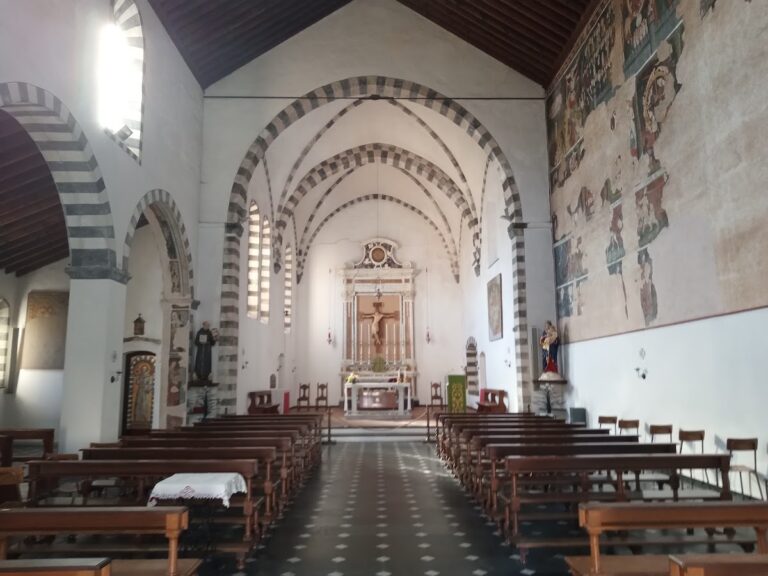
The 1842 works made the principal facade continuous across the formerly independent buildings. Its lower section was given a more monumental appearance with rough, strongly projecting rustication, while the windows were brought into alignment. The former church of Saint Charles Borromeo, once connected to the college by an arch, was later deconsecrated and converted into an auditorium.
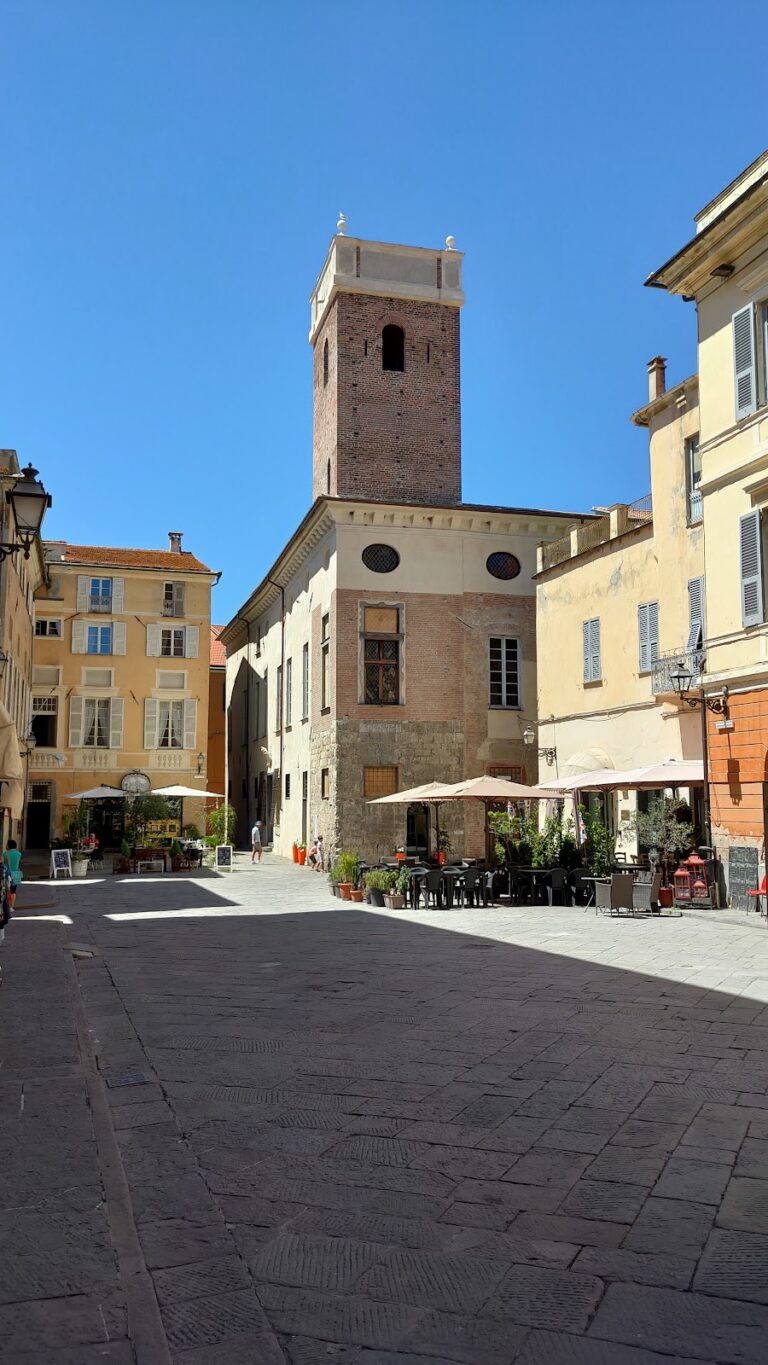
Medieval Tower
The medieval tower survives intact, including its summit and Ghibelline battlements. Unlike the other towers referred to in the complex’s description, it is painted up to the top. Its lower section was incorporated into the nineteenth-century refurbishment of the facade.
Interior Organization
The connected buildings contain ramps and short flights of steps because their floors lie at different levels. The former college was arranged over three principal floors. Classrooms occupied the ground floor; study rooms, boarding facilities, the refectory, and the kitchen were on the first floor; and the second floor contained dormitories for students from outside Albenga.
After the attic was recovered, the complex was organized over five floors. The first floor contains the museum of Roman funerary furnishings, including Magiche Trasparenze, its educational laboratory, and the display of the Blue Plate. The second floor houses the Simonetta Comanedi Civic Library and part of the Don Antonio Balletto collection. Temporary exhibition spaces and a fifteen-seat meeting room occupy the third floor, while the Gian Maria Oddi Foundation has its headquarters in the complex. The top floor contains offices and the music room known as the Musikalische Wunderkammer, with facilities for singing and theater instruction.
Library Collections
The library holds 36,837 volumes, while 21,293 volumes belong to the Don Balletto collection. Its historic collection contains approximately 4,500 volumes dating from the Middle Ages to 1830 and is kept in a climate-controlled room. The library also preserves 500 cartographic documents.
Roman Glass Collections
Funerary Glass Vessels
Magiche Trasparenze arranges the Roman glass according to the original functions of the objects, from cooking to cosmetics, and includes two complete funerary assemblages. Among the vessels are two monochrome translucent or opaque cups in green and turquoise, classified as Isings forms 1 and 20. The Isings system classifies Roman glass vessels by shape. The display also includes Isings 22 cup-pyxis vessels in dark-green opaque glass and emerald-green translucent glass, together with two balsamaria, small vessels used for perfumes or cosmetics. Their neck and shoulder sections survive in peacock-blue translucent glass with fine incisions at the base of the neck.
The Blue Plate
The Blue Plate is made of cobalt-blue glass and shows two dancing putti honoring Bacchus, the Roman god of wine. One winged figure holds a six-pipe syrinx, or panpipe, and a shepherd’s staff. The other carries a bag and a wineskin on his shoulder and holds a thyrsus, a staff associated with the cult of Bacchus.
The plate was cast, then ground and polished, and finally finished by hand. Its figures seem to be in high relief, although the effect is created through contrasts of light and shade. The glass conveys both movement and translucency, and the workmanship has been associated with the school of Alexandria in Egypt.
The plate was found in a tomb containing the ashes of the deceased and of the funeral pyre. Radiocarbon analysis dates the ashes to the beginning of the second century. The Blue Plate is displayed in Magiche Trasparenze at the museum inside Palazzo Oddo.
Nearby sites