Schloss Burgscheidungen: A Baroque Palace in Germany


Site at a Glance
- Rating
- 3.5
- Popularity
- Very Low
- Country
- Germany
- Primary era
- Early Modern
- Eras represented
- Medieval, Early Modern
- Civilizations
- Carolingian, Holy Roman Empire
- Site type
- Domestic
- Remains
- Elite Residence
On this page10 sections
History
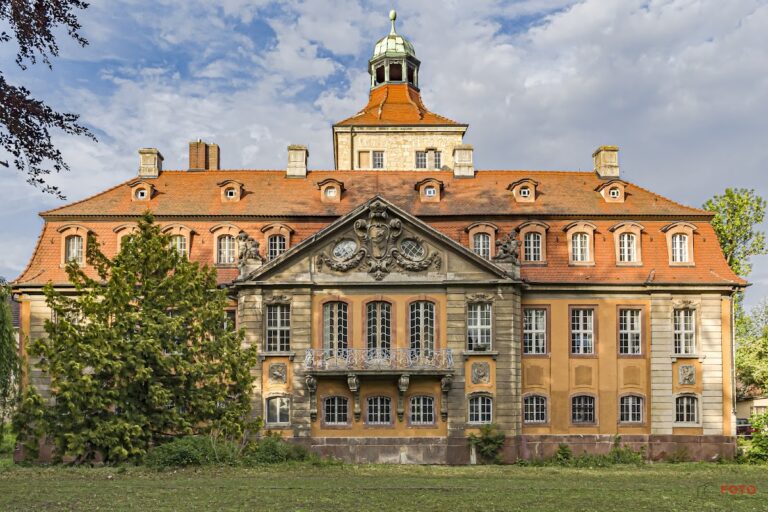
Schloss Burgscheidungen is a Baroque palace in Germany, located in the village of Burgscheidungen near Laucha an der Unstrut in Saxony-Anhalt. It stands on a hill above the Unstrut River and developed from a castle probably founded in the eighth century. Earlier settlement on the hill reaches back to the Neolithic period, while the palace’s present architectural character was created during the Baroque period between 1724 and 1732.
Early settlement and the Scithingi tradition
Burgscheidungen has long been associated with Scithingi, a place mentioned by the tenth-century Saxon historian Widukind of Corvey in his Deeds of the Saxons. Widukind described a castle above the Unstrut where the Thuringians under King Herminafried were decisively defeated by the Franks in AD 531. The account does not identify the precise location of the battle. The connection between Scithingi and Burgscheidungen is therefore a later historical tradition rather than an established identification of the battlefield.
Excavations carried out on the castle hill by the State Museum of Prehistory in Halle between 1960 and 1962 found archaeological evidence that does not support placing a Merovingian royal court at Burgscheidungen. The surrounding archaeological setting likewise offers no confirmation for interpreting the site as a sixth-century Thuringian royal center. The excavations instead brought attention to an early medieval phase associated with the castle’s development.
The medieval castle and its feudal lords
A tithe register compiled between 881 and 899 names the settlement as Scidinge in the Friesenfeld. The same name was adopted by the Scidingeburg, the predecessor of the high- and late-medieval castle and of the present palace. Parts of the surviving Renaissance building fabric belong to the period when the von Scheidingen family held its ancestral seat there.
In 1043, Emperor Henry III gave the estate of Scheidingen to his wife, Agnes of Poitou, as a dower gift. Agnes transferred the castle to the Bishopric of Bamberg in 1069. A bishopric is a church territory governed by a bishop. Bamberg remained the castle’s feudal overlord until 1803, while different noble families held Burgscheidungen as enfeoffed owners or administrators.
From 1128 to 1667, the von Scheidingen family occupied the castle as a hereditary seat. Their status as ministerials reflected the medieval system in which dependent administrative and military servants of rulers or church lords could hold hereditary noble positions. The family’s long association with Burgscheidungen shaped the medieval and Renaissance phases of the site.
The von Hoyms and Anna Constantia von Brockdorff
The von Hoym family first received a claim to Burgscheidungen in 1598, and it was confirmed in 1612 and 1625. After the von Wiehe family died out, the von Hoyms were jointly enfeoffed in 1629 with the von Wuthenau family and members of the Schilling family. Agreements subsequently transferred the co-owners’ shares to the von Hoyms. On 26 January 1630, Prince Christian of Anhalt-Bernburg enfeoffed the brothers von Hoym with Burgscheidungen.
In 1699, the 19-year-old Brunswick court lady Anna Constantia von Brockdorff came to Burgscheidungen as the future wife of Adolph Magnus von Hoym. They married in 1703, but the marriage was dissolved on 8 August 1705 after Adolph Magnus was compelled to agree to a divorce. Augustus II of Poland, also known as Augustus the Strong and Elector of Saxony, later took Anna Constantia as his mistress. The emperor subsequently elevated her to the rank of Imperial Countess of Cosel.
The Baroque palace
Burgscheidungen passed to the von der Schulenburg family in 1722. Between 1724 and 1729, the family commissioned the Leipzig rural architect David Schatz to transform the earlier castle into a Baroque palace. The work altered both the exterior and the interior, and the building campaign was completed in 1732. The von der Schulenburg family retained ownership until its expropriation in 1945.
The palace also had a literary association in the eighteenth century. Christian Felix Weiße, a Leipzig court tutor who later became chief tax collector, lived at Burgscheidungen from 1760 to 1761 as an associate of the counts von der Schulenburg. During this stay, he wrote the tragedies Crispus, Mustapha und Zeangir, and Rosamunde, the comedies Die Haushälterin, Der Mißtrauische gegen sich selbst, and Neue Weiberschule, a translation of Tyrtaeus, and Amazonenlieder.
Expropriation and East German uses
The von der Schulenburg family was expropriated during the land reform of autumn 1945. In 1946, the castle was assigned to the Free German Trade Union Federation as a holiday home. From December 1950, it functioned as a training center for pioneer leaders, and from 1951 it became the Ernst Thälmann State School for Pioneer Leaders of the Free German Youth. It later also accommodated a special school of the Central Council of the Free German Youth for foreign students.
Between 1955 and 1990, Burgscheidungen housed the Otto Nuschke Central Training Center of the Christian Democratic Union of the German Democratic Republic. These changing uses placed the palace within the institutional system of East Germany. In 1972, a bronze memorial plaque by the sculptor Bruno Kubas was installed in the courtyard in memory of Christians who had fallen victim to the Nazi dictatorship. The plaque and an associated memorial room inside the castle were removed by the Treuhand agency after 1990. The Treuhand was the East German trust institution that managed and privatized state-owned assets after German reunification.
Private ownership and new plans
After a purchase at the end of 2007, formally entered in the land register in August 2008, the entrepreneur Bernd Artinger undertook extensive structural stabilization and alteration work. The property was equipped with guest rooms, the Café Gräfin Cosel, and a “Brunnen-Bar.” Parts of the Baroque park were restored, and the palace and its festival halls were adapted for events and weddings. After 13 years, Artinger was compelled to sell the estate.
A change of operator in 2020 introduced the name CryptoCastle and a proposed new orientation as a co-living space, conference center, and cultural venue. The plans focused on blockchain, artificial intelligence, and the Internet of Things, with a blockchain museum also envisaged. Blockchain is a distributed digital record system, while the Internet of Things describes networked physical devices that exchange data. The castle and garden belong to the Gartenträume Sachsen-Anhalt project.
Remains
Schloss Burgscheidungen occupies a hill above the Unstrut and combines the fabric of an earlier castle with the Baroque palace created in the eighteenth century. The surviving complex includes Renaissance elements associated with the von Scheidingen period, Schatz’s transformed palace interiors and exteriors, a terraced garden, and archaeological traces of the early medieval fortification.
Palace and terraced garden
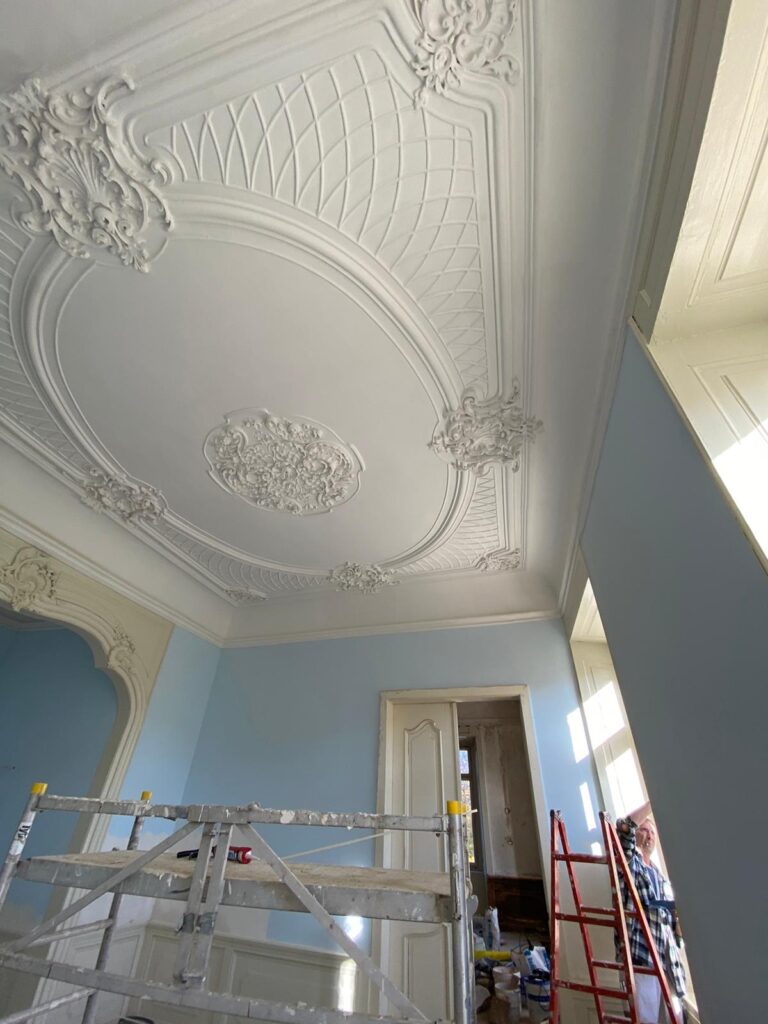
The principal building is a Baroque palace formed through David Schatz’s rebuilding campaign between 1724 and 1732. The work reshaped the castle’s interior and exterior rather than creating an unrelated structure. The palace grounds include a garden arranged in terraces, with a small canal forming its boundary. Parts of the Baroque park were restored during Bernd Artinger’s ownership after 2007. The building was also adapted for hospitality and events, including guest rooms, the Café Gräfin Cosel, the “Brunnen-Bar,” and festival halls.
Archaeological remains and memorial features
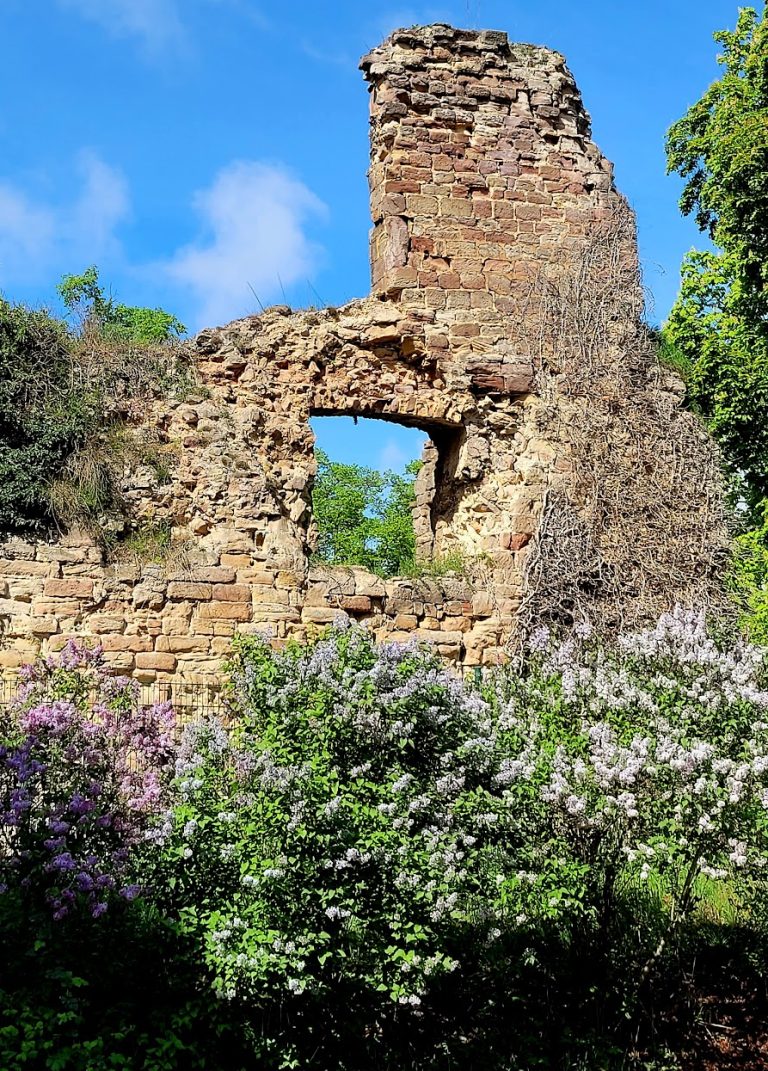
Excavations on the castle hill in the 1960s exposed parts of a ditch dating from the eighth or ninth century. This feature provides physical evidence for the early medieval castle associated with the later Scidingeburg. The Renaissance building fabric preserved within the palace derives from the period when the von Scheidingen ministerial family held the site.
The courtyard once contained a bronze memorial plaque made by Bruno Kubas in 1972. It commemorated Christians who had been victims of the Nazi dictatorship and was linked to a memorial room inside the castle. Both the plaque and the room were removed after 1990, making them part of the site’s modern history of interpretation and alteration.