Albenga Baptistery: An Early Christian Place of Worship in Italy
Site at a Glance
- Popularity
- Medium
- Country
- Italy
- Primary era
- Medieval
- Eras represented
- Classical, Medieval, Modern
- Civilizations
- Genoese, Italian, Roman
- Site type
- Religious
- Remains
- Baptistery
On this page16 sections
History
Late Roman and early medieval origins
The Albenga Baptistery is a Catholic place of worship in Italy, generally dated to the period from the second half of the fifth century to the first half of the sixth. It is regarded as an important Early Christian monument in northern Italy and as evidence of Albenga’s ties with Milan in the later centuries of the Roman Empire and the opening centuries of the Middle Ages.
The building has been associated with an urban renewal program under Constantius III, a Roman general who became emperor in the fifth century. Inscriptions connect fifth-century construction with Flavius Constantius, commonly identified as Constantius III. This attribution may concern an earlier baptistery rather than the present building. Foundations of a predecessor were found in the late twentieth century on the present right bank of the Centa River.
Repairs and later changes
An inscription beneath Bishop Leonardo Marchese’s coat of arms gives the year 1491 for repairs to the building. In 1588, Bishop Luca Fiesco replaced the immersion font with a marble one.
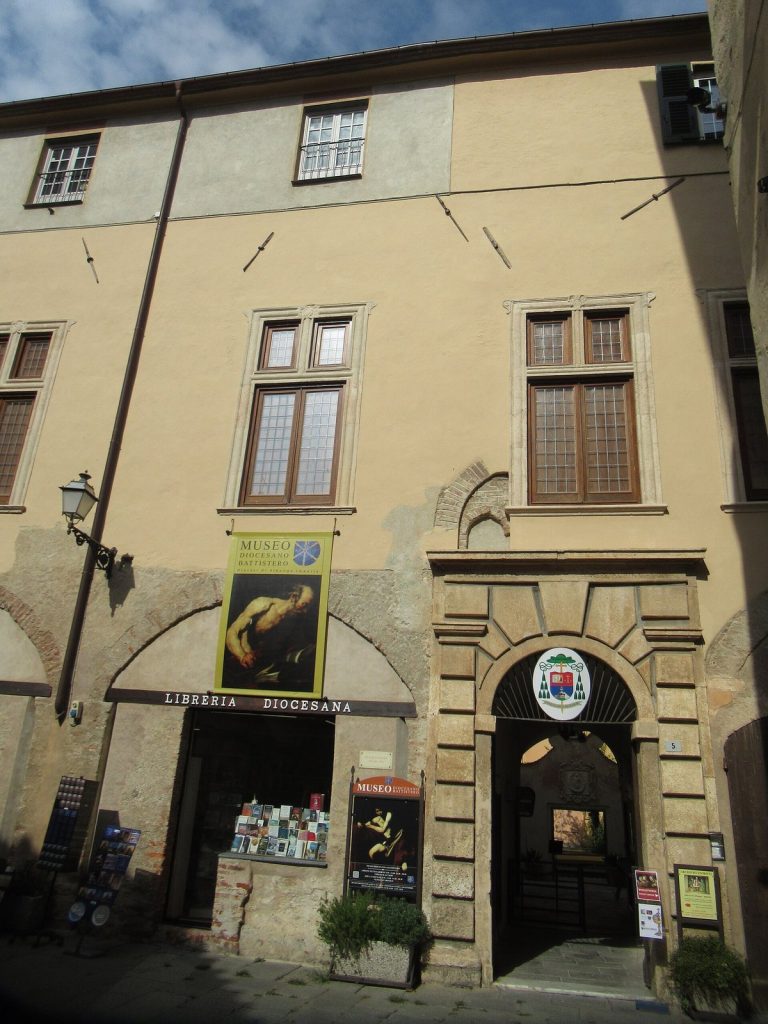
A major alteration around the turn of the twentieth century removed the dome and replaced it with a new roof. The restorer responsible believed the dome was a Renaissance addition that did not suit the building’s ancient character. In 2000, a staircase was built on the side facing the Cathedral of San Michele Arcangelo, descending to the level of the fifth-century city, and the baptistery returned to religious use. It is affiliated with the Diocese of Albenga-Imperia, a bishop-led church jurisdiction, and is part of the Diocesan Museum of Albenga. It is used for Catholic worship in the Roman rite, the principal liturgical tradition of the Catholic Church.
Remains
Plan and elevation
Plan and setting
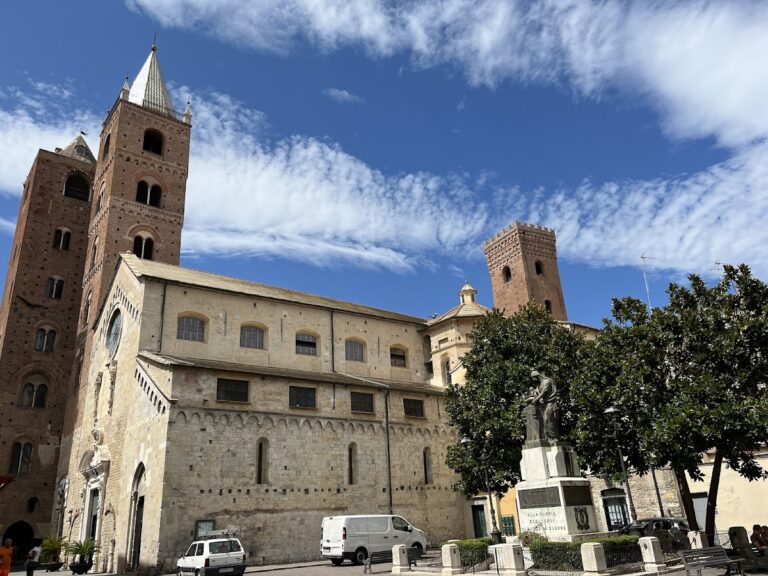
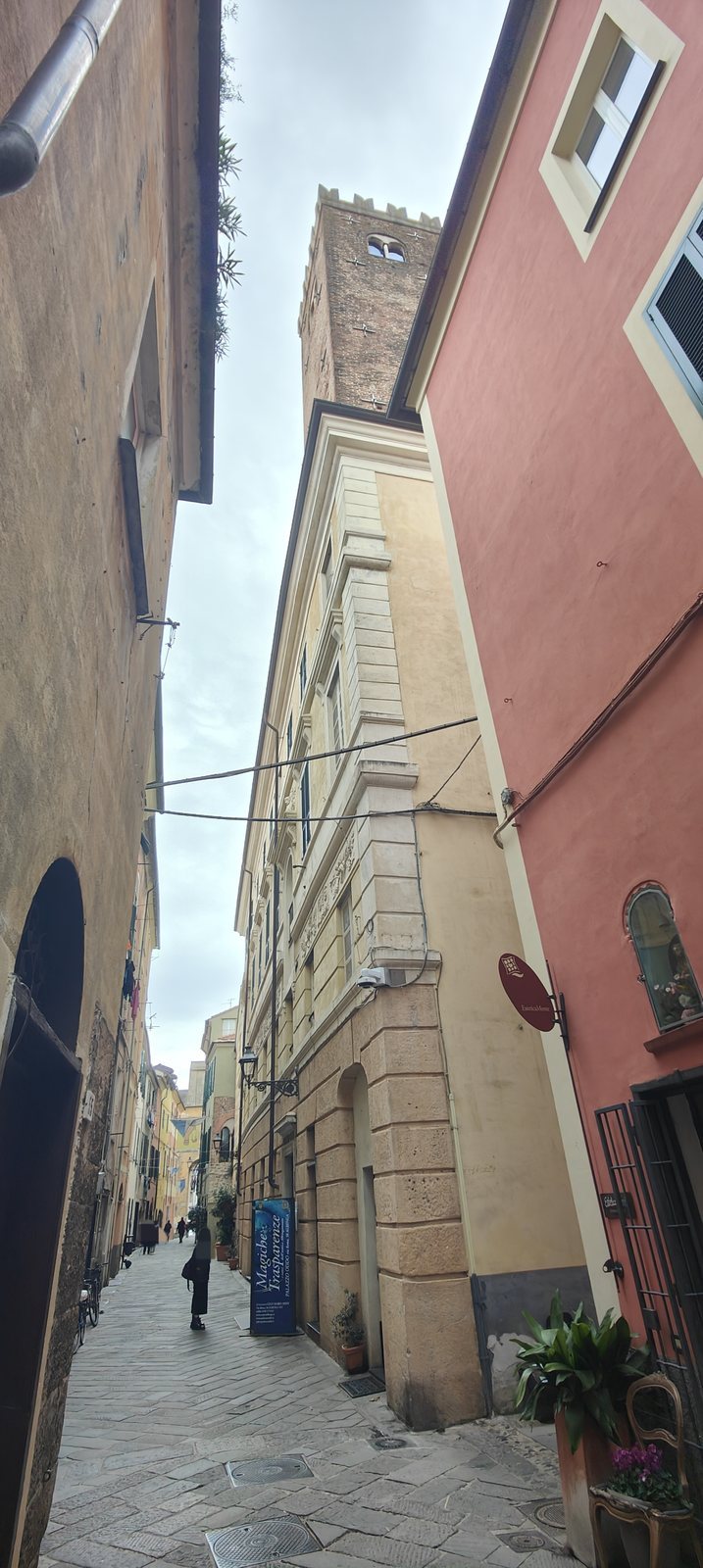
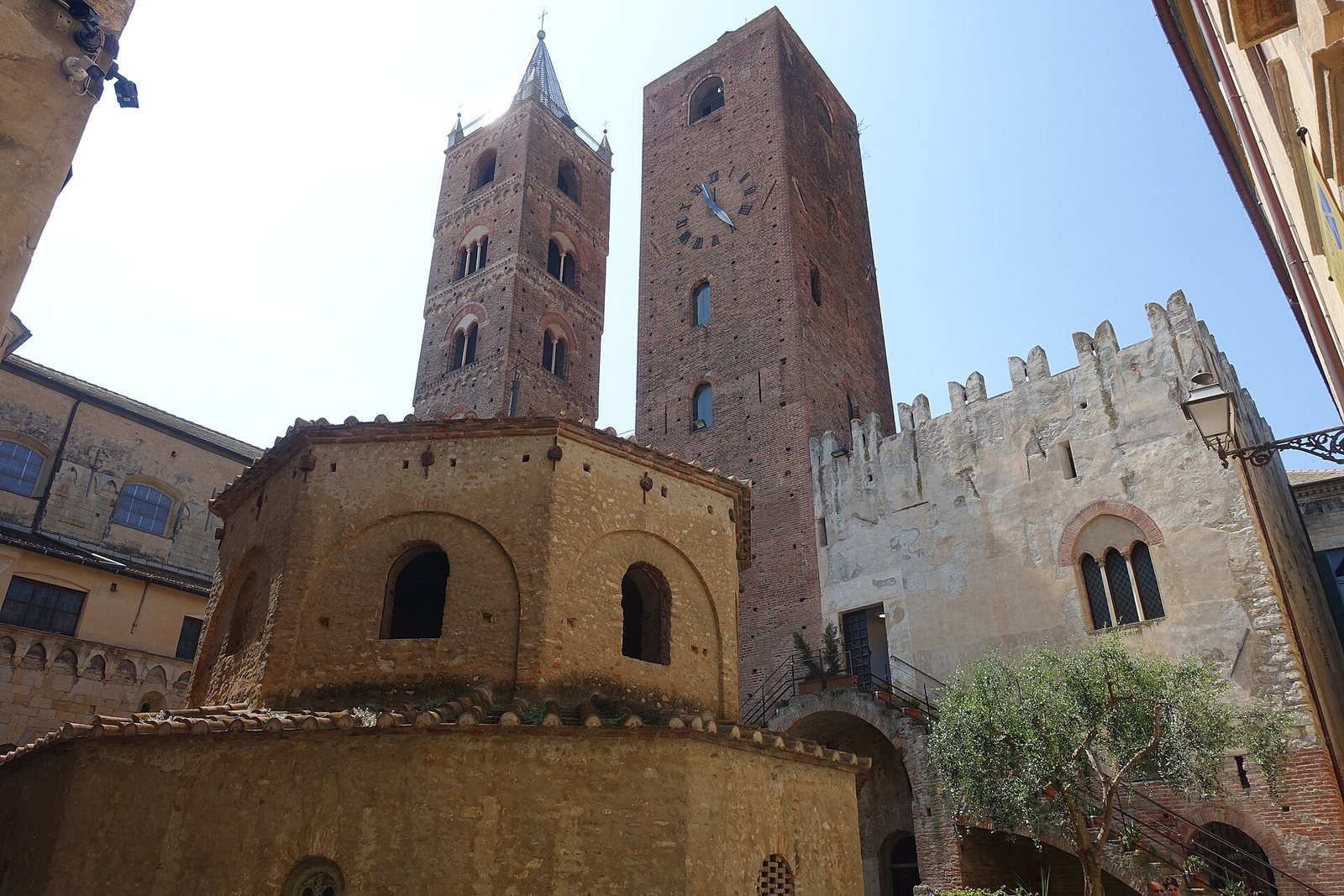
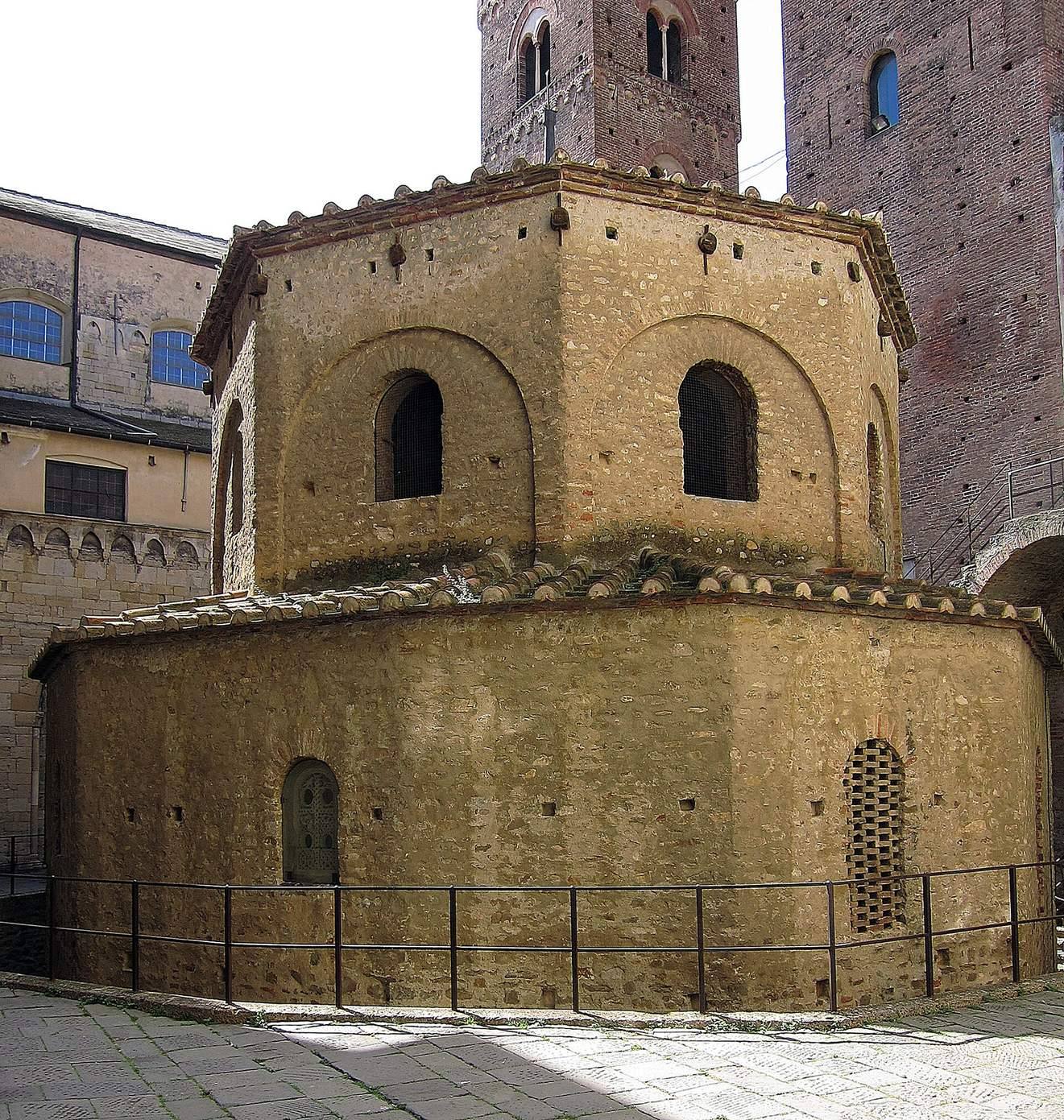
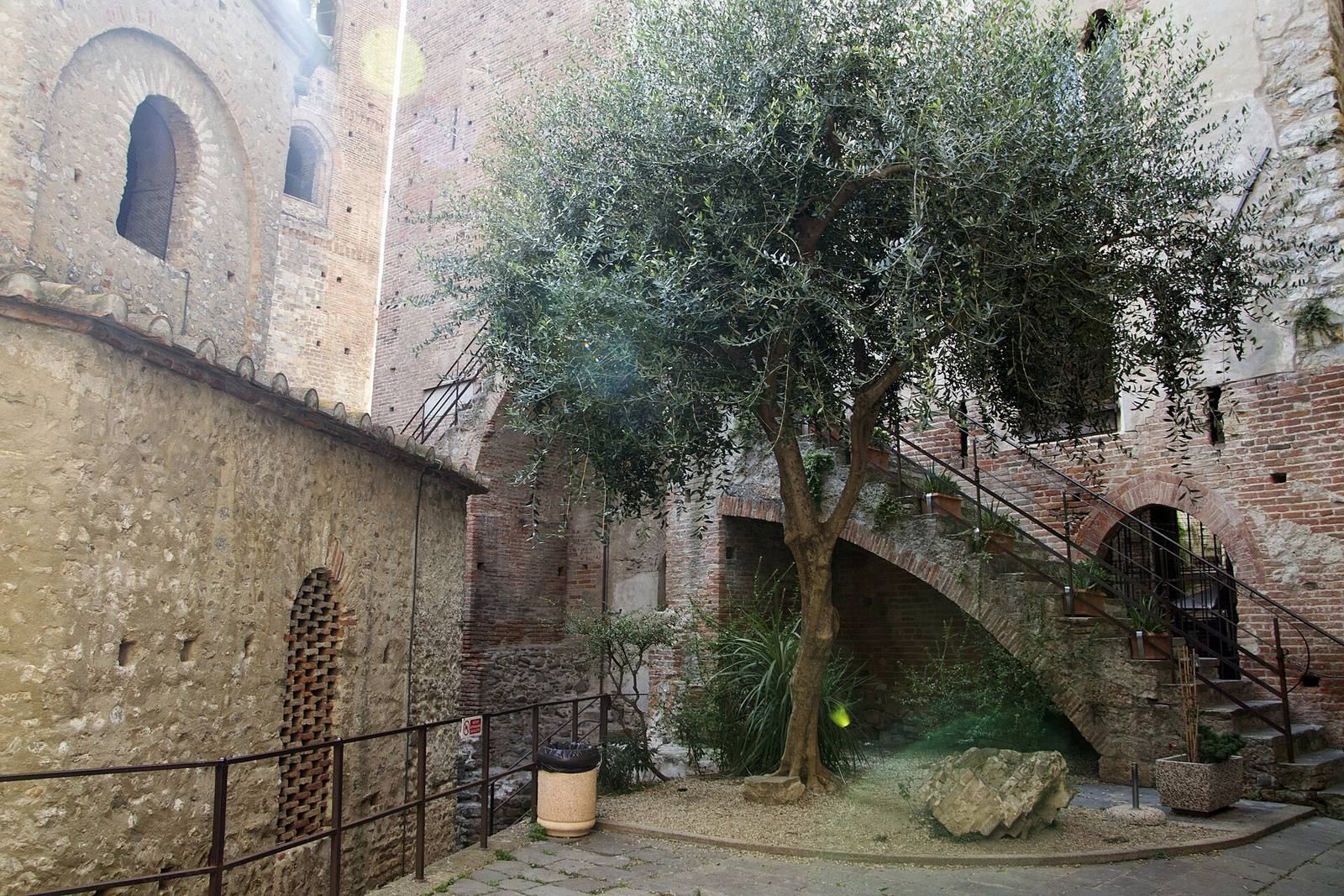
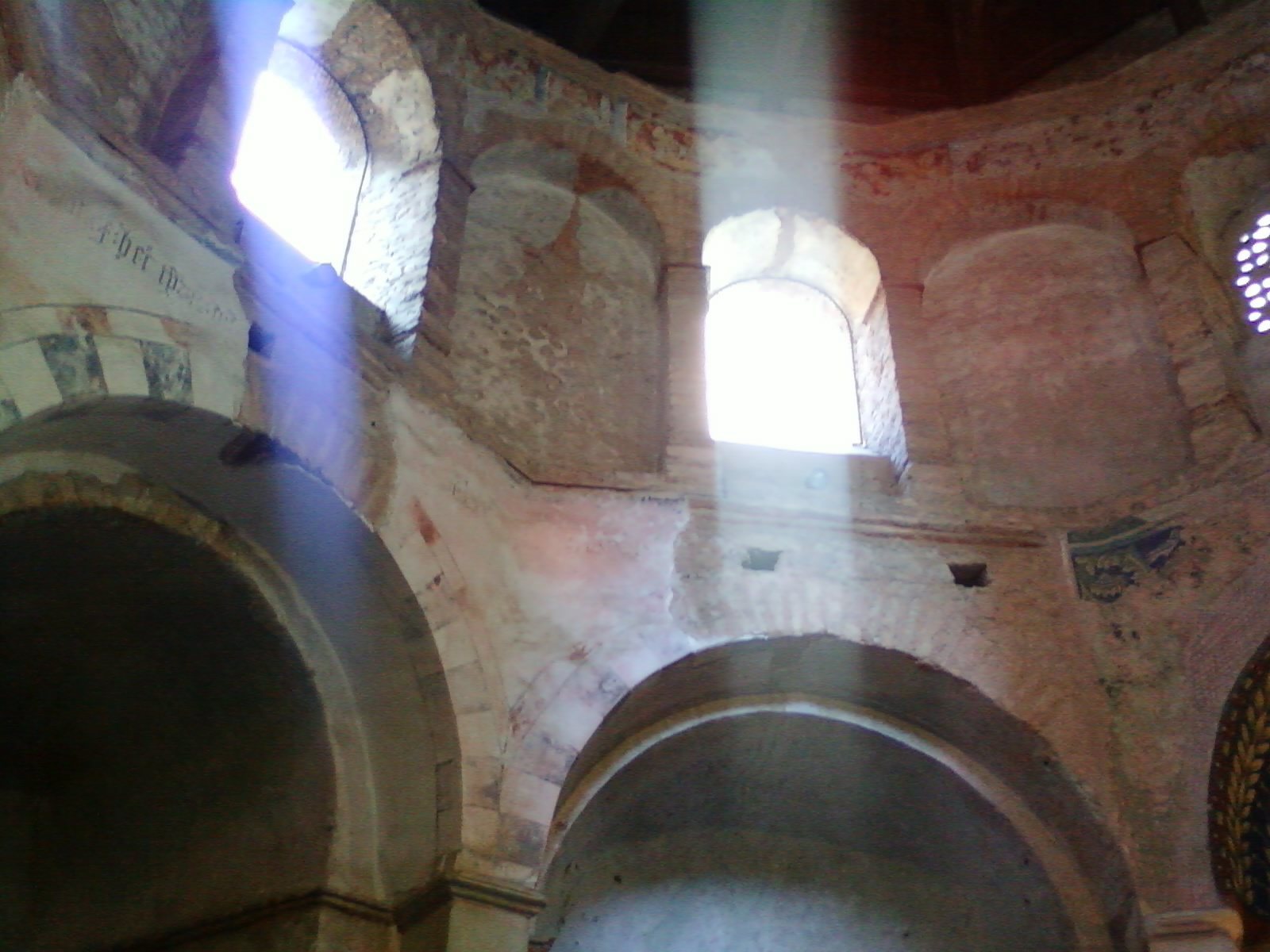
The baptistery stands beside the Cathedral of San Michele Arcangelo, between the cathedral and the old town hall. Its underlying plan is octagonal, with two corners cut off to fit the road layout of its period. This arrangement gives the lower exterior ten sides, while the upper level is octagonal. Inside, the eight-sided room contains recessed square and semicircular niches. The semicircular niches open outward through perforated sandstone windows.
Windows and exterior arches
The upper exterior is decorated with blind arches, decorative arches with no opening behind them, as well as arched windows. The windows may originally have been taller. They may have been raised in the eighth century and closed with pierced sandstone screens bearing Lombard-style ornament. The Lombards were a people who established rule in parts of Italy in the early Middle Ages.
Architectural structure
Arches and columns
Sixteen small arches, aligned with the niches below, rest on pilasters, shallow vertical features attached to the wall, and support the upper octagonal drum, the upright section that supports a dome. Block-shaped supports project beneath the arches. Eight decorative, non-load-bearing columns of Corsican granite have Corinthian capitals, a classical form distinguished by leafy carving. Their foliage suggests Greek workmanship, and they may have belonged to a pagan temple. The baptistery’s plan and form recall the Temple of the Sun at Split, within the palace of the late Roman emperor Diocletian, which served as a model for this type of building.
Roof
The building now has a wooden roof in place of its original dome. The demolished dome is dated to the late Roman period, the later centuries of the Roman Empire. Its vault was constructed with amphorae embedded in the structure.
Baptism and burial features
Baptismal basins
The original octagonal basin used for baptism remains at the center of the interior. A balustraded marble font is preserved in one side niche, while another holds a medieval font with traces of a painting of the Baptism of Jesus.
Entrance tombs
Two tombs set beneath arched recesses stand at the entrance. The tomb on the right is a cast of an original dated to about 750 and decorated in a Lombard style. The original is held in the diocesan museum alongside other carved slabs from the same period.
Mosaic and wall decoration
Sixth-century mosaic
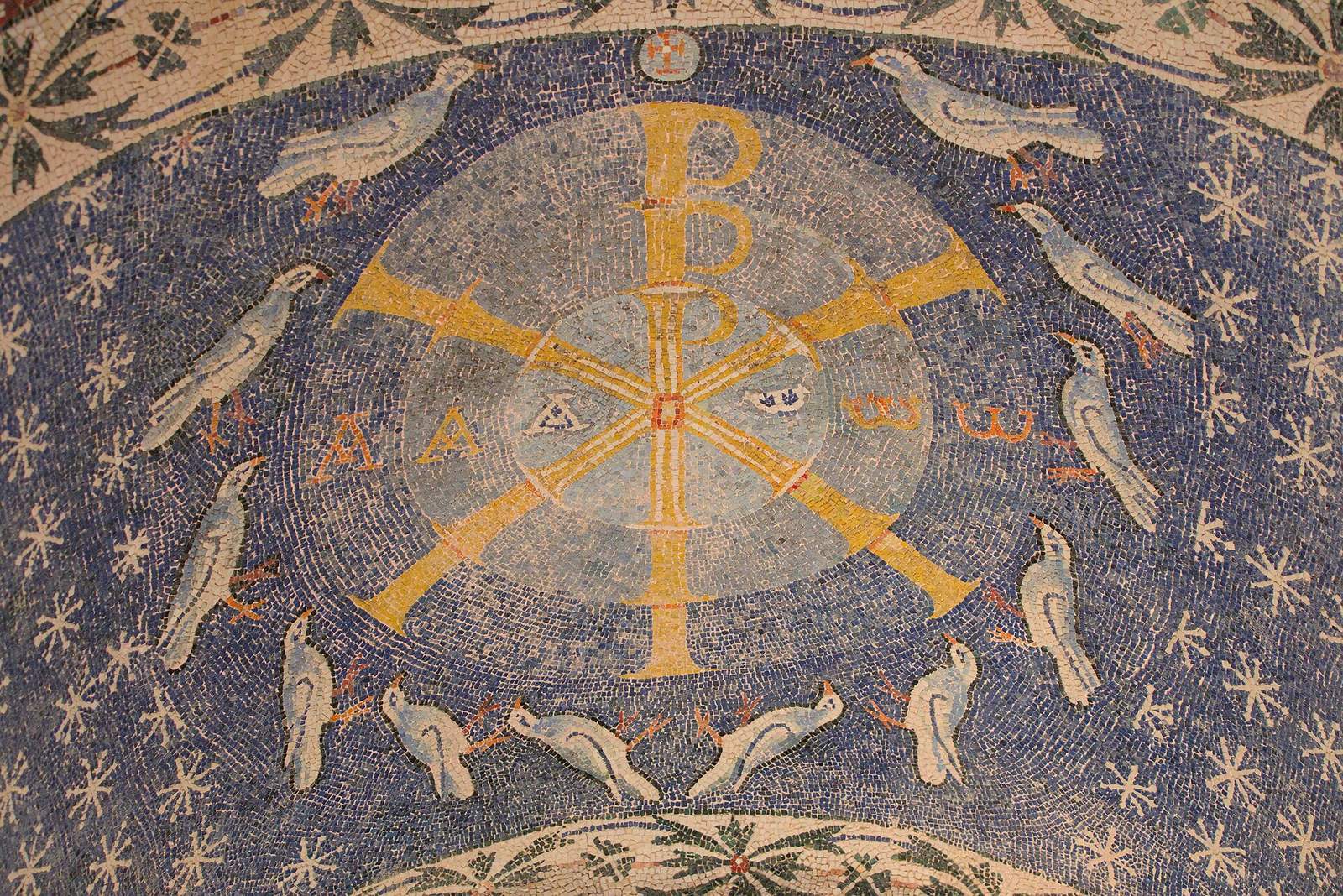
A niche opposite the entrance contains a well-preserved sixth-century mosaic made from small pieces of colored glass. At its center, a Christogram, a monogram representing Christ, sits within three concentric circles. Each circle bears the letters alpha and omega, the first and last letters of the Greek alphabet, which signify the beginning and end of all things in God. The circles represent the Trinity, the Christian belief in one God as Father, Son, and Holy Spirit. Their repeated letters express that each person of the Trinity is equally God.
Twelve doves move toward a small circle containing a red cross, an ancient symbol of the world. The birds represent the apostles sent to preach and baptize, and the dove also signifies the Holy Spirit. The Greek word for dove has a numerical value of 801, matching the combined value of alpha and omega and linking the apostles’ gift of the Spirit with God. In the semicircular panel above the main image, two lambs approach a jeweled cross in a flowered meadow representing Paradise. The lambs probably stand for the Jewish people of the old covenant and Christians of the new, while the cross signifies victory and glory. Eight-pointed stars and an eight-petalled floral border evoke the eighth day, Sunday after the Sabbath, and Christ’s Resurrection. A Latin inscription records a dedication, names saints whose relics may have been placed in the floor, and refers to relics held in the church.
Painted walls and former altar niche
Traces of fifteenth-century wall paintings remain. In the square niche opposite the former entrance, an altar once stood. An earlier stone mosaic on its arch may have included crosses, animals, symbols, and inscriptions.