Château de Forsac: A Historic Château in France
Site at a Glance
- Rating
- 4.7
- Popularity
- Very Low
- Country
- France
- Primary era
- Medieval
- External website
- Open
- Eras represented
- Medieval, Early Modern, Modern
- Civilizations
- French
- Site type
- Domestic
- Remains
- Castle
On this page11 sections
History
Château de Forsac is a historic château in France, in the commune of Benayes in Corrèze. Its origins reach back to the thirteenth century, while major architectural changes took place in the sixteenth and nineteenth centuries. The residence was first held by the Jougnac de Forsac family and later became associated with the La Baume-Forsac and Chérade de Montbron families.
From the Jougnac de Forsac family to the La Baume-Forsac family
Anne de Jougnac de Forsac, described as the last member of her family to bear that name, married François de la Baume, governor of Bergerac, in 1560. Through this marriage, Forsac passed into the La Baume family. During the Wars of Religion, the sixteenth-century conflicts in France between Catholic and Protestant factions, the château was reportedly besieged and burned by the Viscount of Pompadour because the La Baume family was Protestant.
Two fires associated with the Wars of Religion led François de la Baume to rebuild the château toward the end of the sixteenth century. Little of this first reconstruction survives. François de la Baume and Anne de Jougnac’s son adopted the name La Baume-Forsac and converted to Catholicism. He later reportedly became lieutenant to the Viscount of Pompadour.
Ownership from the eighteenth century
In 1778, the heirs of the La Baume-Forsac family sold Forsac to the Beaupoil de Saint-Aulaire family. Six years later, in 1784, the property was resold to Joseph de Parel d’Espeyrut de la Chatonie, a deputy in the Chamber of Deputies elected in 1815 during the Bourbon Restoration and known as the “Unobtainable Chamber” for its strongly royalist character. Ownership subsequently passed by inheritance to the Montbron family.
Aurore de Parel d’Espeyrut married Bernard Auguste du Burguet de Chauffaille in 1803. Their daughter, Lucie du Burguet de Chauffaille, married Théodore-Auguste de Chérade, Count of Montbron, in 1830. After the death of the Viscount of Parel in 1843, she received Forsac and transferred it around 1880 to her son, Robert de Chérade, Count of Montbron.
The nineteenth-century restoration
Robert de Chérade de Montbron restored the château in 1880. He commissioned the Russian decorator Jean d’Alheim, d’Alheim’s wife, and Adolphe Léon Willette to decorate several interior rooms with painted canvases. Forsac has remained in the Chérade de Montbron family since that restoration. The current owners are identified as Jean-Marie and Henri de Chérade de Montbron. The property remains privately owned and is also used as a reception venue and agricultural estate.
Remains
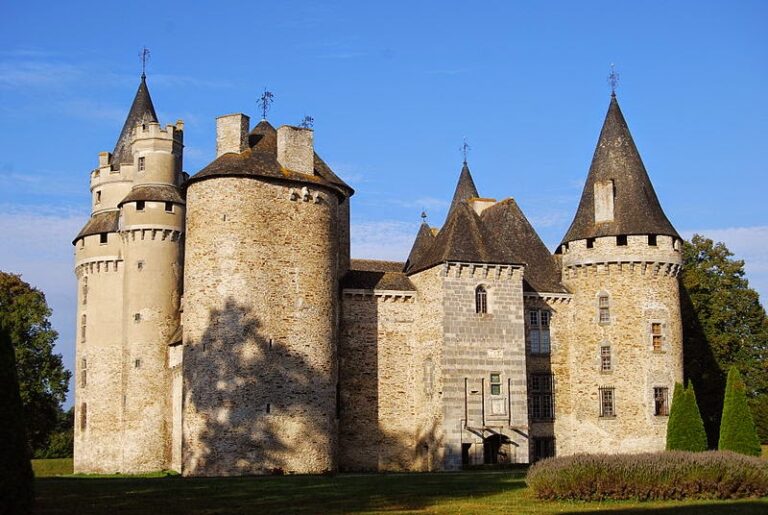
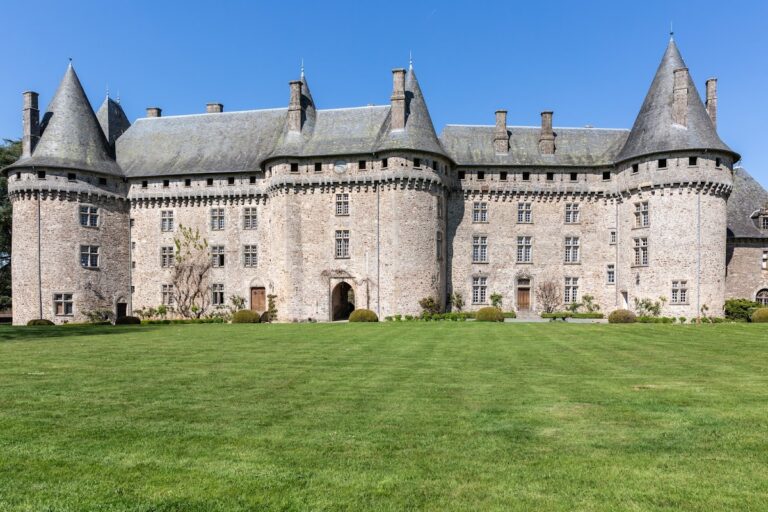
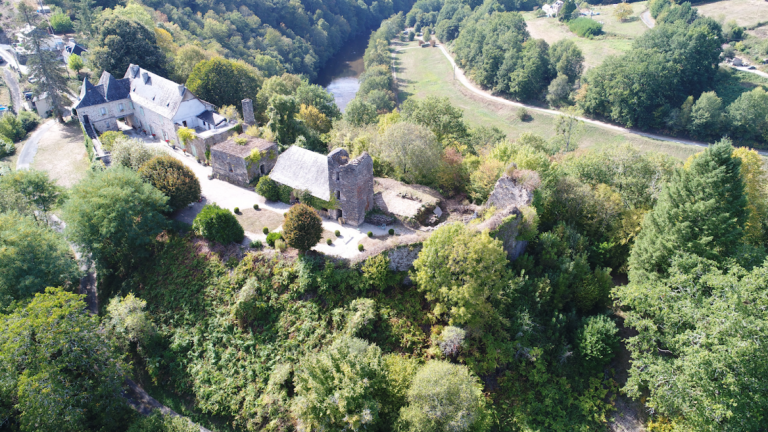
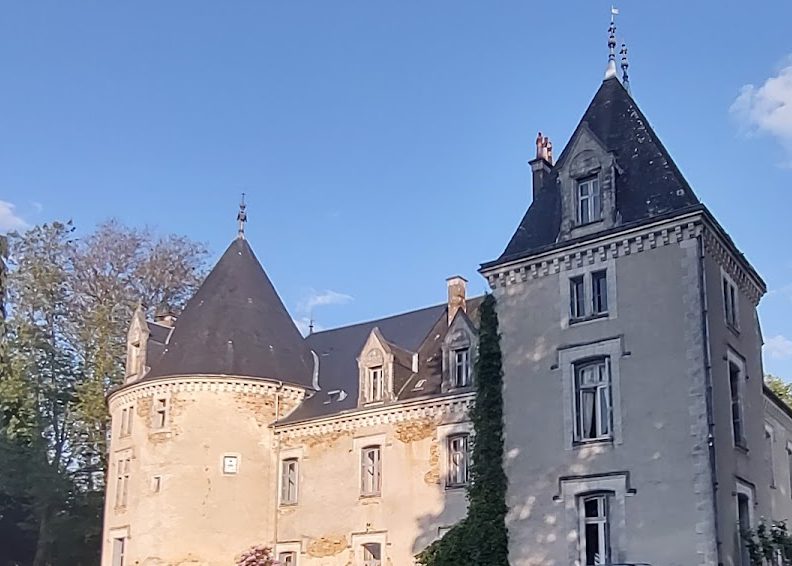
Château de Forsac stands on the summit of a hill and combines architectural elements attributed to the thirteenth, sixteenth, and nineteenth centuries. The building is arranged over three storeys. Two surviving towers preserve evidence of the earlier fortified château, while the nineteenth-century restoration shaped parts of the interior and grounds.
Building and interior decoration
Surviving towers
Only two towers remain from the former fortified château. They provide the principal surviving physical evidence of the residence’s medieval defensive character within the later building.
Painted interior rooms
The great salon, small salon, billiard room, and dining room received painted-canvas decoration during Robert de Chérade de Montbron’s restoration in 1880. These rooms preserve the interior decorative programme associated with the château’s nineteenth-century renewal.
Park and former water feature
Plane trees and lion cage
The park contains notable plane trees. Family tradition holds that the plants were given by Queen Marie Antoinette, queen of France from 1774 until the monarchy was overthrown during the French Revolution, to an ancestor of the present owners. A cage in the park was used by the Count of Chérade de Montbron in the nineteenth century to transport his lions.
Forsac pond
The château’s pond covered approximately two hectares. Its existence and approximate location can be identified on the Cassini map, one of the detailed eighteenth-century maps of France, and in the Napoleonic cadastral records, which were land and property surveys produced under Napoleonic administration. An article published in 1839 stated that the pond still existed at that time.