Schloss Batthyány, Pinkafeld: A Renaissance Castle and Former Lordship Residence

Site at a Glance
- Rating
- 4.8
- Popularity
- Very Low
- Country
- Austria
- Primary era
- Early Modern
- Eras represented
- Early Modern, Modern
- Civilizations
- Habsburg, Hungarian
- Site type
- Domestic
- Remains
- Castle
On this page10 sections
History
Schloss Batthyány, Pinkafeld, in Austria, is a Renaissance castle that probably originated at the beginning of the seventeenth century during the period of the Königsberg family. Its construction date and builder are unknown. The castle became the center of the Pinkafeld lordship and the permanent residence of members of the Batthyány family, a prominent Hungarian noble family whose estates and political influence extended across the historical Kingdom of Hungary.
From the Königsberg period to the Batthyány residence
The former attribution of the castle’s construction to Count Ádám Batthyány in 1658 is no longer accepted. Between 1646 and 1648, however, Ádám expanded the complex with a gate building and drawbridge. He designated Pinkafeld as the residence of his widow and died in 1659. His second wife, Barbara Corbelli, moved into the castle that year, and it then became the center of the Pinkafeld lordship. Her stepsons Christoph and Paul later expelled her, citing what they called her “scandalous behavior.”
Count Emmerich Batthyány directed the construction of the Antonius Chapel in 1757. The castle itself was remodeled during the eighteenth and nineteenth centuries. Around the turn of the twentieth century, ownership passed to the Batthyány-Taxis counts. Baron Neugebauer later acquired the estate through marriage, and Reichsgraf Kagenegg bought it in 1925.
An aristocratic and intellectual gathering place
From 1805 to 1817, Countess Franziska Batthyány made the castle a meeting place for prominent figures from the Church, culture, and scholarship. It became an intellectual center for the Romantic circle associated with the preacher Klemens Maria Hofbauer. Summer visitors included the poet and priest Zacharias Werner, the painters Leopold Kupelwieser and Eduard Steinle, the later bishop of Graz-Seckau Roman Sebastian Zängerle, and the physician and religious author Johann Emanuel Veith. Hofbauer may also have stayed there.
Werner probably met Count Nikolaus Batthyány and his wife Franziska, known as Fanny, during the Congress of Vienna. At the castle, Werner’s activities extended beyond literary life. During his stays, he preached in Pinkafeld’s Calvary Church, led a penitential procession after a fire, and composed the inscription for the town’s Marian column. In 1852, a fire broke out at the castle without causing major damage. Kupelwieser later created a votive picture commemorating the event, an image made in remembrance of protection or deliverance.
The 1827 investigation and later changes
In 1827, a commission met at the castle after Emperor Francis I of Austria ordered its formation on 23 January. Francis had held the title of Emperor of Austria since 1804 and had previously been Francis II, the last Holy Roman Emperor. The commission investigated the Stradafüßler robber band and its leader Nikolaus Schmidhofer, known as Holzknechtseppl. Since 1822, the band had committed numerous cruel crimes in the border region and eventually numbered more than 50 members.
The commission agreed to surround the area with soldiers and advance toward Pinkafeld. Soldiers arrested Schmidhofer and his subordinates on 12 March 1827, although that date is not completely certain. Several accomplices were executed, and Schmidhofer was hanged on Pinkafeld’s Gerichtsberg on 20 November 1828.
The Antonius Chapel deteriorated during the nineteenth century and was demolished in 1904 after its owner allegedly desecrated it. A local tradition holds that the owner, after a night of drinking, shot at the altar painting. According to the same legend, Mass could no longer be celebrated in the chapel and the bullet holes reappeared after repairs.
From 1935 to 1952, the Pinkafeld Fruit Processing Cooperative operated in the castle. During the Second World War, Pinkafeld’s secondary school held emergency classes in one room from 16 to 28 March 1945. Each class attended three times a week, but teaching stopped again on 28 March for the rest of the school year because of the military situation. The last major remodeling took place from 1949 to 1952 and substantially obscured the castle’s original appearance.
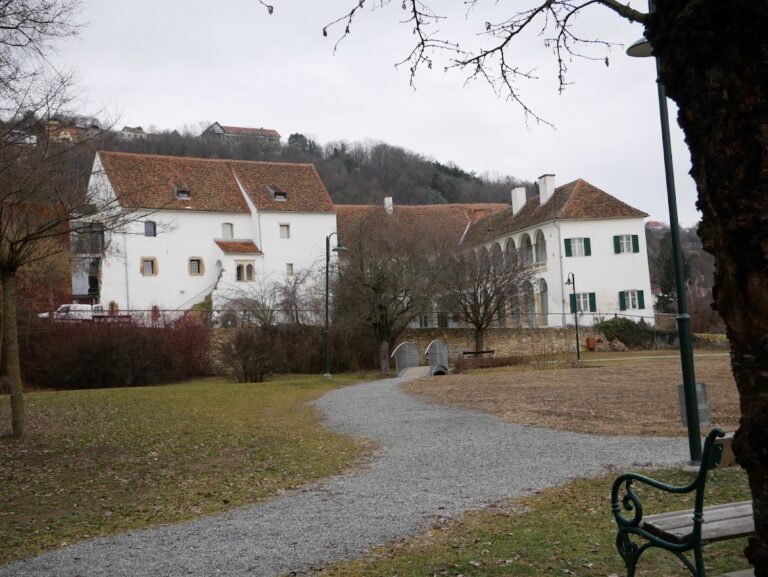
The city of Pinkafeld later became the owner and made the castle and park available free of charge to the Province of Burgenland for use as a vocational school. The castle is now protected as a historic monument and continues to house the school, where apprentices train in masonry, metalworking, carpentry, cabinetmaking, and motor-vehicle mechanics.
Remains
Castle complex and grounds
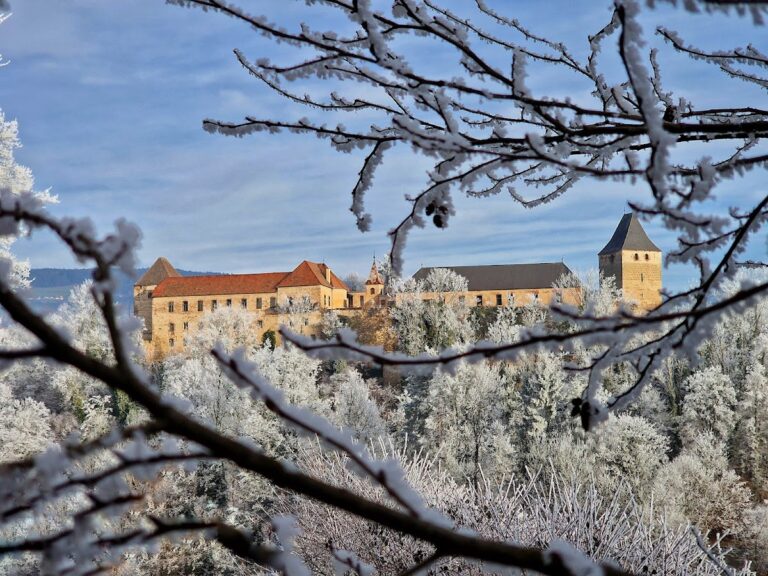
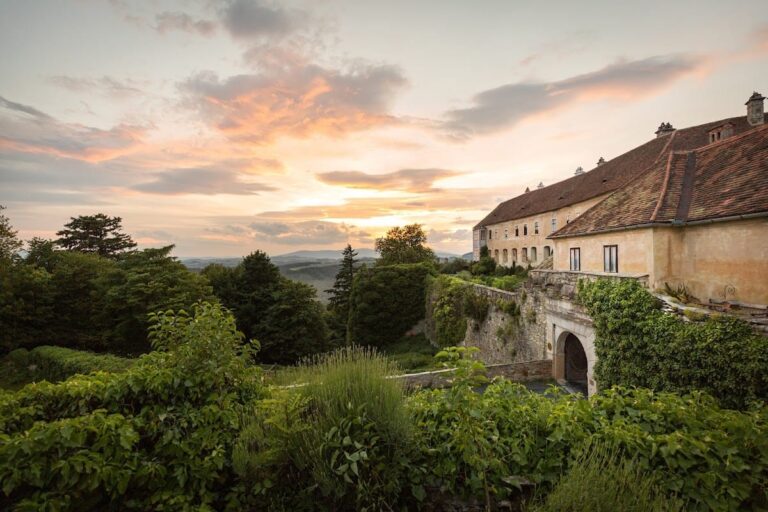
The original complex was a large, multi-storey fortified castle surrounded by a dairy farm. The Renaissance building stood among the village houses and included an arcade passage, a covered gallery formed by a series of arches. A garden surrounded the castle, while the gate building added between 1646 and 1648 controlled access across a drawbridge. The Schlosspark remains part of the estate used by the vocational school.
The castle bears the Batthyány family coat of arms. Its crown has nine spikes, which represent the nine counties where the family shared authority. A pelican feeding its young with blood from its breast expresses the unity of the Batthyány family.
Chapel site and surviving objects
Antonius Chapel site
The Antonius Chapel stood south of the castle, at the beginning of the chestnut avenue, which still exists. Built under Count Emmerich Batthyány in 1757, it was demolished in 1904 after falling into disrepair and after an alleged act of desecration by its owner. The chapel’s former altar painting, showing Saint Anthony, is now kept in the castle. The tradition surrounding the painting connects it with the alleged shooting and with bullet holes said to have returned after renovations.
Saint Anthony statue
A sandstone statue of Saint Anthony of Padua was made around the time the chapel was built. It originally stood before the chapel gate and now stands in front of the vocational-school boarding house.
Paintings and cemetery chapel works
Eduard Steinle left valuable paintings for Pinkafeld’s cemetery chapel. Kupelwieser’s votive picture, made after the castle fire of 1852, commemorates that event and forms part of the artistic record associated with the estate.