Palazzo del Lloyd Triestino: Former Shipping Company Headquarters in Trieste


Site at a Glance
- Rating
- 5
- Popularity
- Very Low
- Country
- Italy
- Primary era
- Modern
- Eras represented
- Modern
- Civilizations
- Habsburg
- Site type
- Civic
- Remains
- Palace
On this page6 sections
History
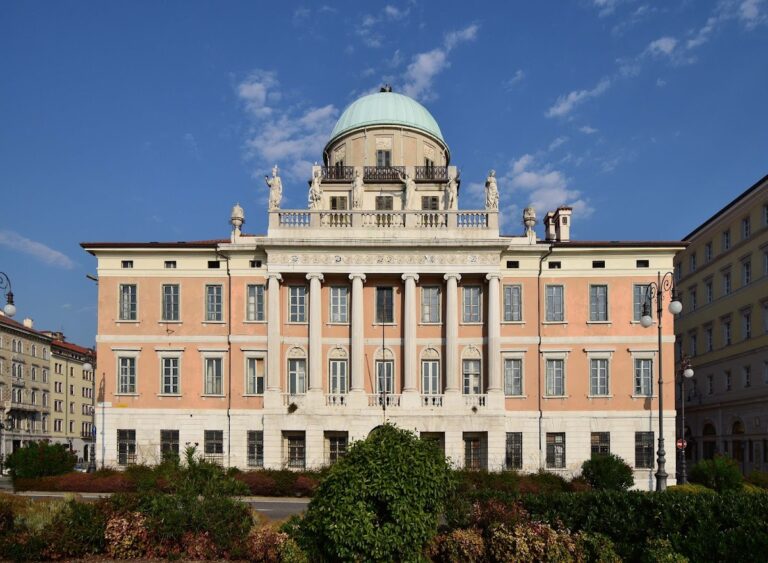
Palazzo del Lloyd Triestino is a nineteenth-century Renaissance-style palace in Trieste, Italy, built between 1880 and 1883 as the headquarters of Lloyd Triestino di Navigazione, a shipping company established in Trieste in 1833. The building was created for the company’s administrative and business operations and now houses the presidency and administrative offices of the Autonomous Region of Friuli-Venezia Giulia, whose territory includes Trieste.
From company premises to new headquarters
Lloyd Triestino first occupied premises at Piazza Tommaseo and later moved to Piazza della Borsa. In 1878, the company began looking for a site for a new headquarters. It acquired the former Pescheria fish-market property in 1880 and held an architectural competition involving architects from Vienna and Trieste. Seven projects were submitted, but the Lloyd council rejected them all and commissioned Heinrich von Ferstel, an Austrian architect known for major historicist buildings, to design and construct the palace.
The foundation stone was laid on 6 December 1880, and construction finished in 1883. The site stood on muddy reclaimed ground, which led Ferstel to use broad, relatively shallow foundations. A tower intended for the seaward side was abandoned because of the same ground conditions.
Expansion, wartime damage, and restoration
In 1899, the civil engineer Eugenio Geiringer added a large covered space in the courtyard for office use. On 1 May 1945, artillery fire from German forces seriously damaged the palace. Radical restoration and structural consolidation followed in 1966–1967, together with an enlargement that added another storey on the courtyard side.
Since 1991, Palazzo del Lloyd Triestino has been occupied by the presidency and administrative offices of the Autonomous Region of Friuli-Venezia Giulia, including the regional government. The region is also the building’s owner.
Remains
The palace is a four-storey Renaissance-style building whose principal facade faces Piazza dell’Unità d’Italia. Its other fronts face Via dell’Orologio, Riva del Mandracchio, and Via del Mercato Vecchio. The central section and two corner bays project slightly from the main facade, while the roofs are enclosed by stone balustrades. The original courtyard office space added in 1899 was later accompanied by a further storey on the courtyard side during the 1966–1967 enlargement.
Principal facade
Rows of rectangular windows with stone frames articulate the floors. On the second upper storey, the windows of the central section and corner bays are round-arched and associated with balconies supported by volute-shaped brackets. Ionic columns rise across two storeys to the eaves cornice in these projecting areas. Between them, the corresponding windows have false balconies and rectangular pilasters instead of columns. Semicircular tympana, the fields above the windows, crown all of these openings.
The ground floor and first upper storey are finished with rustication, a surface treatment that emphasizes joints and projecting blocks, while the two upper storeys are plastered. A cornice separates the first and second upper storeys, and a larger eaves cornice finishes the facade. The corner bays have triangular tympana, and an attic above the central section contains four oval windows.
Entrance, fountains, and roof sculpture
The center of the facade is occupied by a large wooden round-arched portal. The ground and first upper storeys of the central and corner bays contain niches with two fountains rather than windows. Their sculptures represent freshwater and seawater. The figures are identified as Thetis, a sea goddess in Greek mythology, and Venus, the Roman goddess of love and beauty. Venus is shown rising from a shell in the seawater fountain.
Six figures decorate the balustrades above the central section, together with a large sculptural group carrying a shield of the Austro-Hungarian Lloyd, the major Trieste-based shipping company of the Habsburg period. The words “Lloyd Triestino” appear beneath the shield. Allegorical statues on the ground floor and pediment were made by the Viennese sculptors Josef Pokorny and Hugo Haerdtl.
Nearby sites