Schloss Achleiten: A Medieval Fortress Transformed into a Residential Castle


Site at a Glance
- Rating
- 4.5
- Popularity
- Very Low
- Country
- Austria
- Primary era
- Early Modern
- Eras represented
- Medieval, Early Modern
- Civilizations
- Duchy of Austria, Habsburg, Holy Roman Empire
- Site type
- Domestic
- Remains
- Castle
On this page16 sections
History
Schloss Achleiten is a medieval fortress and residential castle in Austria, in the Achleiten district near the Krems River. Its documented history reaches back to the late twelfth century, when the site was held as a fief associated with Kremsmünster Abbey, a Benedictine monastery in Upper Austria. The castle later developed from a fortified stronghold into a residential seat, acquiring much of its present appearance in the eighteenth century.
Medieval lordship and the Achleitner family
Achleiten first belonged to the lordship of Tegernsee before passing to the provostship of Berchtesgaden as a feudal holding. Around 1200 it became a fief of Kremsmünster Abbey. Chunrat and Sieghart were the first recorded holders, while Bernhard von Achleiten, named in 1189, is the first identified lord of Achleiten.
Bernhard’s sons, Walchun, Hartwig, and Otto, were named as donors at the consecration of the Church of Saint Giles near the Wels Traun bridge. The Achleitner family were single-shield knights, a lower-ranking form of knight entitled to bear a simple coat of arms, and held the castle from Kremsmünster Abbey. Berthold von Achleiten became abbot of Kremsmünster Abbey in 1219. Other members of the family appear in documents from 1254, while Otto entered the abbey in 1287. Heinrich and his sons Heinrich, Bernhard, and Berthold were recorded in 1318.
Changing feudal ownership
In 1303 the castle passed from Kremsmünster Abbey to the territorial ruler and subsequently became a fief of the Wallsee family, a prominent Austrian noble house with extensive landholdings and feudal rights. Its holders changed repeatedly during the fourteenth century. The Achleitner family had sold their seat to Conrad von Meillenstorff in 1375, and he sold it later that year to Wilhelm Stadler of Stadlkirchen. Hans Lerbühler acquired the castle in 1377 and gave it to his daughter Wendelmut as a marriage portion. She transferred it in the same year to her husband, Wolfhart von Sinzendorf.
Achleiten remained with the Sinzendorf family until 1602. When Appolonia von Sinzendorf married Erhard von Grienthal, she received the castle as her dowry. By that time, the former stronghold had been converted into a residential castle. Gottfried Freiherr von Grienthal later held Achleiten and in 1674 sold it, together with Schloss Hehenberg near Bad Hall, to his father-in-law Matthias Kastner von Siegmundslust.
Chapel, renovation, and the Thun estate
The castle chapel was damaged by fire and demolished in 1643. A Chapel of the Presentation of Mary was then built on the site of the earlier Saint Leonard Chapel. It contains an altarpiece by Martin Johann Schmidt, the Austrian Baroque painter commonly known as Kremser-Schmidt. Further renovation work took place around 1660.
Count Ernst von Thun acquired the lordship of Achleiten in 1692 and joined it with Hehenberg in a fideicommissum, a legally restricted hereditary estate intended to remain within a designated family line. This arrangement continued until its dissolution in 1815. The lordship was then sold separately. Franz Iglseder acquired the castle in 1816 and sold it in the same year to Franz Planck von Planckburg of Schloss Weyer. Achleiten passed to Ludwig Ritter von Boschan in 1880 and later to the Teufenstein family.
Modern ownership and use
The last Teufenstein owners were Edina, the widow of Baron Georg Teufenstein, and their daughter Tatiana. The Max-Theurer family acquired the castle and park from them in 1982 and restored the complex. Elisabeth Max-Theurer, who won Olympic dressage gold at Moscow in 1980, is the current owner. She uses Schloss Achleiten as her principal residence and maintains her horse-breeding stud there.
At Elisabeth Max-Theurer’s initiative, a riding facility was established at the castle between 1989 and 1991. The estate formerly also included an agricultural yard, the Achleiten estate, and a private hunting ground. These properties are now owned by Hubert and Rosa Winkler. The castle’s former dairy produced Achleitner Schlosskäse, which is now made in Scharnstein. Schloss Achleiten is protected as a monument by the Republic of Austria under designation number 15250.
Remains
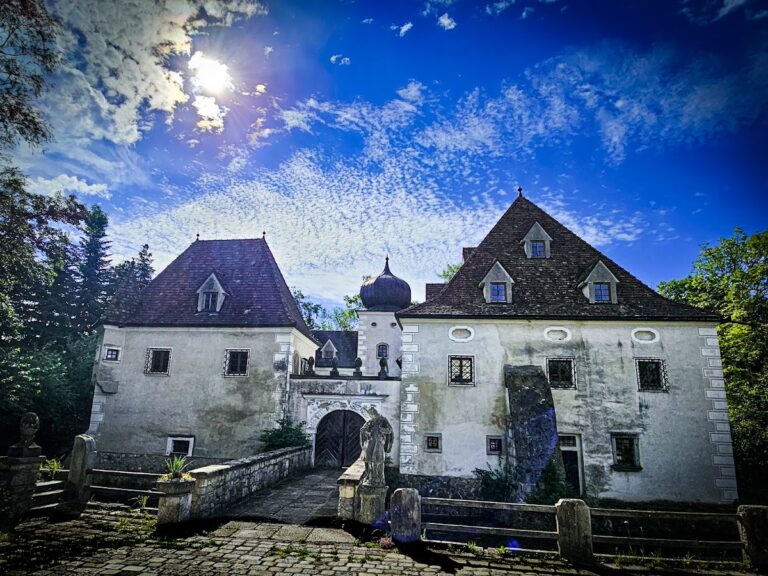
Schloss Achleiten stands on a wooded spur formed by an Ice Age glacial moraine on the left bank of the Krems, overlooking the river. The present castle is a three-storey complex whose irregular ground plan indicates that later walls incorporate foundations and masonry from the earlier fortress. Its surviving elements combine medieval defensive works with residential and decorative additions from the seventeenth and eighteenth centuries.
Fortifications and entrance
Defensive ditches and gate tower
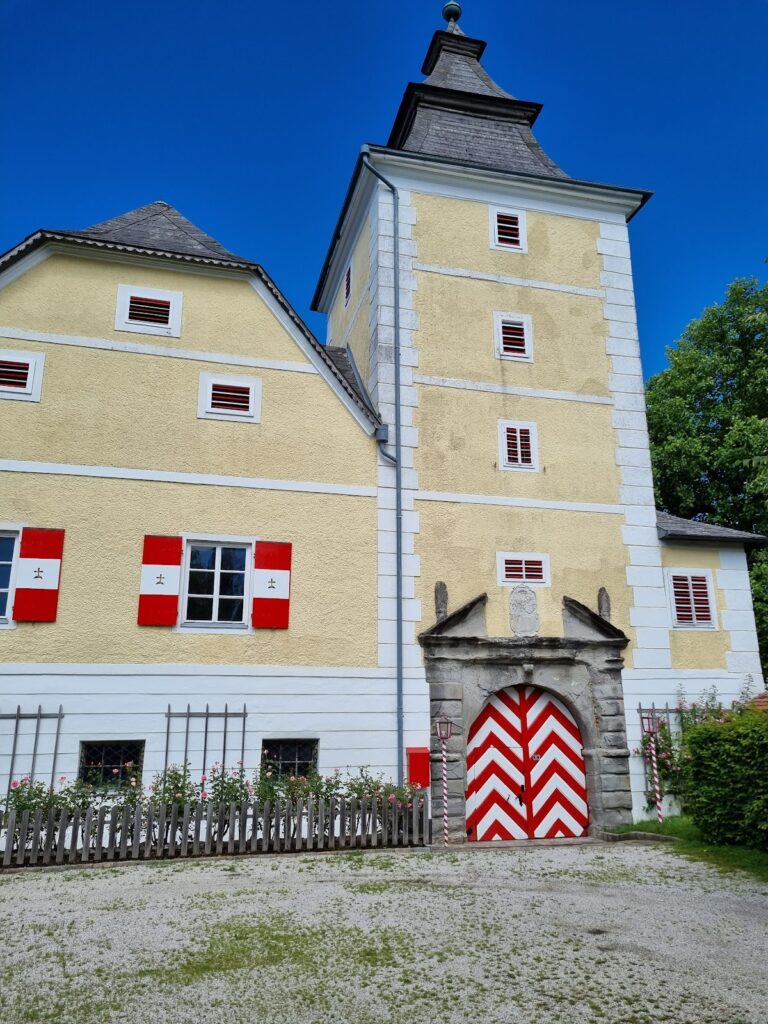
Substantial parts of the medieval fortress survive, including a double ring of defensive ditches and a round tower beside the gate. The tower protected the outer bailey, or fortified outer courtyard. Its upper storey has a crown of keyhole loopholes, narrow openings shaped like a keyhole that allowed weapons to be used from inside the tower while limiting exposure. The roof is formed by an onion dome with a lantern and a second, smaller onion dome carrying a weather vane. The tower’s large windows were opened at a later date.
Bridges, gates, and heraldic features
The original drawbridges have been replaced by masonry bridges, but roller holes above the gates preserve evidence of the mechanisms that once raised the bridges across the defensive ditches. Above the former drawbridge leading to the main building are the coats of arms of the municipality of Steyr-Garsten and Archbishop Ernst von Thun. The present stone bridge has two heraldic cartouches on its parapet and leads to a carved wooden gate dated 1660.
An additional coat of arms from the former Veste Rohr, a fortified stronghold near Achleiten that no longer survives, is dated 1577 and preserved in the entrance hall. The arms of Prince-Archbishop Johann Ernst von Thun und Hohenstein also appear at several points inside and outside the castle.
Residential and service buildings
Main residential wing
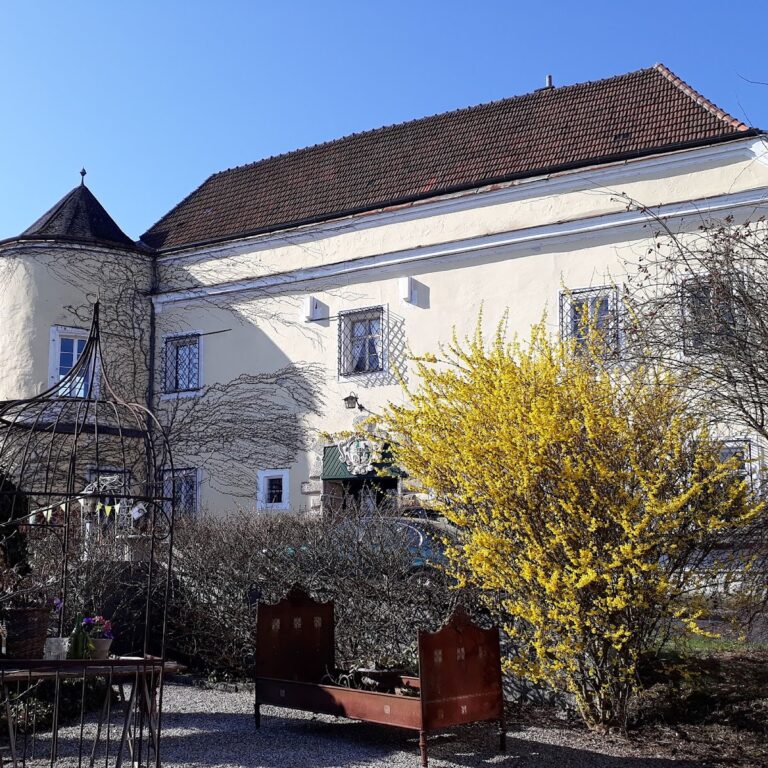
The massive residential wing has a roughly cubic form with a lateral extension on the right. The extension’s roof is incorporated into the roof of the main building, and it probably includes the remains of a tower reduced to roof level. A broad entrance is supported by stone pillars. Each storey contains a vaulted hall with stone columns, reflecting the transformation of the defensive seat into a residence.
Service wing and inner courtyard
A service wing encloses a large inner courtyard on three sides. One courtyard facade has an arcade carried by nine columns, providing a distinct architectural element within the residential part of the complex.
Chapel, well, and garden pavilion
Castle well
The seventeenth-century stone castle well was made by Johann Baptist Spatz in 1692. It is decorated with figures, including an upright stone lion holding the coat of arms of Prince-Archbishop Johann Ernst von Thun und Hohenstein. The same heraldic device appears elsewhere throughout the castle.
Garden pavilion
The garden pavilion contains a rectangular room with a mirror vault, a curved ceiling designed to reflect light, as well as frescoes and stucco decoration dating from the seventeenth century. The pavilion also bears the coat of arms of Ernst von Thun.
Chapel of the Presentation of Mary
The Chapel of the Presentation of Mary occupies the site of the former Saint Leonard Chapel. Its interior includes an altarpiece by Kremser-Schmidt, linking the surviving chapel to the Baroque artistic history of the castle.
Nearby sites