Château de Tigné: A Medieval Castle and Wine Estate in France


Site at a Glance
- Rating
- 4.4
- Popularity
- Very Low
- Country
- France
- Primary era
- Medieval
- External website
- Open
- Eras represented
- Medieval, Modern
- Civilizations
- French
- Site type
- Domestic
- Remains
- Castle
On this page9 sections
History
Château de Tigné is a fifteenth-century castle in France, built as a seigneurial residence and now operated as a wine estate in the Loire Valley wine region. Its medieval history was shaped by its position between Anjou and Poitou, while later destruction, restoration, and vineyard development gave the property its present character.
A feudal center in Anjou
During the Middle Ages, the castle stood at the center of a châtellenie, a feudal jurisdiction administered by the lord of a castle, which depended on the castle of Saumur. Its position on a passage between Anjou and Poitou, near routes leading toward both regions, helped give it strategic value. The lord of Tigné held high-justice rights, meaning authority over serious criminal cases, in the parishes of Tigné, Cernusson, Montilliers, and Tancoigné.
The fief, a landed estate held within a feudal relationship, gave its name to the Tigné family. Their arms consisted of a silver field bearing a cross pattée, whose arms broaden toward their ends, together with a black-and-red gyronny pattern divided into radiating triangular sections.
The Wars of Religion
During the Wars of Religion, the sixteenth-century conflicts between Catholics and Protestants in France, Jacques de Beauvau-Tigné supported the Protestant Reformation. On 13 October 1595, Des Esves, a captain of the Catholic League, a Catholic political and military organization active during the conflicts, surprised the castle, captured Jacques de Beauvau-Tigné, and fortified the site.
Duplessis-Mornay, governor of Saumur, then besieged the castle with help from the Count of La Rochepot, governor of Anjou, the Count of Montsoreau, and Donadieu de Puycharic. The besieging force brought five cannon and about 1,000 arquebusiers, soldiers armed with early firearms who had previously served in the League. For 12 days, these troops pillaged the surrounding area.
An initial treaty failed, but on 5 December 1595 Duplessis-Mornay allowed the besieged defenders to leave with their arms and baggage. The castle then began to be dismantled, although the work was interrupted. Its intact seigneurial keep later provided shelter for King Henri IV, who spent a night there in 1598 after coming from Gonnord. Henri IV ruled France from 1589 to 1610 and had converted from Protestantism to Catholicism during the succession crisis that preceded his reign.
Seizure, siege, and revolutionary destruction
In 1620, the land and castle, then held by the Beauvau family, were seized and awarded through a judicial decision to Claude d’Aubigné. In January 1632, d’Aubigné sheltered several gentlemen who abducted 13- or 14-year-old Urbaine de Maillé. They intended to force her marriage to d’Aubigné’s son. When royal guards demanded her release, the defenders answered with gunfire.
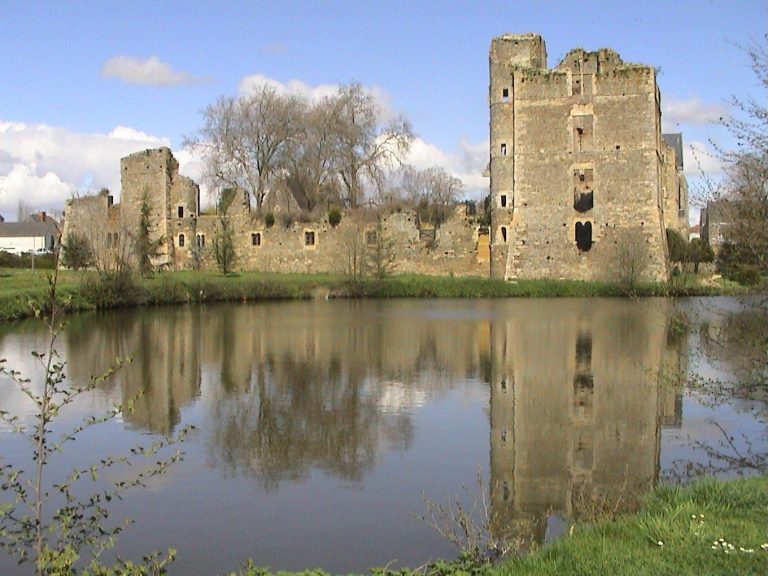
Martin du Bellay, governor of Anjou, besieged the castle for two months. Urbaine de Maillé was finally handed over on 15 March 1632. The last lord of Tigné, Hippolyte-Jean-René de Toulongeon, emigrated during the French Revolution. The castle was burned in 1794, sold to the Angers banker Rogeron, and resold by him in 1826 to Gendron, the notary of Tigné. Gendron’s daughter later married Pierre Péton, a member of the Maine-et-Loire general council.
Nineteenth-century restoration
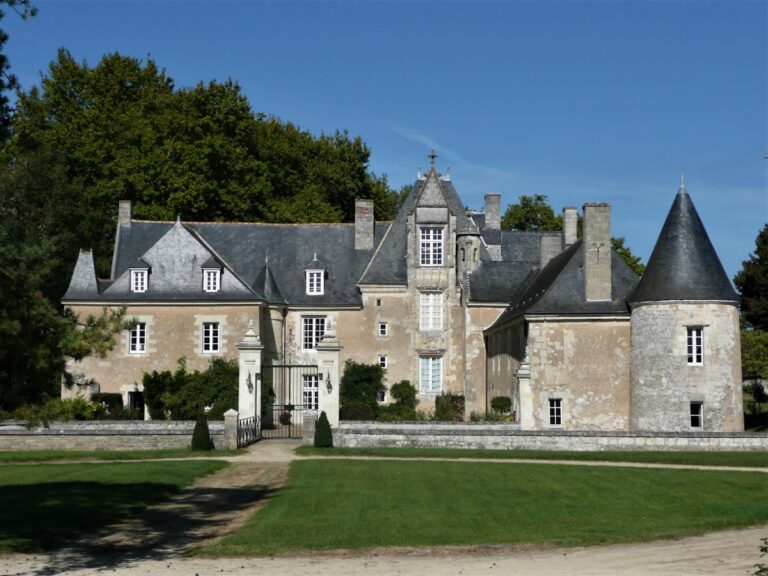
Two towers and the entrance portal were demolished in 1830. Ernest François Dainville restored the castle in 1860 in a Neo-Gothic style, attaching a new residential block to the surviving medieval keep and incorporating the remaining medieval elements. The work involved the castle’s five towers and its surviving échauguette, a small projecting turret or sentry structure associated with a fortified building.
From vineyard crisis to wine estate
At the beginning of the twentieth century, the estate belonged to Joseph-Henri Péton, mayor of Saumur. The spread of phylloxera, an insect pest that devastated European vineyards, ruined him financially, and the estate was sold to the Lalanne family in 1919.
Gérard Depardieu acquired the castle and estate in 1989 and established his first vineyard there. The wine business was organized in the same year as an SCEA, a French civil agricultural company used to operate a farming or wine-producing estate, with Depardieu’s friend and cellar master Dominique Polleau involved in its operation.
Depardieu expanded the property by purchasing additional land, quadrupling its area. Over the following ten years, the estate invested 10 million French francs in equipment and employee wages. Production reached approximately 250,000 bottles annually in 1999, with estimated annual turnover of 10 million French francs, and approximately 400,000 bottles annually in 2005. The wines were distributed through large-scale retail and exported.
The estate produces five types of red wine, including Anjou Rouge AOC, two AOC rosés, Cabernet d’Anjou and Rosé d’Anjou, and six types of white wine, including Coteaux-du-Layon. On 4 June 1994, during a rosé-wine festival, the street beside the castle was named Jean-Carmet in memory of the actor and Gérard Depardieu’s friend, who had died several months earlier.
Remains
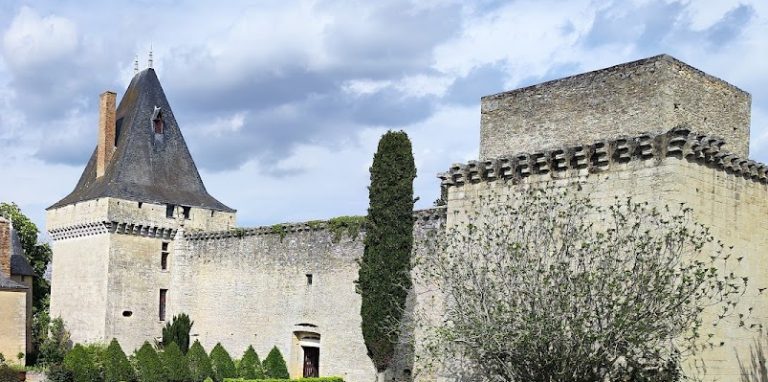
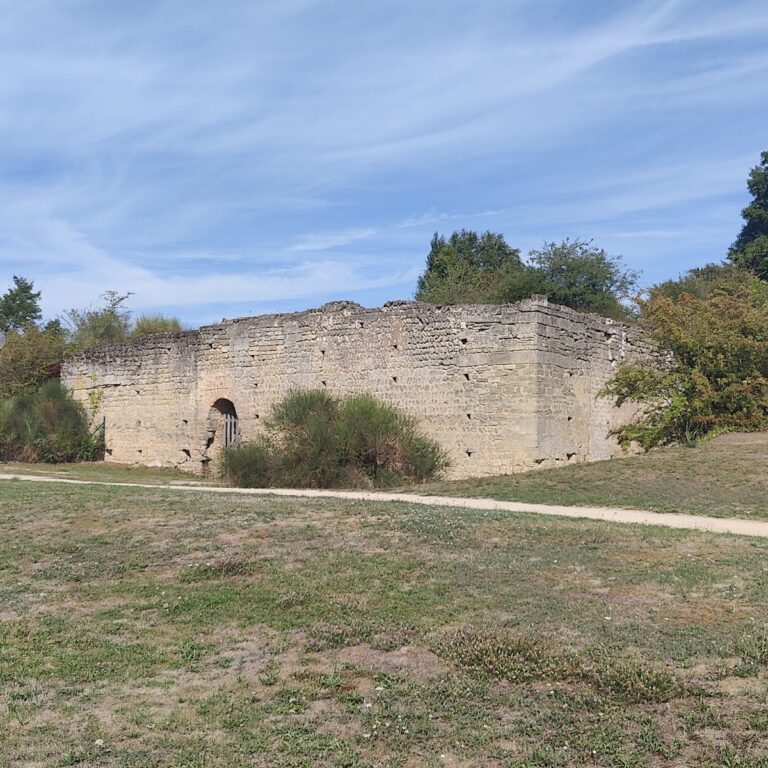
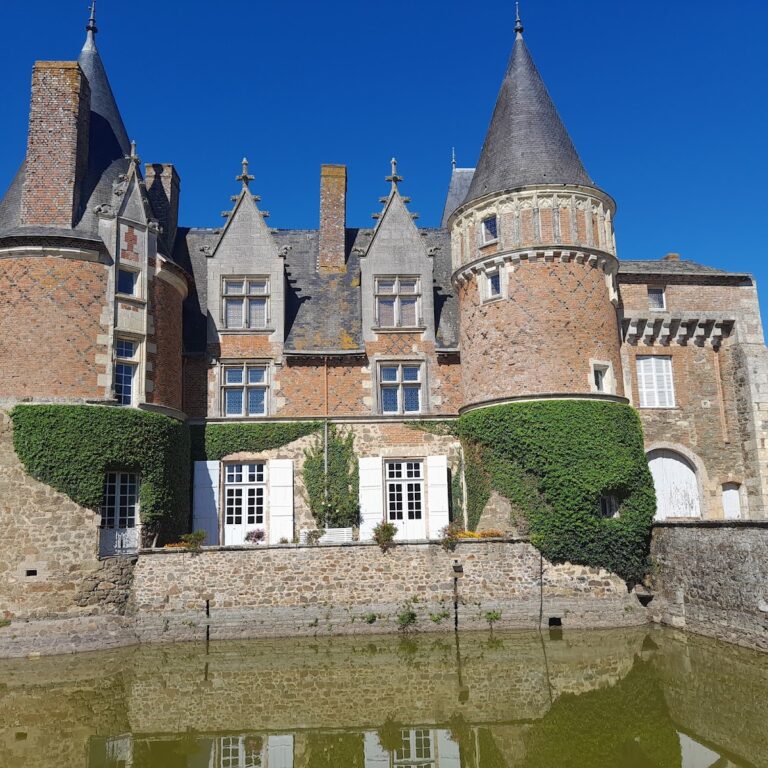
Château de Tigné combines the surviving fabric of a fifteenth-century medieval castle with substantial nineteenth-century Neo-Gothic alterations. The present complex includes the former medieval keep, a later residential block attached to it, two surviving towers identified among the original five, and visible remains of the castle’s double defensive enclosure.
Medieval defensive remains
The seigneurial keep is one of the two surviving original towers. It contains a chapel dedicated to Saint James and forms the principal medieval element incorporated into the later residence. The second surviving tower is known as the Treasury Tower. Together with the visible traces of the double defensive enclosure, these features preserve the fortified character of the earlier castle.
Neo-Gothic residential fabric
The residential block built in 1860 is attached to the medieval keep and gives the present château its combined medieval and Neo-Gothic appearance. The restoration incorporated the remaining medieval elements while involving the castle’s five towers and the surviving échauguette. The entrance portal and two towers had already been demolished in 1830, leaving the later building closely integrated with the surviving defensive fabric.