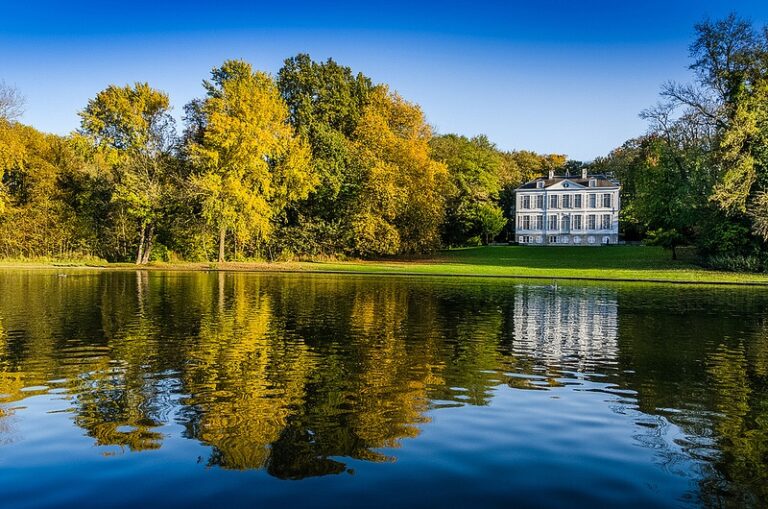
Château of Trois-Fontaines: A Former Forest Court and Prison in Belgium


Site at a Glance
- Rating
- 4.4
- Popularity
- Very Low
- Country
- Belgium
- Primary era
- Medieval
- External website
- Open
- Eras represented
- Medieval, Early Modern
- Civilizations
- Duchy of Brabant, Holy Roman Empire, Spanish
- Site type
- Military
- Remains
- Castle
On this page10 sections
History
The Château of Trois-Fontaines is a medieval ducal site in Auderghem, Belgium, at the edge of the Sonian Forest. Associated with the dukes of Brabant, it developed as a hunting lodge and residence linked to the administration of the ducal forest. The earliest reference, from 1321, describes a hermitage, while the name Trois-Fontaines first appears in 1329, also in the forms Dryen Borren and Drie Borne.
Ducal hunting lodge and forest administration
A keep is traditionally attributed to John II, Duke of Brabant. In 1329, his successor John III was recorded as having built a tower and a square at the hamlet of Dry Borren. John III also used the site for big-game hunting. Trois-Fontaines became the residence of the forest judge, or gruyer, an official who supervised the duke’s hunting grounds, forest resources, and related jurisdiction.
The site served a judicial and penal purpose as well as a residential one. From 1373, the castle was used mainly to imprison poachers and people subject to the Forest Tribunal or the Consistory of the Horn, institutions concerned with offences involving forest administration and hunting rights. Prisoners also included wood gatherers, robbers, political prisoners, and others placed under forest jurisdiction.
Chapel and medieval jurisdiction
In 1355, John III founded a chaplaincy in the castle chapel in honour of the Virgin Mary and Saint Catherine. A chaplain was required to celebrate Mass four times each week and live in a house beside the castle walls, formerly occupied by Duke Godefroid’s cook. The endowment provided 15 old écus, 10 small Florentine florins, 12 muids of rye, 50 measures of wood, 25 muids of charcoal, and grazing rights in the forest for four cows or four mares.
In 1373, the mayor of Leuven brought Arnoul Van Redingen to Trois-Fontaines after arresting him near Vorde bij der Loo. Leuven objected that its citizens could not be imprisoned outside the city walls, and Duke Wenceslas ordered Arnoul’s release on Saint George’s Day that year. The same privilege was violated again in 1377 on the duke’s orders, without Leuven receiving redress.
Wein van Cotthem became chaplain in 1429 and probably lived at Trois-Fontaines. He is associated with writing a continuation of the Brabantsche Yeesten there. By 1446, the chapel had fallen into ruin, and its services were temporarily transferred to the chapel of the ducal residence at Boitsfort. On 13 September that year, Philip the Good, Duke of Burgundy and ruler of Brabant, united the chaplaincy’s benefice with the conventual mensa, or income supporting a religious community, of the community of Saint James on Coudenberg. The arrangement partly compensated the convent for losses caused by monetary fluctuations.
Several people from Liège imprisoned at Trois-Fontaines escaped in 1446. The Council of Brabant later granted them letters of safe-conduct, allowing them to travel to Brussels and assert their rights.
Destruction, rebuilding, and the prison
During the wars of religion, the domain was looted and destroyed. It was rebuilt under Philip II, the Habsburg king of Spain, and a force of about thirty men, including horsemen, was assigned to patrol the domain. The prison was restored to use, and a bakehouse was added in 1659.
A letter patent of 6 August 1680 made the gruyer Madoets, by virtue of his office, the concierge or castellan of Trois-Fontaines, responsible for maintaining the site. In the later period, the gruyer was ordinarily also lieutenant to the grand huntsman. From the sixteenth century onward, the castle was used chiefly to imprison poachers and people who stole wood. The new Wavre road reached the castle around 1730 and was extended to Jezus-Eik after 1736.
On 6 May 1786, Archdukes Albert and Maria Christina ordered that the prisoners at Trois-Fontaines be transferred to the prisons at the Laeken Gate in Brussels. Charles Théodore de l’Escaille was the last keeper of the duke’s hunting grounds to occupy the site. Joseph II, the Habsburg ruler of the Austrian Netherlands, suppressed that office in 1793. The castle was then abandoned and fell into ruin, while the forest-judge office and the prison were also abolished.
From estate to protected monument
In 1822, the estate became part of the properties of the Société générale de Belgique, which had acquired the Sonian Forest. The company sold the remains of the keep, and the remaining buildings were converted into a farm. Josse Devisser owned the property in 1832, the Marnix family in 1845, and the Vinck family from 1882. François Sombrijn held it from 1901 to 1906.
The Belgian state acquired Trois-Fontaines in 1906 for protection purposes. Forest workers were housed there, and the site was later used as a forest house. The Conseil de Trois-Fontaines restored the castle between 1973 and 1976 and organized exhibitions about the Sonian Forest. The Brussels Institute for Environmental Management managed the site from 1973. The surviving remains received protection as a historic monument by royal decree on 19 November 1986, and ownership passed to the Brussels-Capital Region in 1991. The property has been disused since 2008 and, since March 2014, has been administered through the Brussels-Capital Region’s building-management service.
Remains
The castle stood beside the Watermaelbeek stream at a place associated with three springs. The Clabots pond lay opposite it across the Wavre road. A quarry, a lime kiln, and an old dwelling marked the location of the earlier castle site. At the height of its development, the complex had an L-shaped plan and was enclosed by water on every side in the form of a moat. Access was provided by a single-span bridge and a drawbridge.
Castle buildings
The keep
In the sixteenth century, the manor included a stone tower or keep and two small, single-storey residential buildings with stone foundations. The keep had a pointed-arch entrance portal, small square windows, and a roof topped by a spire. Only the foundations of the tower survive.
The residential building and hall
The adjacent building survives more or less in the form created by its rebuilding at the end of the sixteenth century. Its rear façade and great hall date from the fifteenth century. The basement containing the former dungeons remains, while the building also preserves a monumental Gothic fireplace.
Images of the castle
The earliest known image of Trois-Fontaines dates from about 1532 and appears on the tapestry for April in The Hunts of Maximilian. A 1659 engraving by Lucas Vorsterman the Younger, engraved by Jacobus Harrewijn, depicts the castle under the title Castrum trium fontium, vulgo Dry Borren. Another engraving was published by Antoon Sanders in the same year, and Paul Vitzthumb produced a view of the site in the nineteenth century.
Nearby sites