Château de Malle: A Historic Château and Sauternes Estate in Preignac

Site at a Glance
- Rating
- 4.9
- Popularity
- Very Low
- Country
- France
- Primary era
- Early Modern
- External website
- Open
- Eras represented
- Early Modern
- Civilizations
- French
- Site type
- Domestic
- Remains
- Castle
On this page9 sections
History
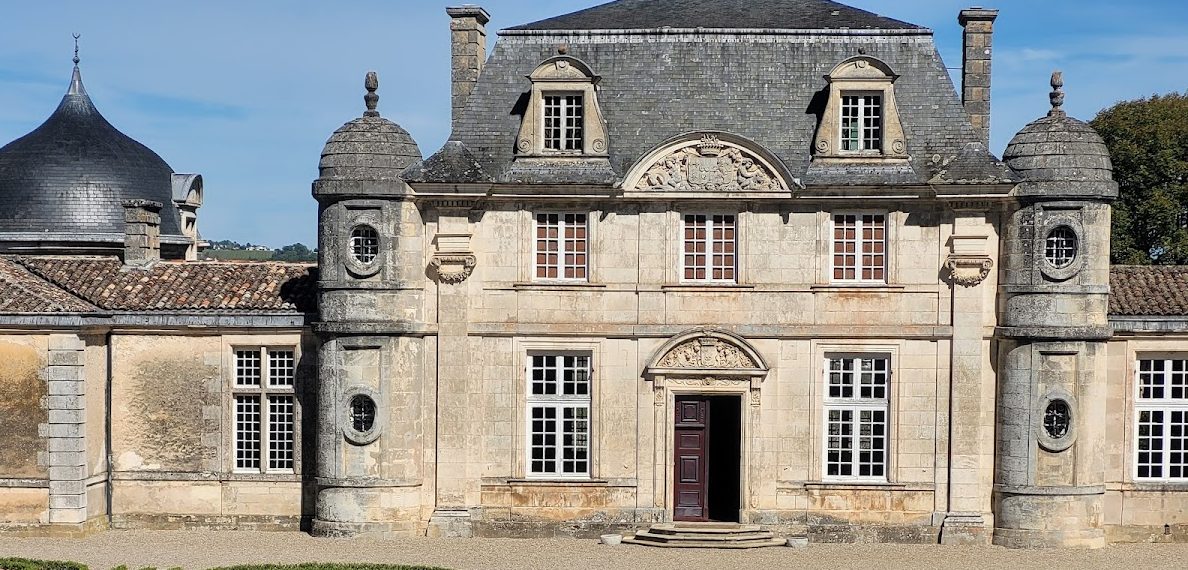
Château de Malle is a historic château and wine estate in Preignac, France, whose present residence was commissioned at the beginning of the seventeenth century in an architectural style combining Classicism with Renaissance-inspired elements. The estate is associated with the Bordeaux appellations of Graves and Sauternes, and its Sauternes was classified as a Second Growth, or Deuxième Cru, in the official Bordeaux Wine Classification of 1855.
Foundations and the de Malle family
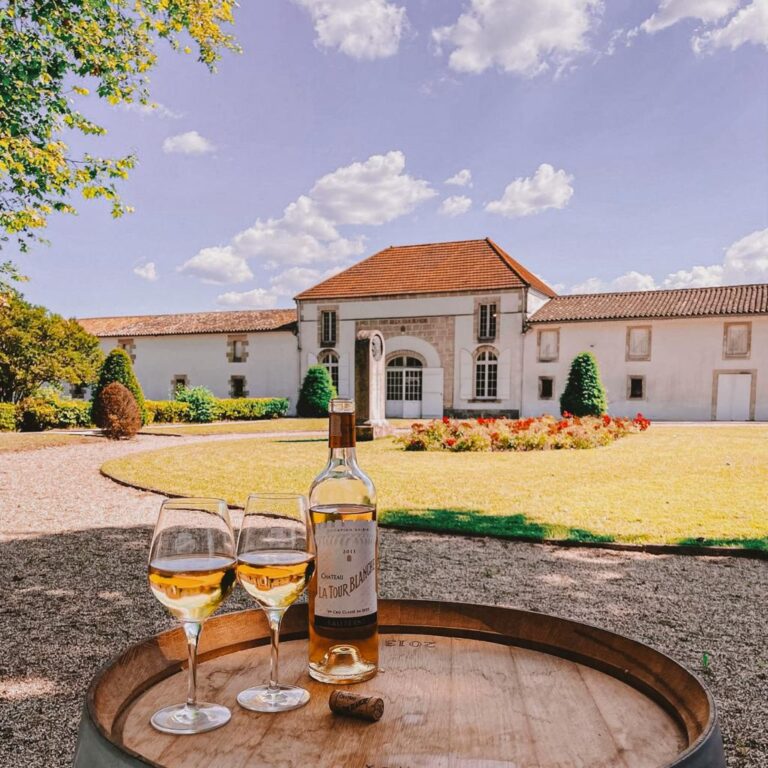
Arnaud de Malle, a Bordeaux bourgeois and merchant, built an earlier house on the estate in 1598. That building survives as the structure now used for the château shop. At the beginning of the seventeenth century, his son Jacques de Malle (1590–1654), president of the Parlement of Bordeaux, commissioned the present château. The Parlement was the French monarchy’s senior judicial and administrative court in Bordeaux, making Jacques’s presidency a prominent public office.
Jacques de Malle also began producing white wine for sale to Bordeaux brokers and foreign merchants. In 1643, the estate’s harvest amounted to 54 casks and two barrels. Viticulture is documented at Château de Malle from 1666, establishing a long continuity between the estate’s early modern history and its later identity as a wine property.
Transfer to the Lur-Saluces family
The estate remained with the de Malle family for five generations. It passed to the Lur-Saluces family through the marriage of Jeanne de Malle to Alexandre-Eutrope de Lur-Saluces (1672–1754), Baron of Fargues and Count of Uza. Alexandre-Eutrope embellished the grounds with formal gardens and added the family coat of arms to the façades. The arms feature three crescents, understood here as symbols of three family crusades.
Pierre de Lur-Saluces (1702–1780), Baron of Drugeac, inherited the estate in 1754. In 1780, ownership passed to Claude Henri de Lur-Saluces (1731–1793), who took the title Lord of Malle. During the French Revolution, Claude Henri was guillotined in Bordeaux on 24 December 1793 for “aristocratic crime.” In the same year, the property and title passed to his younger son, Louis-Alexandre-Eugène de Lur-Saluces (1774–1842), a royalist deputy representing Gironde.
Nineteenth-century estate and classification
After Louis-Alexandre-Eugène’s death, his brother Ferdinand-Eugène de Lur-Saluces (1780–1867) inherited the title and château. Ferdinand-Eugène’s son Henri de Lur-Saluces (1808–1891), later a senator of Gironde, managed the estate. During this period, the château’s Sauternes received its Second Growth classification in the 1855 Bordeaux classification, a system that placed Bordeaux wines in ranked categories.
Pierre de Lur-Saluces (1844–1937) reduced the vineyard from 40 to 15 hectares during the nineteenth-century phylloxera crisis. Phylloxera was an insect infestation that devastated European vineyards and forced many estates to replace their vines. Having no direct descendants, Pierre bequeathed Château de Malle in 1937 to his sister Adélaïde de Lur-Saluces (1846–1942), the wife of Henry d’Auzac de Campanac (1839–1903).
Their only daughter, Augustine Léontine Mathilde d’Auzac de Campanac (1870–1959), inherited the estate in 1942. She was married to Paul Charles Marie Just de Lespinasse de Bournazel (1866–1961). Their grandson Pierre de Bournazel (1929–1985), son of Henri de Bournazel, took over the property after the Second World War.
Restoration and modern ownership
When Pierre de Bournazel assumed responsibility, the property had been irregularly inhabited for almost two generations. Its buildings and vineyards were in serious disrepair. He rebuilt the fermentation cellar, studied estate management and oenology, and worked with his wife to restore the château’s rooms while preserving their original appearance.
Frost destroyed the entire vineyard in 1956, requiring it to be replanted. Pierre later became president of the Association of Classified Growths of Sauternes and Barsac. In 1959, he founded the Commanderie du Bontemps de Sauternes et Barsac, a wine confraternity associated with the classified sweet-wine districts of Sauternes and Barsac.
After Pierre de Bournazel died in 1985, his widow, Countess Nancy de Bournazel, continued work on the château and gardens and further improved the vineyard with help from their three sons. The château and vineyard were left abandoned in 2018, and the last vintage offered for sale was from 2016. In April 2024, Luc Planty, former director of Château Guiraud, and his wife Clémence purchased the estate and its stocks. This was the first transfer of the château outside inheritance. They began converting the estate to organic agriculture.
The gardens received historic-monument protection on 2 December 1943, while the château and its entire built ensemble gained the same protection on 8 September 1949. The gardens were designated a Jardin Remarquable in 2005.
Remains
Château and honor court
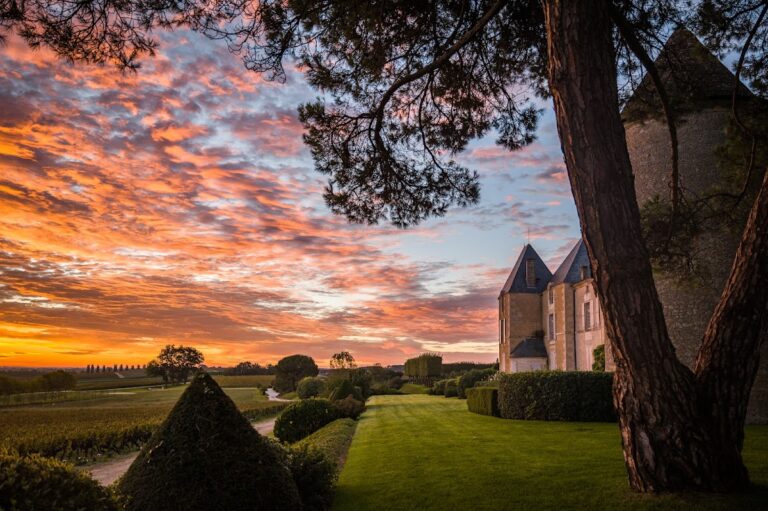
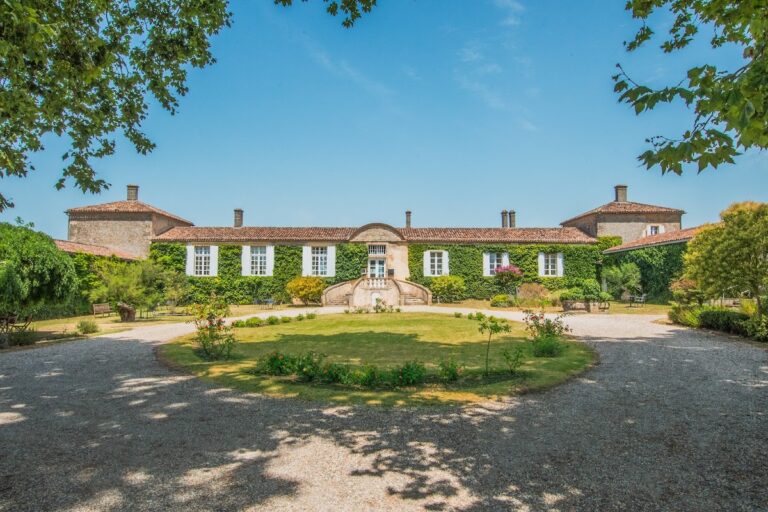
The château is an ornamental residence arranged around an honor court. Entry is through a gate, and the court is decorated with pilasters. The main residential block encloses the court together with two returning wings, each ending in a tower. This composition presents the residence as a formal ensemble rather than a single isolated block. The separate house built by Arnaud de Malle in 1598 remains part of the estate and now serves as the château shop.
Terraced formal gardens
The gardens cover six hectares and combine Italianate and French-style formal design. Their terraces are organized around a broad central axis, with two levels, pools, groups of statues and vases, and a staircase linking the terraces. A French formal garden uses geometric planning, strong axes, terraces, ornamental water and sculptural decoration, while the Italianate character of these grounds is expressed through their Renaissance-inspired terraces and statuary.
The sculptures include figures from Greek mythology such as Cephalus, Aurora, Cupid, Aphrodite, Adonis and Flora. Other statues represent viticulture, winemaking, hunting, fishing, wine and intoxication. East of the first terrace stands a small theatre decorated with figures from the Italian commedia dell’arte, a theatrical tradition built around recurring masked and stock characters, including Pantalone, Scaramouche and Harlequin. The second terrace contains statues symbolizing earth, wind, air and fire.
Cultivated grounds and vineyards
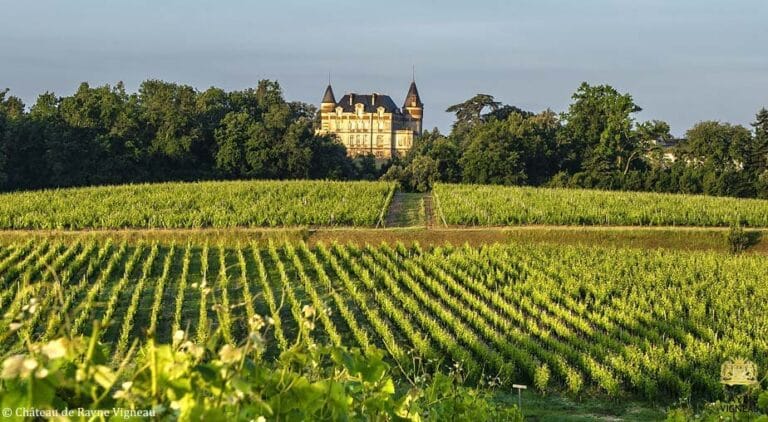
Southeast of the château, a basin contains a cultivated area of vegetables and fruit trees. The wider estate’s vineyards cover about 50 hectares across Preignac, Toulenne and Fargues. They comprise 28 hectares in the Sauternes appellation, three hectares for Graves Blanc and 20 hectares for Graves Rouge.
The estate produces several wines. Château de Malle Sauternes is made from 70 percent Sémillon, 28 percent Sauvignon Blanc and two percent Muscadelle, with one-third of its barrels new oak. The dry Graves white, M de Malle, contains 70 percent Sauvignon Blanc and 30 percent Sémillon and matures for six to nine months in oak barrels, 30 percent of them new. Red Graves is produced as Château de Cardaillan, composed equally of Cabernet Sauvignon and Merlot, and Château Pessan, made from 60 percent Merlot and 40 percent Cabernet Sauvignon. The Sauternes range also includes the unclassified Château de St Hélène.