Palazzo Zurla De Poli: A Renaissance Residence in Crema, Italy


Site at a Glance
- Rating
- 4.6
- Popularity
- Very Low
- Country
- Italy
- Primary era
- Early Modern
- External website
- Open
- Eras represented
- Early Modern, Modern
- Civilizations
- Habsburg, Italian, Venetian
- Site type
- Domestic
- Remains
- Elite Residence
On this page14 sections
History
Palazzo Zurla De Poli is a Renaissance residence in Crema, Italy, built around 1520 in an area north of the city that remained largely undeveloped after the Venetian walls were expanded between 1488 and 1509. Giacomo Zurla commissioned the house in his will of 1516, and his son Leonardo carried the project forward. An inscription gives 1520 as the construction date. From 1523, Aurelio Buso worked on the interior and exterior decoration of the two-storey palace.
The Zurla family and the sixteenth century
The palace belonged to the Zurla family, one of Crema’s oldest and most widespread noble families. Giacomo Zurla was still alive in 1524, when he supported the surrender of Crema to Louis XII, king of France from 1498 to 1515. The king knighted him, but when Venetian rule returned, Zurla was exiled to Grenoble for several months.
The family’s later history also connected the palace’s owners with major political and military events. Evangelista Zurla the Younger, Leonardo’s son, commanded the galley Crema San Vittorio at the Battle of Lepanto in 1571, the naval conflict between the Holy League and the Ottoman fleet. He was credited with capturing a twenty-eight-bench galley, a substantial oared warship. Its weapons and insignia were sent to Crema for placement on the altar of the Madonna in the cathedral. Evangelista’s son Leonardo and grandson Rutiliano, both described as noble galley officers, fought alongside him.
A later Giacomo Zurla, who was living in 1700, received the title of marquis from Leopold I of Habsburg in 1699. The family also owned a painting of Saint Sebastian by Raphael Sanzio, the Italian High Renaissance painter. They sold it to the engraver Giuseppe Longhi in 1818. Count Guglielmo Lochis later acquired the painting and donated it to the Accademia Carrara in Bergamo in 1886.
Alterations and change of ownership
In 1836, the nobleman Angelo Zurla enlarged and embellished the peristyle, an open space surrounded by a colonnade, the museum, and the palace interiors. The work also dealt with damage caused by the Soncino earthquake of 1802.
The property remained with the Zurla family until the early twentieth century. Following the deaths of Adalberto Zurla in 1895 and Alba Zurla, who had married into the Douglas Scotti family, in 1913, Adalberto’s wife, Chiara Parravicini, sold the palace to Dr. Giovanni Viviani in 1903. Viviani demolished the external loggia, a covered gallery, which had been recorded in an 1874 photograph. Its removal left frescoes exposed to the weather. Paintings attributed to Carlo Urbino, showing scenes from Jerusalem Delivered, were still intact in 1915, but only fragments survive today.
Giovanni Viviani sold the palace in 1921 to Count Gaddo Vimercati Sanseverino. In 1931, the count transferred part of the garden to the Committee for Honouring the Princes of Piedmont for construction of the Prince Umberto Nursery School. Completed in 1935, the building is now the municipal Casa dei Bambini–Iside Franceschini nursery school.
Restoration and conservation
Also in 1931, engineer Francesco De Poli acquired the palace. Because the building was in precarious condition, he restored it and made it his residence. The property has remained with his descendants.
Drainage works along Via Giovanni Bottesini and the impact of a salt-spreading vehicle in 1985 caused cracks and detachments in the southern wing, damaging its frescoes. Static consolidation and new plaster were needed. Conservation work in 2019 exposed several painted sections believed to have been lost, including areas concealed beneath later stucco.
Remains
Façade, entrance, and courtyard
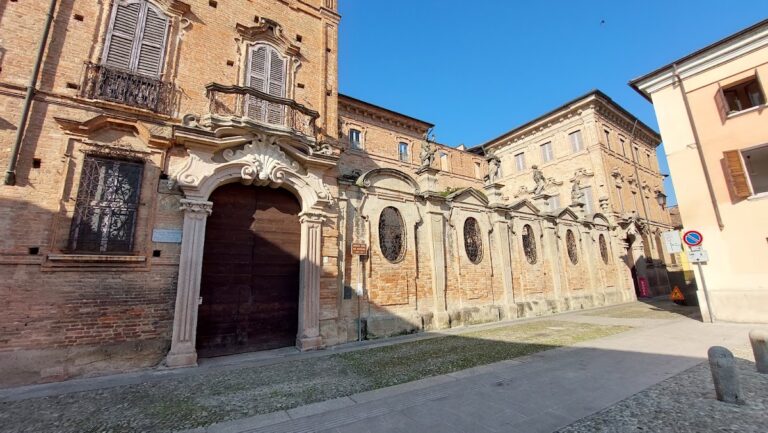
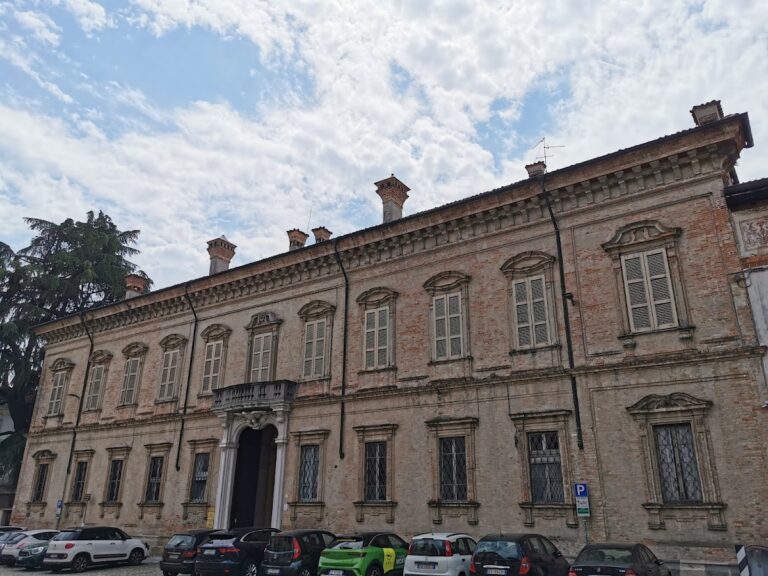
The palace is a two-storey Renaissance dwelling arranged around the inner area of a U-shaped plan, with wings of different volumes. Its façade on Via Tadini is exceptionally plain and linear. Aurelio Buso probably decorated it in monochrome fresco. The windows on the two sides of the portal sit at different levels, while a stringcourse runs below the eaves, which contain several oculi, or small circular openings. Simple openings at street level provide access to the cellars.
Portal and courtyard
The slightly off-centre portal has a round arch and opens into a passage marked by wheel tracks. This passage leads to a cobbled courtyard. Until the early twentieth century, the courtyard contained a giant-order loggia with five arches separated by Ionic pilasters on high plinths. A cornice ran above the arches, with further oculi arranged above it. A small balustraded stairway of sedimentary stone rises on the right towards the principal entrance. It was formerly protected by the loggia.
Garden
Beyond the courtyard lies an Italian-style garden. It was once considerably larger and was redesigned during the 1930s by the brothers Mosè and Lodovico Zappelli.
Frescoed rooms
The right wing contains four frescoed rooms. They form the palace’s most distinguished interior spaces and include several cycles of mythological, biblical, and narrative painting. Their authorship is debated among Aurelio Buso, Giovan Battista Castello, Vincenzo Civerchio, and Carlo Urbino, depending on the room and the interpretation of its decoration.
Banquet Hall
The entrance stairway leads to the ceremonial Banquet Hall. Its central pavilion-vaulted ceiling, formed by sloping surfaces rising towards a central ridge or point, bears a fresco of The Banquet of the Gods. The surrounding lunettes, semicircular decorative fields beneath the vault, together with panels and ovals, contain twelve mythological scenes from Cupid and Psyche. Some scenes were removed at an uncertain date, transferred to canvas, and later reattached to the ceiling.
The principal attributions for the cycle are Aurelio Buso and Giovan Battista Castello, a pupil of Vincenzo Civerchio. The hall also has a fireplace contemporary with the palace. Its architrave is interrupted by rosettes, two statues stand on the hood, and a central cartouche, or framed decorative panel, depicts The Triumph. A bust formerly placed above the fireplace disappeared after the structural failures of 1985. During the 2019 restoration, the walls were repainted pale green, replacing their previous purple colour.
Stories of the Patriarchs Room
The room of the Stories of the Patriarchs contains eleven scenes of biblical patriarchs. Older attributions connected the paintings with Vincenzo Civerchio, while comparisons and later studies have suggested Giovan Battista Castello.
Stories of Naaman the Syrian Room
The room of the Stories of Naaman the Syrian contains ten episodes from the life of the Aramaean general, framed by elaborate cartouches. One shows a ruler beside the inscription “V.C. CARLO V 1540,” which was restored to visibility in 2019. The inscription refers to Charles V, who was in Lombardy between 1540 and 1541.
The cycle has traditionally been associated with Vincenzo Civerchio, partly because of the initials V and C. More recent interpretations regard those initials as possibly apocryphal and propose Giovan Battista Castello or an early work by Carlo Urbino.
Prodigal Son Room
The Prodigal Son Room contains ten panels illustrating the parable of the Prodigal Son. It suffered the most severe damage in 1985, including detachments of painted material. Restoration revealed part of the scene showing the Prodigal Son in the fields with a shepherd. It also uncovered a previously lost stone marker inscribed “D. AVR BVSO,” identifying Aurelio Buso as the artist. Traces of an illegible date remain on the marker.
Surviving exterior paintings
Frescoes depicting Jerusalem Delivered once decorated the palace wall beside the former loggia. They are attributed to Carlo Urbino or to the school of the Campi. The demolition of the loggia and the resulting exposure to weather led to the loss of most of the paintings, leaving only fragments.
Nearby sites