Chiesa di S. Bernardino degli Osservanti: A Franciscan Church in Crema, Italy
Site at a Glance
- Rating
- 4.5
- Popularity
- Very Low
- Country
- Italy
- Primary era
- Early Modern
- Eras represented
- Early Modern, Modern
- Civilizations
- Venetian
- Site type
- Religious
- Remains
- Church
On this page24 sections
History
Chiesa di S. Bernardino degli Osservanti is a Catholic church in Crema, Italy, built by the Observant Franciscans in the sixteenth century and consecrated in 1534. The Observants were a reform branch of the Franciscan Order that promoted stricter observance of its rule. The church is also known as San Bernardino degli Zoccolanti, San Bernardino in Città, and the Bruno Manenti Auditorium.
Bernardino of Siena and the first foundation
The church’s origins are linked with the solemn preaching of Bernardino of Siena in Crema during the autumn of 1421. Bernardino was a Franciscan preacher and reformer whose sermons encouraged religious devotion and reconciliation between rival communities. His preaching was associated with an attempted reconciliation between the Guelf and Ghibelline factions of the city, although the truce ended when conflict resumed after the fall of Giorgio Benzoni in 1423.
During his passage through the area, Bernardino founded the convent of Santa Maria de Supravalle at Pianengo. It belonged to the Observant Province of Brescia. Four years after Bernardino’s canonization in 1450, the province established an affiliated convent beyond the Serio River near Crema. The foundation stood outside the city and remained exposed to the military dangers of the early sixteenth century.
Destruction and rebuilding within the walls
In 1514 the outlying convent was demolished to prevent Prospero Colonna from using it as a fortified position during the siege of Crema. Renzo da Ceri, who defended the city for the Republic of Venice, had ordered the removal of trees and houses around the walls as part of the defensive preparations.
In 1515 the Observants asked permission to establish a new convent within Crema, apparently in part to compensate for the loss of the earlier foundation. They received land north of Piazza Maggiore, where construction of a new convent and church began in 1518. Contributions from the faithful supported the work, and the complex was completed in 1534, when the church was consecrated.
The convent grew around the church. The original cloister was later joined by a larger one, represented in a 1610 fresco in the convent of San Giuseppe in Brescia. A third cloister was subsequently constructed between present-day Via Cesare Battisti and Via Giovanni Bottesini. During the following two centuries, the church retained its basic structure while its chapels, altars, and interior decoration were progressively developed.
Alterations, suppression, and institutional reuse
An organ made by the Antegnati family was installed behind the apse in 1580. The instrument was later enlarged by the Serassi family and altered by Pacifico Inzoli in 1884. The Napoleonic suppressions of 1810 transferred the convent to state ownership, while the church became a subsidiary church of the cathedral.
Giambattista Pisani purchased the former monastery and later sold it to nobles who intended to establish a boarding school for girls. With the involvement of Maria Crocifissa Di Rosa, founder of the Handmaids of Charity, the institution opened. The boarding school was suppressed in 1972. That same year, the religious order established affiliated nursery and primary schools, which it managed until 2000. The school facilities were then transferred to the Carlo Manziana Foundation and were put up for sale in 2023.
Earthquakes, structural repairs, and continuing use
The Soncino earthquake of 1802 caused substantial damage, including the fall of part of the plaster from the triumphal arch. In 1809 the pinnacle of the bell tower was dismantled to allow the installation of an optical telegraph, which was removed in 1814.
By the middle of the nineteenth century, fissures and cracks had created serious structural problems. Carlo Donati de’ Conti and Luigi Re directed major restoration works in 1868 and 1869. The floor was renewed and the interior redecorated by Luigi Manini. Further restoration took place in 1910 and 1913, followed by additional works in 1994 and 1996. The church remains consecrated and is used for religious services when the cathedral is closed for restoration. Its scale also allows it to serve as an auditorium dedicated to the philanthropist Bruno Manenti, as well as a venue for cultural events, particularly classical and religious concerts.
Remains
Exterior and overall layout
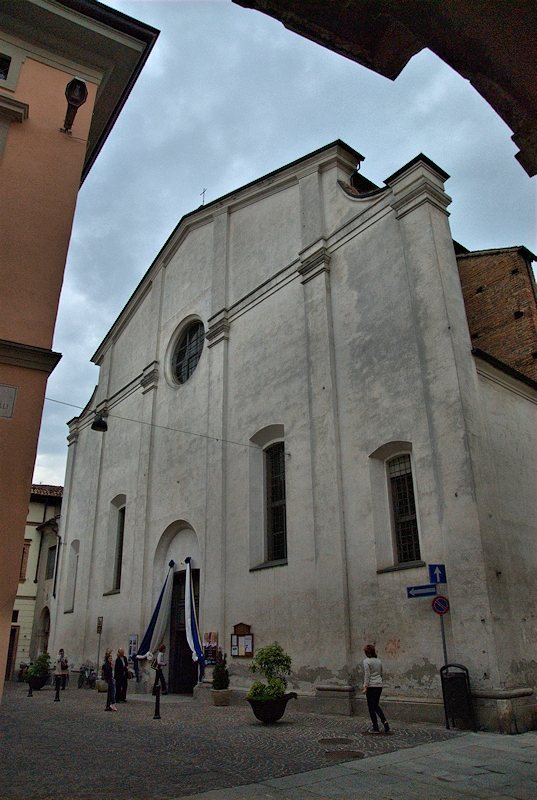
The church is visible externally on two sides. Its broad façade is fully plastered and whitewashed, with five sections divided by thin pilasters. The central section contains a portal beneath a simple arch. The side sections have single-light openings at different levels. A plain entablature occupies the upper zone and is interrupted by a circular window. Above it, a partial pediment covers three sections, while volutes connect it with the outer parts of the façade.
The south side is plastered and divided by pilasters. Exposed-brick buttresses rest against them and support the walls of the taller nave. The nave roof rises above the roofs of the lateral chapels, making the relationship between the central worship space and its side chapels clear from the exterior.
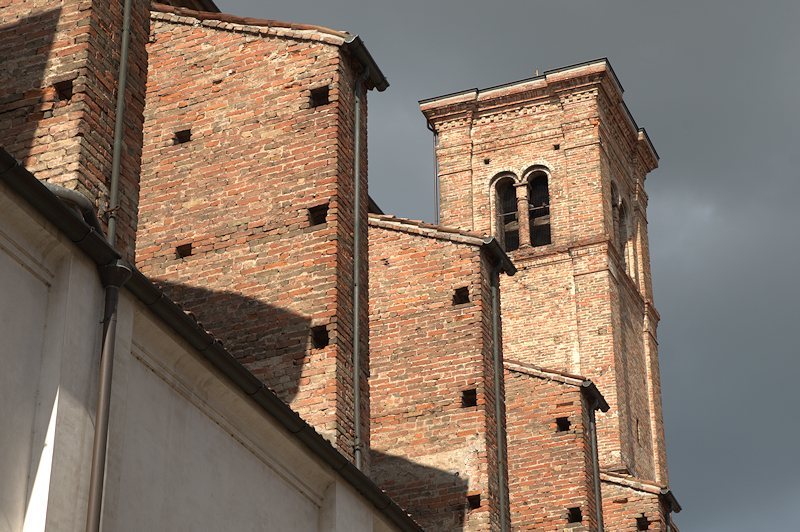
The exposed-brick bell tower has slender pilasters at its corners and projecting cornices that divide it into three sections. The upper section contains the belfry, with paired arched openings, and ends in a dentilled cornice. Five bells are installed in the tower. Two were made by Andrea Crespi in 1804 and are tuned to C4 and F4. Three others were made by Emanuele Allanconi of Bolzone in 2008 to replace bells requisitioned during the Second World War; they are tuned to B-flat3, D4, and E-flat4.
Nave, chapels, and painted architecture
The interior is a large rectangular space with a single nave and six lateral chapels on each side. A deep, narrow presbytery, the area around the main altar reserved for the clergy, lies at the eastern end and is flanked by one chapel on either side. The church’s unusually large dimensions for sixteenth-century Crema reflect the crowds attracted by Franciscan preaching. It is the second-largest church in the Diocese of Crema after the cathedral.
Each lateral chapel has a sail vault, a vault formed by a section of a sphere over a rectangular bay, and an external semicircular arch. Projecting pilasters with Corinthian capitals separate the chapels and support an elaborate cornice decorated with meanders and foliage. Above it is a barrel vault with six lunettes on each side. Three lunettes on each side contain windows that light the nave. Luigi Manini later enriched the interior with painted architectural effects, including false crossing ribs, rosettes, candelabra, and areas of simulated shadow.
Chapel of Saint Bonaventure
The Chapel of Saint Bonaventure became the Vimercati family’s patronage chapel during the seventeenth century. A patronage chapel was maintained and decorated by a family, confraternity, or other institutional patron. Its altarpiece is Tomaso Pombioli’s Madonna and Child with Saints Bonaventure and Francis, an oil painting dated approximately 1625–1636. The Madonna and Child appear among angels above, while an angel holding a book occupies the lower centre and Saints Bonaventure and Francis stand at the sides. Stucco capitals support a broken pediment with the Vimercati coat of arms and the inscription Divo Bonaventurae Sacrum. The altar uses grey, red, and Belgian black marble, and a niche above the tabernacle preserves the head of Saint Fermo. The remaining decoration is attributed to Luigi Manini’s workshop.
Chapel of Saint Diego of Seville
An act of 1593 assigned the Chapel of Saint Diego of Seville to the Griffoni family of Sant’Angelo. The family commissioned Aurelio Gatti’s Saint Diego and Two Franciscan Saints Adoring the Madonna, an oil painting dated approximately 1550–1559. The chapel contains a polychrome-marble altar with an inlaid image of Saint Diego, along with Tomaso Pombioli’s paintings of the Annunciation and the Madonna with the Symbols of Sacred Scripture. Its decoration was signed by Fruttuoso Spagnoli and dated 1759.
Chapel of Saint Joseph
The Chapel of Saint Joseph was first dedicated to the Virgin and later assigned to Saint Eligius under the patronage of the de Marchi family. It received its present dedication in 1868. Its polychrome-marble altar supports a nineteenth-century statue of Saint Joseph by an unknown sculptor. Giovanni Brunelli’s Nativity and Saint Eligius Distributing Alms to the Poor hang on the side walls. The latter is dated approximately 1700–1710, while the rest of the chapel’s decoration is nineteenth-century.
Chapel of the Madonna
The Chapel of the Madonna was initially dedicated to Saint John the Baptist and later to Saint Mark under the patronage of the weavers’ confraternity, a lay religious association organized around shared worship, charity, or devotion. It received its present dedication in 1799, when a red Verona-marble altar was installed. Above it stands a statue of the Woman of the Apocalypse, probably by Giacomo Bertesi. Carlo Antonio Barbelli produced much of the seventeenth-century decoration, which depicts the life and martyrdom of Saint Mark. The scenes include Saint Mark preaching and healing the sick, being struck while celebrating Mass, dictating the Gospel to Saint Peter, and being dragged by executioners. Some of the paintings and panels were altered in the nineteenth century with Marian subjects.
Chapel of Saint Anthony of Padua
The Chapel of Saint Anthony of Padua was first dedicated to the Madonna and rededicated during the seventeenth century. Gian Giacomo Barbelli and the stucco artist Antonio Prandi substantially revised its pictorial and decorative scheme. Barbelli’s principal altarpiece, Saint Anthony with the Christ Child, is dated 1651. Other works show Saint Anthony healing a sick man, healing a woman with his cord, resurrecting a drowned child, and reattaching a young man’s leg. The vault combines stucco decoration with painted angels. A white-marble altar with inlays supports two columns, the altarpiece, and a pediment containing a cartouche with the responsory of Saint Anthony.
Chapel of Saints Bernardino of Feltre and Peter of Alcantara
This chapel has a seventeenth-century altar and several paintings by Giovan Battista Lucini. Its altarpiece, Saint Peter of Alcantara and Saint Bernardino of Feltre, represents the two saints who established the monte di pietà, a charitable lending institution that provided loans on pledged goods at more accessible rates than commercial moneylenders. The chapel also contains Saint Rose of Lima, probably transferred from the former church of San Domenico and probably painted shortly after 1671, and an anonymous Lombard-school painting of Saint Margaret of Cortona between Two Franciscan Saints.
Chapel of Saint Philip Neri
To the left of the presbytery, the Chapel of Saint Philip Neri was initially dedicated to Saint John the Evangelist. Luigi Manini decorated the chapel, whose polychrome inlaid-marble altar supports painted columns and an elaborate pediment. The pediment bears the inscription In Mediatione Mea Exardescit Ignis, from Psalm 38. Painted medallions and arches on the side walls open onto an illusory room in perspective. The seventeenth-century altar carries an anonymous nineteenth-century copy of Guido Reni’s Madonna and Child with Saint Philip Neri.
Chapel of the Friar and the Warrior
This chapel was originally dedicated to Franciscan martyrs beheaded in Morocco in 1227 and was under the patronage of the Baruffi family. During the eighteenth century it passed to the Bondenti family, who rebuilt it and rededicated it to Saint John of Capestrano and Saint Paschal Baylon. Giovanni Antonio Galliari decorated it with painted draperies, vases, flowers, angel heads, and a perspectival dome preceded by a curved illusory balcony with seated angels. Its polychrome-marble altar carries Martino Cignaroli’s The Madonna and Saints John of Capestrano and Paschal Baylon, dated approximately 1709–1724.
Chapel of Saint Eligius
The Chapel of Saint Eligius was originally dedicated to Saint Joseph, as surviving inscriptions indicate, and retains scenes from Joseph’s life. A real window from the façade opens on one side opposite a painted false window. Nicola Scotti signed and dated the polychrome-marble altar in 1824. Above it is Gian Giacomo Barbelli’s Miracle of Saint Eligius, an oil painting dated 1639, together with other paintings of the saint by Gabriello Brunelli.
Chapel of the Pardon of Assisi
Originally dedicated to the Twelve Apostles, this chapel was rededicated in 1759 when it was granted to the Consortium of the Pardon of Assisi. The Pardon of Assisi refers to the indulgence traditionally associated with the Franciscan devotion known as the Porziuncola indulgence. The chapel’s Baroque altar has inlaid marble, high-relief angels, simulated columns, an entablature, and a curved pediment with angels. Mauro Picenardi’s Vision of the Pardon of Assisi, dated approximately 1750–1799, shows Saint Francis kneeling before Christ and requesting indulgence. Other works include an anonymous seventeenth-century Madonna and Child with Saints and Gabriello Brunelli’s Saint Eligius before the King’s Throne. The tempera decoration is nineteenth-century.
Chapel of Saint Peter in Chains
The Chapel of Saint Peter in Chains was successively dedicated to Saint Francis, the Japanese martyrs, and Saint Peter. Its Verona-marble altar bears crossed keys. Above it, painted columns support an entablature and a crest with a pastoral staff, papal cross, and tiara. Giovan Battista Lucini’s Liberation of Saint Peter from Prison, dated 1675, occupies the centre. The chapel also contains an anonymous seventeenth-century Miraculous Draught of Fishes and Christ with Saints Peter and John the Evangelist, attributed to Giovanni da Monte and transferred from the cathedral. The painted decoration is nineteenth-century.
Chapel of the Guardian Angel
The Chapel of the Guardian Angel was formerly under the patronage of the Consortium of the Guardian Angels. Its Baroque altar has stucco-marble columns and a pediment with two cartouches. A niche contains an anonymous statue of an angel with the Child. Tomaso Pombioli’s paintings represent Hagar and the Angel, Gideon’s Calling, the Angel Destroying Sennacherib’s Army, the Angel Liberating Saint Peter from Prison, the Angel Inspiring the Prophet Habakkuk, and the Angel Casting a Demon into Hell.
Chapel of the Holy Crucifix
The Chapel of the Holy Crucifix has retained its dedication and was formerly under the patronage of the Vimercati family. Above its red-and-green marble altar are statues of the Sorrowful Virgin and Saint John, with a niche above them containing the Crucifix of the Dying, attributed to Giacomo Bertesi. The statues came from the former church of Santa Caterina. Seventeenth-century stucco and frescoes, perhaps by Tomaso Pombioli, meditate on the Passion and Resurrection through scenes involving Abraham, Isaac, and Jonah. A cartouche records restoration in 1869.
Chapel of the Franciscan Order
The chapel dedicated to the Franciscan order was originally a full chapel with its own altar and altarpiece. Its side portal was opened at an uncertain date, possibly during the nineteenth century. The surviving decoration is attributed to Gian Giacomo Barbelli and includes frescoed panels showing the Temptation of Saint Francis, the Apparition of Jesus and Mary, the Adoration of Mary and the Christ Child, and the partly effaced Purgatory of Saint Francis. Other painted figures include Richard the Bishop, Peter, Homobonus, Leo, Conrad, Thomas, Roch, Eleazar, Louis the King, Ivo, Joan, Elizabeth of Hungary, Elizabeth the Empress, and Margaret.
Presbytery, choir, and organ
The presbytery is enclosed by a balustrade of white, red Verona, and Belgian black marble, with an iron gate at the centre. Its central altar is made of polychrome marble and bears a representation of Saint Bernardino. The elaborate Baroque throne now in the presbytery was acquired from Santissima Trinità in 1886. A smaller marble throne from the same church was installed on the high altar in 1887. Manini decorated the presbytery, choir, and barrel vault with painted balustrades, windows, balconies opening onto fictive perspectives, and geometric designs.
Two Eucharistic paintings by Giovanni Battista Lucini are displayed in the presbytery. The Miracle of Turin recalls the event of 16 June 1453, when a stolen consecrated host rose from a sack and came to rest in a chalice. The Miracle of Valencia represents the discovery in 1238 of buried hosts stained with blood. A strongly realist Last Supper by Giovanni Angelo Ferrario is also displayed there.
The seventeenth-century choir consists of twenty-five walnut stalls. Above it, against the rear wall of the apse, is the organ that the Antegnati family made in 1580. The Serassi family enlarged it in the eighteenth century, Pacifico Inzoli altered it in 1884, and the Tamburini firm worked on it in 1994 and 1995.
Triumphal arch and counter-façade
The triumphal arch, which separates the nave from the presbytery, was painted by Vincenzo Civerchio with the Annunciation. Luigi Manini later retouched the fresco and restored areas of plaster that had fallen during the 1802 earthquake. The Archangel Gabriel appears on the left before a balustrade, while Mary kneels on the right behind a lectern bearing the book of prophecies. The central area, now filled with strong radiance, may originally have contained God the Father.
The counter-façade contains several commemorative inscriptions and an elaborate wooden organ case at its centre. Peranda of Caravaggio made the case in 1647 for the Confraternity of Mercy, and it was later transferred from the cathedral. Pierced, painted, carved, and gilded, it stands above an eighteenth-century walnut entrance screen.