Palace of the Mount of Piety (Crema): Renaissance Headquarters of a Charitable Lending Institution


Site at a Glance
- Rating
- 4.5
- Popularity
- Very Low
- Country
- Italy
- Primary era
- Early Modern
- Eras represented
- Early Modern
- Civilizations
- Venetian
- Site type
- Civic
- Remains
- Palace
On this page10 sections
History
The Palace of the Mount of Piety is a Renaissance building in Italy, commissioned in 1569 and completed in 1586 for the Mount of Piety of Crema. The palace served as the institution’s headquarters until 1991, linking its architecture to a charitable lending system that supported people of limited means while managing property pledged as security for loans.
Foundation of the Mount of Piety
The Mount of Piety was formally established by a resolution of Crema’s Grand Council on 24 April 1496. Its foundation had been prepared earlier, when the council assigned 200 ducats from a duty on linen cloth on 20 May 1492. Regulations adopted on 15 July 1493 followed the model of the Mount of Piety of Padua, and a Venetian ducal decree ratified Crema’s foundation on 12 July 1496.
The institution’s creation was probably encouraged by the preaching of Ludovico della Torre and was chiefly promoted by the Observant Franciscan preacher Michele d’Acqui. Michele joined the first council with ten citizens. He supported charitable distributions, collections connected with the Corpus Christi procession, donations from nobles and clergy, subscription income, and a competition among Crema’s four city gates. A voluntary confraternity also contributed to the treasury for about a decade.
A Mount of Piety was a charitable lending institution that generally provided pawn loans to people with limited means. Borrowers deposited property as collateral and could recover it by repaying the loan and its charges. Crema’s Mount initially lent money without interest and had no permanent headquarters. It operated first in the house of Jacopo Zurla, then in a house belonging to Bernardino Bremaschi, and later in the house of Nicola Leale. That property had previously been granted to Crema’s Jewish community for lending activities. The Mount remained there until the palace was completed in 1586.
Early pressures and the move to a permanent palace
Crema’s Jewish community had been present since at least 1447 and lived mainly in the Contrada del Ghirlo. In 1468 it unsuccessfully sought permission to establish a synagogue. A cemetery outside the city walls was permitted, although its precise location is unknown. A gravestone found in 1960 on land belonging to the Vimercati Sanseverino family records the burial at Crema of Aaron Moses, son of Jacob Levi, who had died at Brescia on 17 September 1490.
The Mount suffered a severe interruption during the 1514 siege of Crema by a coalition of the Duchy of Milan, the Spanish Empire, and the Swiss Confederation. As the population became exhausted and funds for soldiers’ pay failed, the defending commander Renzo da Ceri seized the assets of the Mount and of Santa Maria della Croce. He used them to mint fifteen-soldi coins known as petacchie, which carried only the image of Saint Mark on one side.
By 1544 the Mount possessed considerable real-estate assets, but its income remained low in part because it had to meet testamentary bequests made by benefactors. It therefore introduced interest-free loans for small sums and progressively higher rates for larger loans. Critics argued that interest contradicted the institution’s founding principles. Pope Gregory XIII absolved the administrators of Crema, and on 1 May 1581 he authorized fair interest rates for paying staff, preserving the institution’s property, and covering foreclosure expenses. The palace, commissioned a little over a decade before this decision, provided the permanent administrative base for the Mount’s expanding responsibilities.
Charity, education, and Venetian administration
Benefactors steadily enlarged the Mount’s resources through gifts and inheritances. Antonio Da Monte left 300 ducats in 1499. Bernardino Benvenuti made the Mount his universal heir in 1502 while requiring four annual marriage dowries, and Luigi Verdelli’s inheritance in 1524 funded dowries. Michele Cerri followed with a universal inheritance in 1549. In 1576 Emilia Zurla assigned half her estate to provide dowries for seven poor young women. Francesco Coldaroli De Musinappi left his estate in 1619 with the obligation of providing a daily Mass, while Giuseppe Mandricardi made the Mount his heir in 1883 and required a bequest to the Hospital of the Infirm.
During the seventeenth century the Mount acquired the church and small monastery of San Marino. The Humiliati, a medieval Italian religious order, had been suppressed in 1571, after which the property became a simple benefice. In 1621 Monsignor Agostino Morosini transferred the former Humiliati house and church to the Observants of Saint Augustine, a reform branch of the Augustinian order. The Observants sold the complex to the Mount of Piety in 1655.
The Mount financed two schools of grammar and humanities at the former San Marino complex, including the teachers’ salaries. Lay teachers had an uncertain beginning, but the Clerics Regular of Saint Paul, commonly called Barnabites, later assumed responsibility for instruction and achieved success. The Barnabites were a Catholic congregation devoted to pastoral work and education.
Venetian inspectors revised the Mount’s regulations in 1644 and directed annual surpluses to five charitable institutions: the Capuchin nuns, the Convertite nuns, the Conservatory of Unmarried Girls, the Beggars, and the Hospital of the Foundlings. Additional obligations followed. The Mount gave 40 ducats to prisoners in 1669 and bought a house owned by Camillo Zurla in 1679 to create a more dignified prison. Its charitable payments extended to the Tertiary Mothers in 1681 and the Hospital of the Infirm in 1699.
In 1722 the Venetian Senate required the Mount to contribute to a fund for health emergencies, an obligation that lasted until 1790. The institution also paid for cathedral embellishment, other religious works, repairs after Franco-Spanish and Imperial military clashes in the Cremasque, and road repairs in Crema in 1793. In 1734 it lent 5,000 ducats to the Republic of Venice.
The San Marino schools eventually became too expensive for the Mount to maintain. In 1744 the church and convent were transferred to the Barnabites, together with an annual payment of 4,700 lire. The agreement required the religious community to return the property if it left Crema. A Venetian Senate law of 1767 further reorganized the Mount’s administration. Five superintendents received three-year terms, followed by three years without re-election, while new posts were created for a lawyer, a full-time chancellor, and a custodian and liaison officer. Podestà-captain Daniele Balbi appointed Luigi Benzoni, Marquis Benedetto Obizzi, Marquis Luigi Zurla, Faustino Griffoni of Sant’Angelo, and Carlo Premoli as the first superintendents.
Reorganization under French and Austrian rule
In 1800 the Cisalpine Republic required Crema to pay 83,000 Milanese lire under threat of military occupation. The Cisalpine Republic was the French-backed state that governed much of northern Italy from 1797 to 1802 and imposed administrative and financial reforms on charitable institutions. Because the municipality could not raise the sum, the money was taken from the Mount’s funds and those of the hospital.
The Cisalpine Republic suppressed the Mount’s statute in 1809. After deducting 40 percent, it directed the surplus to the House of Shelter, and in 1811 it dissolved the board of deputies and transferred the assets to the Congregation of Charity. The Austrian Empire later restored the Mount’s full autonomy.
Following French religious suppressions, the San Marino complex and the school built by the Barnabites returned to the Mount in 1810. The municipality could use the school without rent but paid 4,000 lire for teachers’ salaries. An agreement in 1857 granted the municipality perpetual use of the school building. Parish authorities of Saint Benedict later received permission to use rooms in the small convent, which led to repeated disputes over their rights.
A regulation of 1859 widened the categories of property accepted as pledges. Italian legislation in 1862 separated funds derived from bequests and donations from those produced by pawn activity, leading to a new statute in 1873. In 1879 the Mount agreed to the municipality’s request to acquire and demolish the church and convent of San Marino for a new square. Two thousand lire from the sale supported the expansion of Santa Maria Stella, while compensation went to the parish of Saint Benedict.
State control and twentieth-century decline
A state reform of 1883 abolished the Mount’s board of trustees and created a Congregation of Charity incorporating the Mount, the Opera Pia Verdelli, and the House of the Poor. Between 1884 and 1885 the new administration eliminated liabilities connected with inheritances and public-debt securities.
From the 1890s, competition from cooperative banks, savings banks, and mutual-aid societies contributed to the Mount’s financial difficulties. Repeated efforts to obtain authorization for banking operations failed between 1903 and 1920. An agreement in 1920 allowed the Mount of Piety of Cremona to open a branch in Crema, with half its profits assigned to the city. The branch was unprofitable and closed in 1926. Its few account holders were absorbed by the savings bank, while the Congregation of Charity assumed its losses.
Another attempt to transform the institution into a bank was rejected in 1926. In 1928 the administrators decided to dissolve the Mount and transfer its remaining assets to the House of Shelter, but the Ministry of Agriculture halted the process in 1929 and ordered pawn lending to resume. Following another statutory amendment, activities officially restarted in 1934.
Law 745 of 1 May 1938 defined the Mounts of Piety as legal entities providing pawn credit and allowed the suppression of institutions that remained inactive or ran deficits for three consecutive years. The Mount of Piety of Soncino was suppressed in 1941, and its assets were transferred to Crema.
World War II increased reliance on pawn loans, but pledged property was increasingly left unredeemed and auctions attracted few buyers. After a brief suspension in 1945, the Mount resumed operations with help from benefactors, the Municipal Assistance Authority, the Popular Bank of Crema, and the Savings Bank. Unsuccessful or speculative auctions continued, and the institution could not recover its interest and capital.
The economic boom of the 1960s reduced the use of pawn lending. The service increasingly aided isolated, unemployed, or elderly people facing severe hardship, while the decline continued through the 1980s. In 1989 the administrators began incorporating the institution into the Bank of Mount of Lombardy. The merger took effect on 1 January 1991, ending the Mount’s existence as an independent institution and closing the palace’s long period as its headquarters.
Urban history after 1991
The palace stood beyond Crema’s irrigation ditch, in an area incorporated into the city’s Venetian walls only a few decades before its construction. The adjacent road changed names several times. It was known as Contrada di là dell’acqua, Contrada dietro l’acqua, Strada dietro l’acqua, and Viale all’acqua before becoming Via Monte di Pietà in 1871. It was named for Italo Balbo in 1941, returned to the name Mount of Piety after World War II, and became Via Giuseppe Verdi in 1951. The street along the building’s eastern side took the name Via Monte di Pietà at the same time.
After the Mount was incorporated into the Bank of Mount of Lombardy, the historic palace was offered to the municipality, which declined to negotiate. A private company then acquired the building and carried out a general restoration. The palace subsequently came to be used for offices and financial activities, giving its later history a direct connection to its former institutional purpose.
Remains
Renaissance palace facade
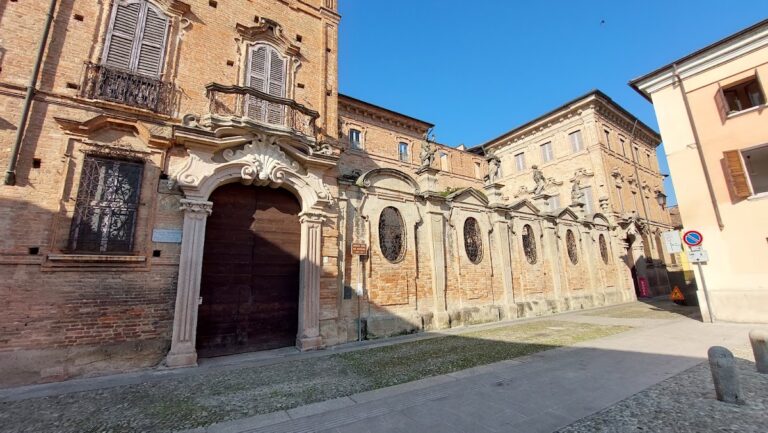
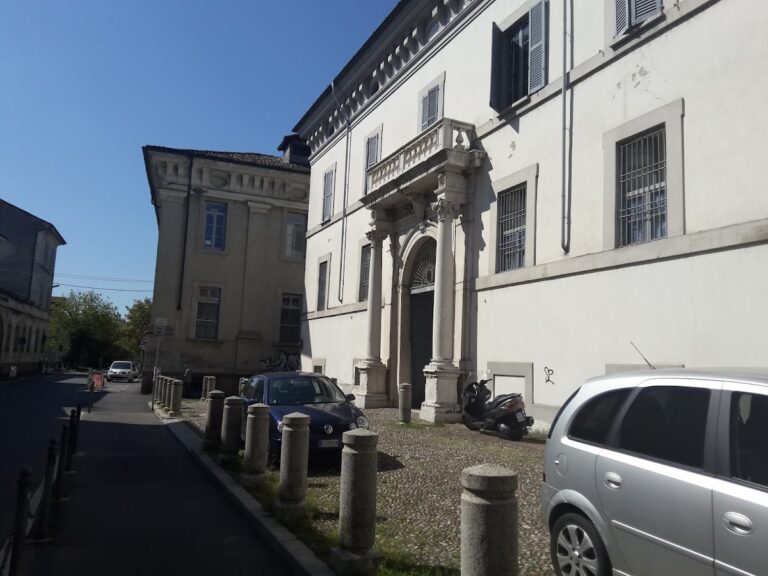
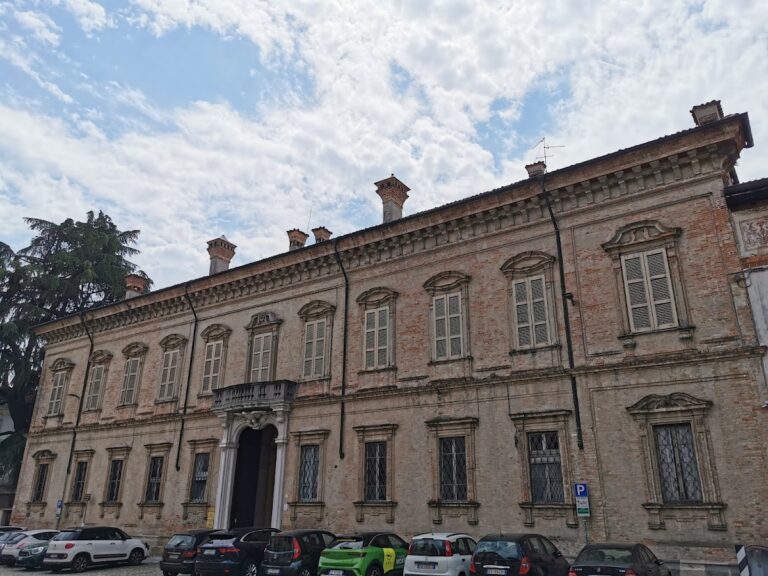
The surviving palace is a Renaissance building with a tall principal facade organized by nine Ionic pilasters on high pedestals. Two levels of windows are set between the pilasters, and wrought-iron grilles protect the openings. At ground level, the entrance portal has a terracotta surround. Above it, the inscription “MONS PIETATIS” identifies the institution for which the building was constructed, while a panel retains traces of a fresco depicting the Pietà.
The pilasters end in terracotta capitals of Corinthian style. They support a string-course cornice with corbels, and rectangular windows are aligned within the upper zone. The facade’s regular arrangement preserves the building’s institutional Renaissance character, while the portal inscription and surviving painted traces connect the architectural design to the charitable body that occupied the palace for more than four centuries.
Former ditch and urban setting
The building’s original position beyond the Crema ditch formed part of its historic setting. The ditch was covered in 1952 for the construction of the covered market. The palace’s documented urban history also includes its location along the former Via Monte di Pietà and its later use for offices and financial activities after restoration.
Nearby sites