Piber Castle: A Baroque Ecclesiastical Estate and Lipizzaner Administration Center in Austria


Site at a Glance
- Rating
- 4.5
- Popularity
- Low
- Country
- Austria
- Primary era
- Early Modern
- External website
- Open
- Eras represented
- Medieval, Early Modern
- Civilizations
- Habsburg, Holy Roman Empire
- Site type
- Domestic
- Remains
- Castle
On this page7 sections
History
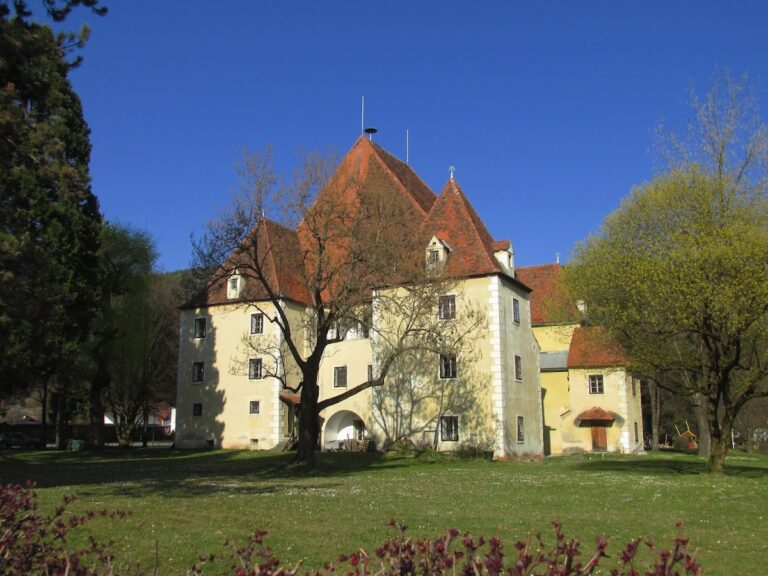
Piber Castle is a Baroque castle in Austria, located in the village of Piber within the municipality of Köflach. Built between 1696 and 1728, it developed from an early medieval fortified farm and served as an administrative estate and summer retreat for St. Lambrecht Abbey. It later became the administration center of the Federal Stud Piber, where Lipizzaner breeding has been based since 1919.
Early foundations and ecclesiastical control
The history of Piber reaches back to 1000, when Margrave Adalbero of Eppenstein began settling the area after receiving the land from Emperor Otto III. Around 1020, a fortified farm was established on the site of the present castle. The complex consisted of a fortified house enclosed by a wall and moat.
In 1103, Duke Henry III gave the farm and its surrounding land to the newly founded Abbey of St. Lambrecht. The abbey administered the estate through appointed officials, several of whom adopted the name Piber. Otto of Piber appears in a record from 1145. In 1219, Archbishop Eberhard of Regensberg transferred the estate and parish to the Diocese of Seckau, a Roman Catholic ecclesiastical jurisdiction in Styria. The transfer began a prolonged dispute with St. Lambrecht Abbey, which was settled in the abbey’s favor in 1414. The bishop of Seckau did not finally abandon his claim until 1492.
Ulrich of Seckau, a former archbishop of Salzburg, spent the final ten years before his death in 1268 at Piber. From the late thirteenth through the fourteenth century, nobles held the estate as benefices, income-bearing offices or properties. Konrad of Wallsee, one of these holders, was reputed to be exceptionally cruel and was killed by enraged peasants.
Administration, conflict, and rebuilding
After the settlement of 1414, St. Lambrecht Abbey established a provost’s estate at Piber. A provost’s estate was an administrative property managed for a religious institution, and Piber became the abbey’s center for administering its holdings in western Styria. A later dispute between the abbey and the Hollenegg family continued until the seventeenth century.
Conflicts repeatedly affected Piber during the sixteenth century because the estate had been assigned to secular nobles, most of whom were Protestants. In 1586, Wolf of Saurau, Georg Bernhard of Herberstein, and Christof Georg of Khollenburg besieged the castle with a small force. The surrounding fields belonging to the estate were destroyed during the siege. In 1596, St. Lambrecht Abbey resumed direct administration and appointed Hans Stübich as manager.
The present castle was constructed between 1696 and 1728 as a summer retreat for the abbots and monks of St. Lambrecht Abbey. Its design is traditionally associated with Domenico Sciassia, a Baroque architect. A chronogram above the main gate, an inscription whose selected letters encode a date as Roman numerals, records the completion of the building in 1728 and names Abbots Franz of Kaltenhausen and Anton Stroz as its builders.
State ownership and the Federal Stud
St. Lambrecht Abbey was dissolved in 1786, and Piber passed to the state Religious Fund. Ownership changed again in 1792. A stud for military horses had been established beside the castle in 1789, and in 1867 it came under the Imperial and Royal Ministry of Agriculture.
Lipizzaner breeding was transferred from Lipica to Piber in 1919. The Lipizzaners are a horse breed historically associated with the Habsburg court and with the Lipica and Piber stud farms. During the Second World War, the breeding operation moved to Hostouň. The horses returned to Piber in 1952, when the castle became the administration center of the Federal Stud Piber.
The castle was restored in 1967, and parts of its interior were restored between 1970 and 1972. In 2003, it housed part of the Styrian regional exhibition Myth of the Horse. It now accommodates the administration of the Federal Stud Piber and is also used as a cultural exhibition space and concert venue.
Remains
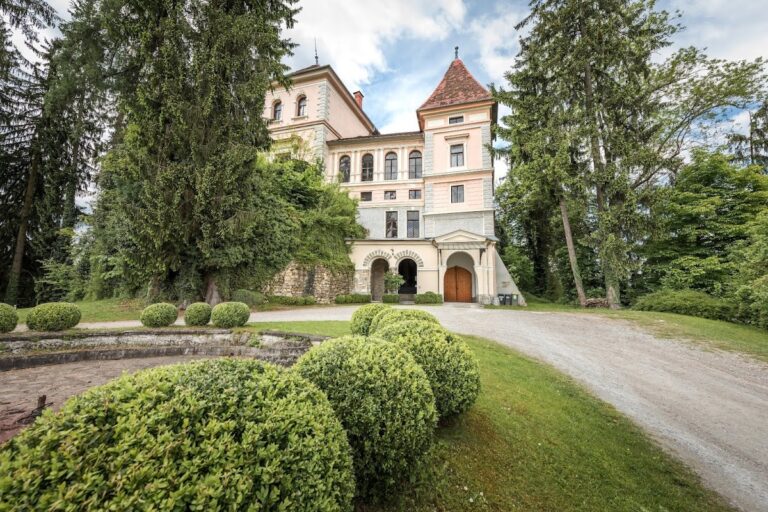
Piber Castle stands beside Piber parish church on a low hill with relatively steep slopes that were partly cut back artificially. The three-story Baroque building has four regular wings arranged on an approximately square plan. These wings enclose a large arcaded courtyard, with pier arcades extending through all floors.
Exterior and defensive remains
Each wing has three-axis projections at its corners. Painted pilasters rise across the three stories, while painted surrounds frame the windows. Decorative panels beneath the windows mark the divisions between the floors. The western main gate bears the date 1726, and a side portal bears the date 1728.
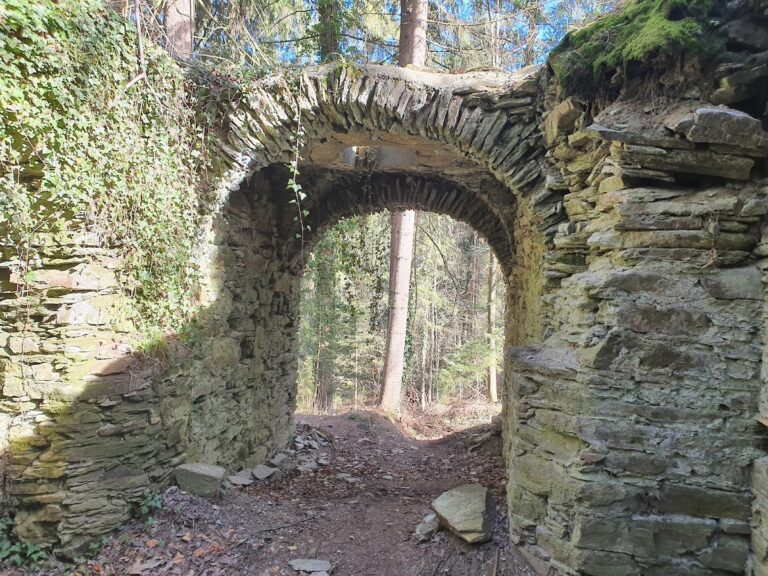
The northern approach lay beside a broad defensive moat associated with the earlier fortified estate. Several retaining walls survive from the former defensive wall, linking the present Baroque building with the site’s earlier defensive character.
Interior spaces
Several rooms in the south wing retain eighteenth-century Baroque stucco ceilings, restored between 1970 and 1972. The large banqueting hall contains numerous heraldic representations, providing a surviving decorative element within the castle’s eighteenth-century interior.