Wittumspalais: A Historic City Palace in Weimar, Germany



Site at a Glance
- Rating
- 4.6
- Popularity
- Low
- Country
- Germany
- Primary era
- Early Modern
- External website
- Open
- Eras represented
- Early Modern
- Civilizations
- Holy Roman Empire
- Site type
- Domestic
- Remains
- Palace
On this page8 sections
History
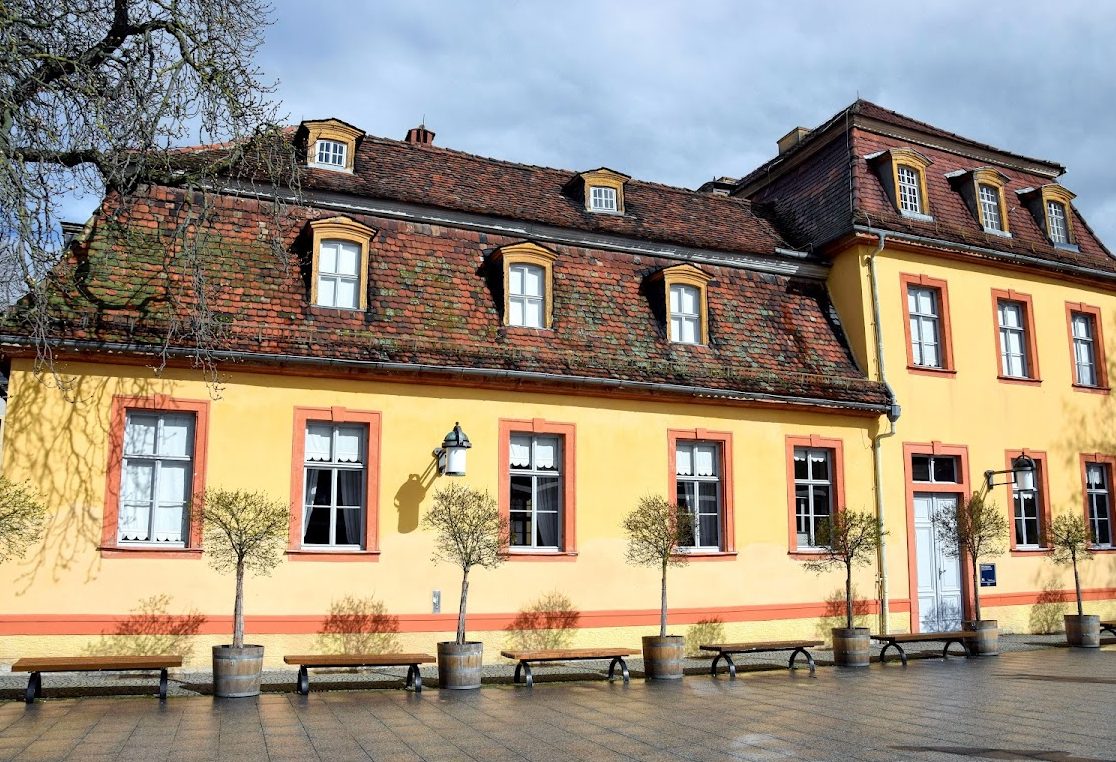
Wittumspalais is an eighteenth-century city palace in Weimar, Germany, built between 1767 and 1769 on the site of a former Franciscan monastery. Jakob Friedrich von Fritsch, a Weimar minister and privy councillor, commissioned the building, which was designed by the Saxon state architect Johann Gottfried Schlegel.
From City Palace to Widow’s Residence
After the Weimar Palace fire in 1774, Duchess Anna Amalia moved into Wittumspalais in May of that year. Anna Amalia, the duchess of Saxe-Weimar-Eisenach and a major patron of Weimar’s courtly and literary culture, purchased the palace in 1775 for 20,100 Reichstalers. The name refers to a Wittum, a widow’s provision or residence. The palace remained her home until her death in 1807.
During Anna Amalia’s lifetime, Wittumspalais became a center of Weimar’s social and literary life. The famous table gatherings of the Weimar court of the Muses took place there, as well as at Ettersburg and Tiefurt. The interiors were fitted out from 1775 onward, creating the domestic setting associated with the duchess’s residence.
Nineteenth-Century Institutional and Artistic Uses
After Anna Amalia’s death, the Ducal Court Marshal’s Office administered the palace. From 1808 to 1848, the Freemason lodge Anna Amalia zu den drei Rosen met there. A Freemason lodge was a local association in which members of the fraternal organization met. From 1833 to 1848, the state parliament held its sessions in the festival hall. In 1848, the library of the Lesemuseum moved into the building.
The festival hall later became an artists’ studio. From 1858, the painter Leopold Graf von Kalckreuth worked there, and Friedrich Preller used it from 1864 to 1868 for his Odysseus cycle. Grand Duke Carl Alexander commissioned extensive restoration work in 1870 and 1871. In 1919, the Goethe National Museum took over Wittumspalais. The institution is devoted to the literary and cultural legacy associated with Johann Wolfgang Goethe.
War Damage and Museum History
Air raids on Weimar during the Second World War heavily damaged the roof of Wittumspalais and destroyed doors and windows. The palace reopened as a museum in 1949. It is operated as a museum by the Klassik Stiftung Weimar and forms part of the Classical Weimar ensemble, which was inscribed on the UNESCO World Heritage List in 1998 together with eleven other sites.
Remains
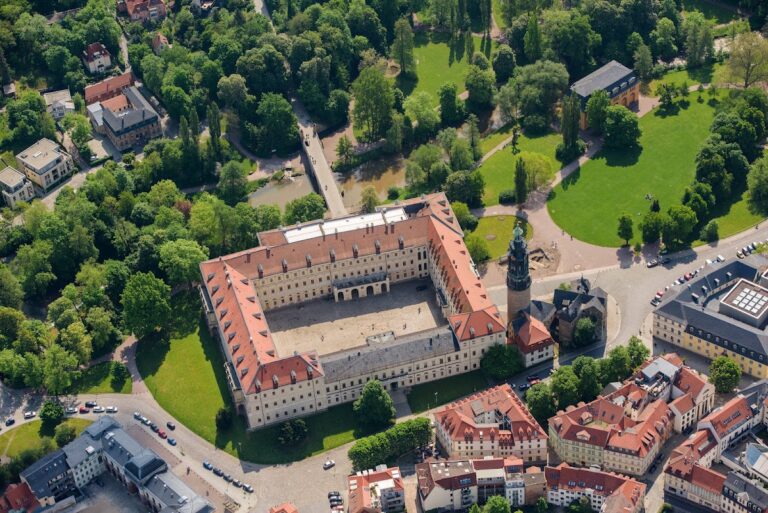
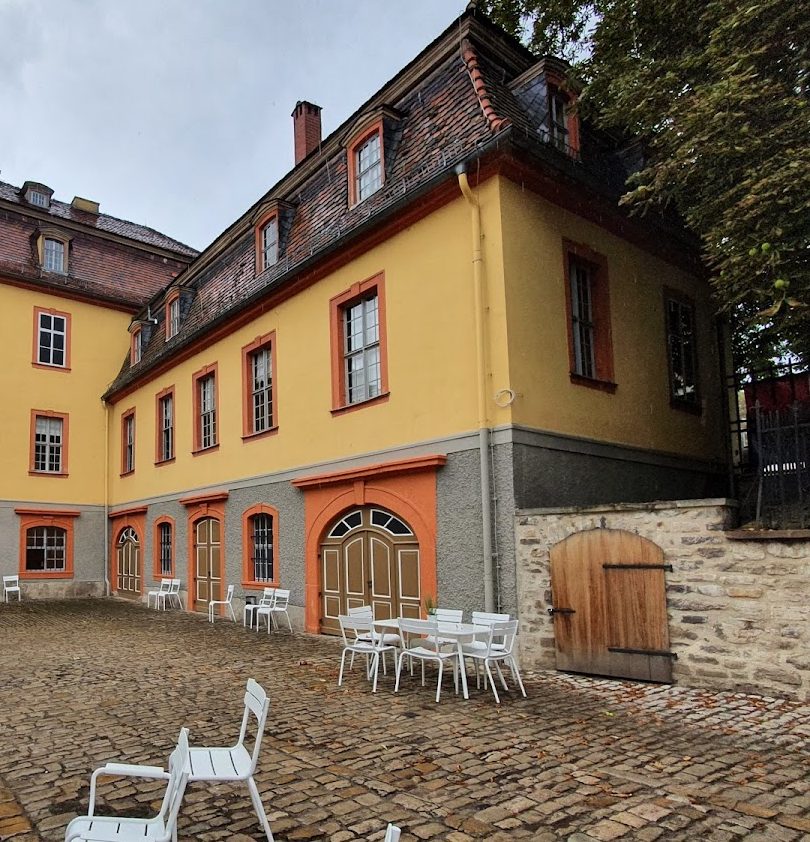
Wittumspalais occupies a city-centre building plot beside the representative Esplanade, now Schillerstrasse. The palace stands within a defined urban space between Theaterplatz, Schillerstrasse, the Zeughof, and Geleitstrasse. Its setting also includes the square-like paved area called Am Palais, bounded by Wittumspalais, the former Franciscan monastery, and houses 1 and 2. A route beside the monastery leading from this area bears the same name.
Palace Interiors
The surviving residential rooms present an illustrative picture of aristocratic domestic culture. Their interiors include ceiling paintings by Adam Friedrich Oeser, a painter known for decorative and ceiling painting. Together, the rooms and their decoration convey the character of the palace as a residence rather than solely as an administrative or ceremonial building.
Festival Hall
The festival hall is a distinct surviving interior associated with several later uses. It served successively as a meeting room for the state parliament, a studio for Leopold Graf von Kalckreuth, and a studio for Friedrich Preller’s Odysseus cycle.
Am Palais Urban Space
The area called Am Palais retains characteristic street paving and forms a defined space between the palace, the former Franciscan monastery, Geleitstrasse, and the adjacent houses. Its arrangement preserves the immediate urban context in which Wittumspalais was built.
Nearby sites