Grafeneck Euthanasia Centre: Nazi Killing Centre and Memorial in Germany


Site at a Glance
- Rating
- 4.5
- Popularity
- Low
- Country
- Germany
- Primary era
- Early Modern
- External website
- Open
- Eras represented
- Early Modern
- Civilizations
- Duchy of Württemberg, Holy Roman Empire
- Site type
- Domestic
- Remains
- Castle
On this page15 sections
History
Grafeneck Euthanasia Centre in Germany was a Nazi killing centre established at Grafeneck Castle near Gomadingen in 1939–40. It became one of the sites of Action T4, the centrally organised Nazi programme for murdering people with mental illnesses and disabilities. During 1940, thousands of patients from care institutions across southern and western Germany were killed there, making Grafeneck an important site in the history of the Nazi persecution and murder of disabled people.
From hunting lodge to care institution
Grafeneck Castle was built around 1560 as a hunting lodge for the Dukes of Württemberg. Between 1762 and 1772, it was enlarged as a Baroque castle. A large Rococo palace built in front of it during the eighteenth century was later demolished, and the castle was used by the Forest Service during the nineteenth century.
The Samaritan Foundation acquired Grafeneck in 1928 or 1929 and established a home for disabled people there in the following year. A separate cemetery was created in 1930. The institution continued to operate until the Nazi authorities selected the castle for Action T4.
Selection and conversion in 1939
The Württemberg Ministry of the Interior in Stuttgart worked closely with the Berlin T4 central office while planning the killing centre. Grafeneck’s secluded woodland location, two access roads, and rooms suitable for administration and staff accommodation made the grounds easy to control and adapt.
On 13 October 1939, Richard Alber, the Landrat, or administrative head of a rural district, in Münsingen ordered the castle cleared for the next day. On 14 October, four buses operated by the Charitable Ambulance Transport GmbH, known as Gekrat, removed approximately 100 disabled male residents and several women, together with the director’s family and 12 employees. The evacuated patients were taken to St. Elizabeth Monastery in Reute and survived Action T4.
Between October 1939 and January 1940, the former Samaritan Foundation institution was deliberately transformed into a killing centre. Living and administrative rooms were adapted for the new operation, while a special registry office, police office, wooden barracks, bus parking area, crematorium, and gassing building were added. The number of people working at the castle rose from approximately 10 to 20 in late 1939 to nearly 100 during 1940.
Systematic murder in 1940
The first killings took place on 18 January 1940. Victims were taken into a gas chamber disguised as a shower room, where carbon monoxide was released through a valve. The gas cylinders were supplied by Mannesmann, and the carbon monoxide came from the IG Farben plant at Ludwigshafen, later known as BASF. The first victims came from the Eglfing-Haar mental hospital in Bavaria.
Patients were transported to Grafeneck from 49 institutions for disabled and mentally ill people. These included 17 institutions in Baden, 12 in Württemberg, seven in Bavaria, and one each in Hohenzollern, Hesse, and the Rhine Province. The grey buses used by Gekrat became closely associated with the movement of patients from hospitals and care homes to the killing centres.
Doctors carried out the killings under orders from the T4 organisers Viktor Brack and Karl Brandt, who interpreted Adolf Hitler’s authorisation of 1 September 1939 as permitting doctors to conduct the operation. Grafeneck’s doctors used code names in correspondence. Horst Schumann served as medical director from January 1940 until the end of May or the beginning of June, followed by Ernst Baumhard, who had been deputy director from January to April. Günther Hennecke served as deputy from 25 April until December 1940. Schumann later worked at the Pirna-Sonnenstein killing centre and became a camp doctor at Auschwitz-Birkenau, while Baumhard and Hennecke later held posts at Hadamar.
Christian Wirth was the principal non-medical director and office manager. He supervised security, staff, the special registry office, and the killing process. His deputy, Gerhard Kurt Simon, also signed documents as a registrar. Jakob Wöger headed the special registry office until June 1940, when Hermann Holzschuh succeeded him. Josef Oberhauser supervised the cremation of bodies, and Hermann Schwenninger led the Gekrat transport unit.
The special registry office issued officially falsified death certificates. Ludwig Sprauer, Baden’s highest medical officer, authorised transport lists after patient registration forms had been assessed. Otto Mauthe, Württemberg’s highest medical officer, administered the euthanasia programme, while Eugen Stähle helped select Grafeneck and directed the department of the Württemberg Ministry of the Interior that functioned as a regional T4 office.
Closure and later uses
Gas killings continued from January through December 1940. The last victims were burned in the crematorium on 13 December. The Hartheim statistics give a total of 9,839 people killed at Grafeneck between January and December 1940. The Württemberg Grafeneck trial in summer 1949 established a figure of 10,654 victims, and both figures remain associated with the site’s historical record.
The killing centre closed in December 1940. The failure to preserve secrecy and growing protests from churches and institutions contributed to the closure. A deeper reason may have been that the regime’s intended targets had already been reached or exceeded. Grafeneck personnel were transferred to the Hadamar killing centre in Hesse, where killings, along with those at other centres, continued until August 1941.
After the killing centre closed, Grafeneck was used for Kinderlandverschickung, a Nazi programme that evacuated children from cities threatened by wartime bombing and placed them in institutions or other accommodation. French occupation authorities used the castle in 1945. In 1946–47, it returned to the Samaritan Foundation, and disabled residents expelled at the beginning of the war who had survived came back to the castle.
Trials and remembrance
After the war, Ludwig Sprauer and Arthur Schreck were indicted before the Freiburg jury court. They were convicted in 1948. The Grafeneck trials held in Tübingen in 1949 produced eight further indictments.
An Euthanasia Working Group was established in 1982 to develop a memorial and permanent exhibition. Since October 2005, Grafeneck has housed a documentation centre with the permanent exhibition Grafeneck 1940 – Murder of Patients under Nazism: History and Remembrance. The trial records were later digitised, linking the site’s memorial work with the surviving legal evidence.
Remains
Castle and killing-centre grounds
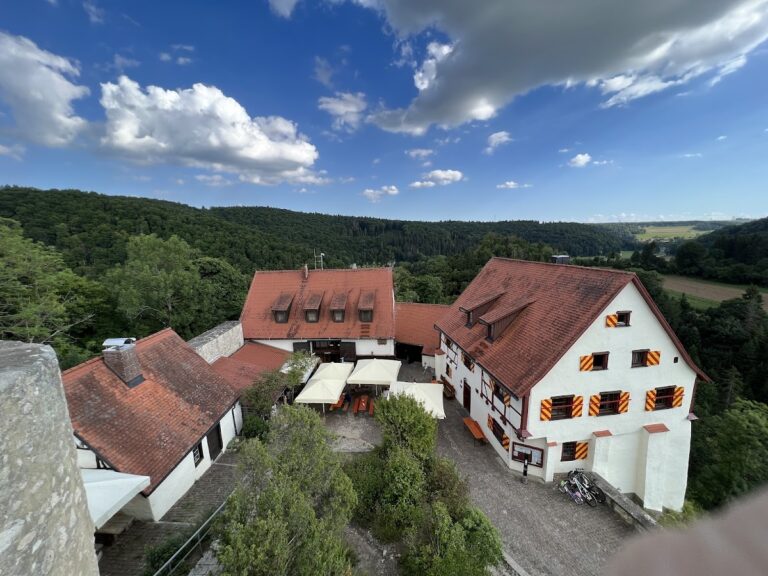
Grafeneck lies in a wooded, secluded setting between Engstingen and Münsingen, about 25 kilometres southeast of Reutlingen. The grounds had two access roads. The castle itself contains the rooms that were used for living and administration during the killing-centre period, including the special registry office and police office.
Grafeneck Castle
The surviving castle began as a hunting lodge built around 1560 for the Dukes of Württemberg and was enlarged into a Baroque residence between 1762 and 1772. Its earlier architectural history shaped the physical setting later adapted for the Nazi operation. The large Rococo palace formerly standing in front of the castle has been demolished.
Gassing and cremation installations
During the conversion of 1939–40, a wooden barracks with approximately 100 beds, a parking area for the grey buses, a crematorium furnace, and a gassing shed were constructed on the grounds. The gas chamber stood inside a building described as a garage and was disguised as a shower room. Its supply system used carbon monoxide from steel cylinders, while specially installed crematorium furnaces were used to burn the bodies.
The barrack-like building containing the gas chamber was demolished in 1965. An agricultural-use building complex was later erected on its site. The surviving grounds therefore combine the historic castle and cemetery with later structures occupying part of the former killing-centre area.
Cemetery and memorial landscape
Cemetery and open chapel
The cemetery contains two urn graves and a memorial area with an open chapel. Developed as a place of remembrance from the 1950s and 1960s onward, the memorial was artistically designed by the sculptor Rudolf Kurz of Stimpfach.
1990 memorial
A memorial created in 1990 has a crack in its rear wall, intended to express the pain caused by the crimes committed at Grafeneck. At the entrance, a stone threshold set into the ground names more than 40 institutions and homes in Baden-Württemberg and Bavaria from which people were transported to the killing centre.
Name book and Alphabet Garden
A memorial and name book was first presented in 1995. Since October 1998, it has been kept near the memorial and made freely accessible. It contains more than 8,000 victims’ names, while research into additional unidentified victims continues.
The Alphabet Garden, created in August 1998, commemorates victims whose names remain unknown. Its concept was developed by the English writer Diane Samuels, adding a dedicated memorial space to the cemetery and memorial grounds.
Documentation Centre
Established on the site in 2005, the Grafeneck Documentation Centre forms part of the present memorial complex. Its permanent exhibition, Grafeneck 1940 – Murder of Patients under Nazism: History and Remembrance, presents the history of the killing centre and its victims. Together with the memorial landscape, the centre preserves the connection between the surviving site, the names of those murdered, and the legal records of the post-war trials.
Nearby sites