Erbdrostenhof: A Westphalian Baroque Aristocratic Palace in Münster


Site at a Glance
- Rating
- 4.7
- Popularity
- Low
- Country
- Germany
- Primary era
- Early Modern
- External website
- Open
- Eras represented
- Early Modern
- Civilizations
- Holy Roman Empire
- Site type
- Domestic
- Remains
- Elite Residence
On this page8 sections
History
Construction and Baroque Design
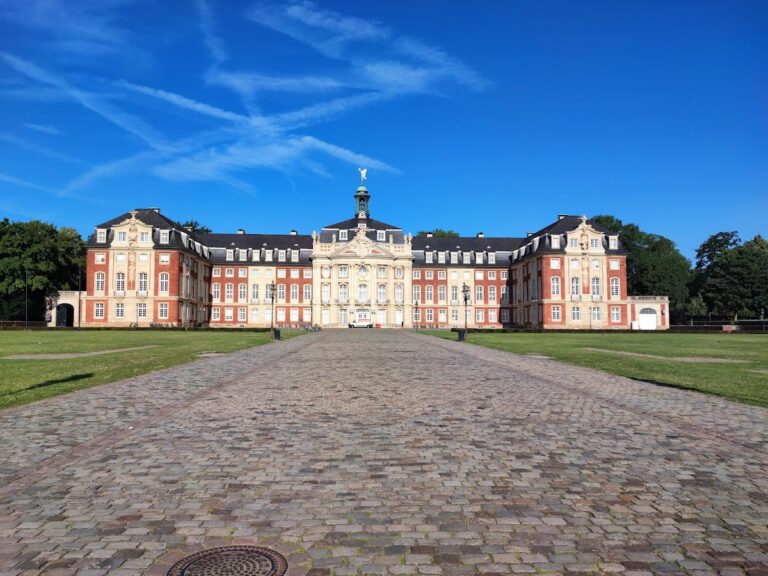
Erbdrostenhof is a protected aristocratic palace in Münster, Germany, built between 1753 and 1757 in the Westphalian Baroque style. Adolf Heidenreich Droste zu Vischering, the hereditary drost of Münster, commissioned the building from the architect Johann Conrad Schlaun. The hereditary drost was an administrative office broadly comparable to a steward or seneschal in the historical territories of Westphalia. Johann Christoph Manskirch also contributed to the sculptural design. The palace was planned as a highly representative residence on a very confined urban plot.
War Damage and Reconstruction
Air raids on Münster during the Second World War destroyed Erbdrostenhof. The Landschaftsverband Westfalen-Lippe, a regional public institution responsible for cultural, social, and heritage-related functions in Westphalia-Lippe, reconstructed the palace between 1953 and 1970 using historic plans. The original frescoes in the Baroque ballroom had been created by Nikolaus Loder and were lost during the war. Paul Reckendorfer recreated them between 1965 and 1967 as part of the reconstruction.
Institutional Use and Conservation
Erbdrostenhof has been the seat of the Landschaftsverband Westfalen-Lippe since 1970. It first housed the Westphalian Office for Monument Preservation. After that office moved to the Landeshaus Westfalen-Lippe, the LWL Museum Office for Westphalia, the Historical Commission, the Literature Commission for Westphalia, and the Droste Research Centre moved into the palace. In 2012, the exterior underwent conservation work that cleaned the sandstone facades and restored the windows. The palace also supports the LWL’s cultural-preservation work through its collection of historic keyboard instruments.
Remains
Palace Layout and Facades
Erbdrostenhof retains the form of a three-winged Baroque palace designed to create a highly representative effect within a restricted site. Its principal facades are faced with Billerbeck sandstone. The 2012 conservation campaign cleaned approximately 800 square metres of sandstone on the Salzstraße facade and another 230 square metres on the Ringoldsgasse facade. More than 50 windows facing those two streets were restored. Made from pitch pine during the reconstruction of the 1950s, the windows form part of the palace’s post-war fabric.
Baroque Ballroom
The reconstructed Baroque ballroom is a notable interior space within the palace. Its original fresco decoration, produced by Nikolaus Loder, was destroyed during the Second World War and recreated by Paul Reckendorfer between 1965 and 1967. The reconstructed ballroom was regarded as an exceptional spatial creation and remains part of Erbdrostenhof’s restored interior.
Historic Keyboard Instruments
Erbdrostenhof houses the LWL’s collection of historic keyboard instruments. Among them is a Ruckers harpsichord from 1640, loaned by the Count of Landsberg-Velen. The instrument has three choirs, meaning three sets of strings, and two manuals, meaning two keyboards. It is described as one of the world’s most important historic keyboard instruments.
Nearby sites