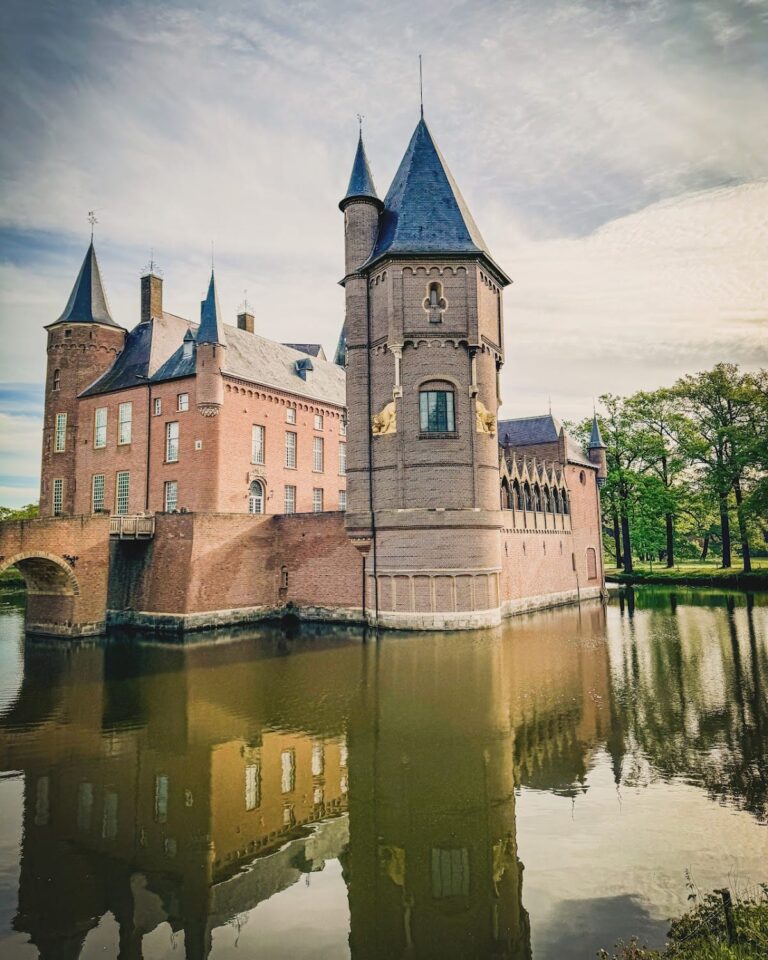
Stapelen Castle: A Moated Castle and Former Assumptionist Monastery in the Netherlands


Site at a Glance
- Rating
- 4.4
- Popularity
- Low
- Country
- Netherlands
- Primary era
- Medieval
- External website
- Open
- Eras represented
- Medieval, Modern
- Civilizations
- Duchy of Brabant, Holy Roman Empire
- Site type
- Domestic
- Remains
- Castle
On this page16 sections
History
Stapelen Castle is a moated castle in Boxtel, the Netherlands, probably built around the thirteenth century by a member of the Randerode family. Its medieval origins lay within the manor of Boxtel, initially held as a fief, or land and jurisdiction granted in return for loyalty and service, from the County of Loon. The name appears as de Stapelo in 1134, although its meaning remains uncertain. The first recorded mention of the castle itself dates from 1293.
Medieval Lords and Later Owners
At the beginning of the thirteenth century, Stapelen came into the possession of Willem I van Boxtel of the Randerode family. Willem was a medieval lord of Boxtel, married to Aleidis van der Aa, the widow of Hendrik van Cuijck. The estate later became associated with her child, Justina van Diepenbeek. Willem was knighted by the Duke of Brabant.
The Van Boxtel family was followed as owner by the Van Merheim and Van Ranst families. In the sixteenth century, Stapelen passed to the Van Horne family, who retained it until 1763. Filips van Leefdael, a seventeenth-century writer and historian, described the property in 1645 as a large old castle surrounded by broad, attractive moats. During the Dutch Year of Disaster in 1672, the year when the Dutch Republic faced invasions and a major military and political crisis, King Louis XIV of France stayed at Stapelen for several days.
Confiscation and Nineteenth-Century Rebuilding
After 1763, the estate passed to the Van Salm-Kyrburg family. Frederik III of Salm-Kyrburg was guillotined in Paris in 1794 during the French Revolution. After the hereditary political and social order known as the ancien regime was abolished, Stapelen Castle was confiscated. In 1810, it was described as very large and old-fashioned. The property was sold in 1815 and eventually acquired, through several owners, by Hendrik Mahie, a councilor from ’s-Hertogenbosch.
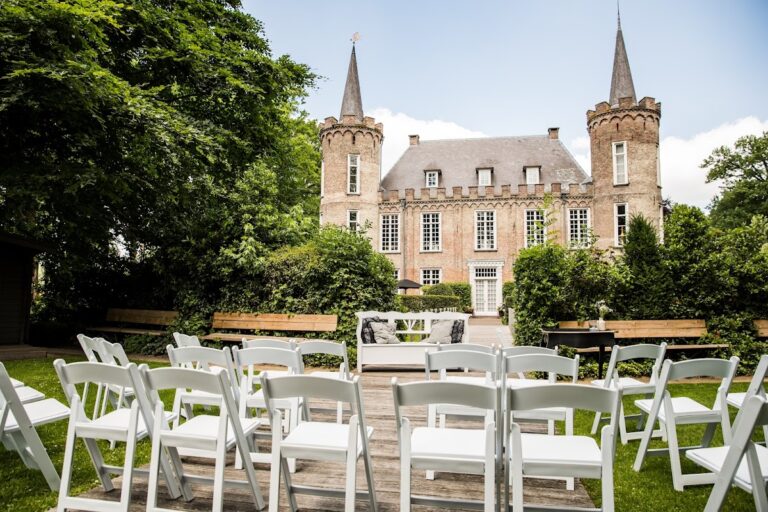
Mahie extensively rebuilt the castle in 1857 and 1858. The work used Neo-Gothic architecture, a nineteenth-century revival of medieval Gothic forms, to create an idealized castle appearance. Its English-inspired design was criticized because it differed from customary Dutch castle architecture. The rebuilding reshaped much of the complex, particularly its northern side, while older elements survived in the southern section.
Assumptionist Monastery
After Mahie’s death, his widow continued to live at Stapelen. She agreed to leave only on the condition that the castle became a monastery. Newspaper advertisements brought the Assumptionist fathers to the estate around 1915. The Assumptionists, formally the Congregation of the Assumption, made Stapelen a monastery and the headquarters of their Dutch province, which belonged to the Paris-based congregation.
The congregation’s activities included pastoral care, Catholic journalism, education, ministry directed toward workplaces and business life, and missionary work. The castle also initially housed a minor seminary, an institution that prepared boys and young men for possible entry into the priesthood before advanced theological training. Because many seminarians arrived, a separate building was constructed in the castle garden in 1927 as the Apostolic School St. Theresia, also called Mission House St. Theresia. It ceased to function as a minor seminary around 1970 and later became an apartment building.
Tradition and Modern Ownership
A tradition associated with Stapelen links the castle chapel to the origins of Boxtel’s annual Holy Blood procession. Shortly before 1400, the priest Eligius is said to have spilled white consecrated wine, ritually dedicated for use in the Christian Eucharist, on an altar cloth during Mass. A red stain supposedly appeared and could not be washed out. According to the tradition, Eligius disclosed the event on his deathbed to the castle lord Willem van Merheim, who received clerical permission to show the cloth publicly. The procession is held on the first Sunday after Pentecost.
The Assumptionists sold and transferred Stapelen to Eindhoven property manager Xander van Mierlo on 1 September 2018, ending the castle’s 104-year use as a monastery and placing it in private ownership. The complex is now used for cultural and social activities and as a wedding venue. The Assumptionists retained buildings at Prins Hendrikstraat 43 and 45, while the cemetery in the castle park was to remain available for the burial of Assumptionist fathers for at least another fifty years. With permission from the Bishop of ’s-Hertogenbosch, the Saint George Chapel was withdrawn from worship. Stapelen is protected as a Dutch national monument under register number 10060.
Remains
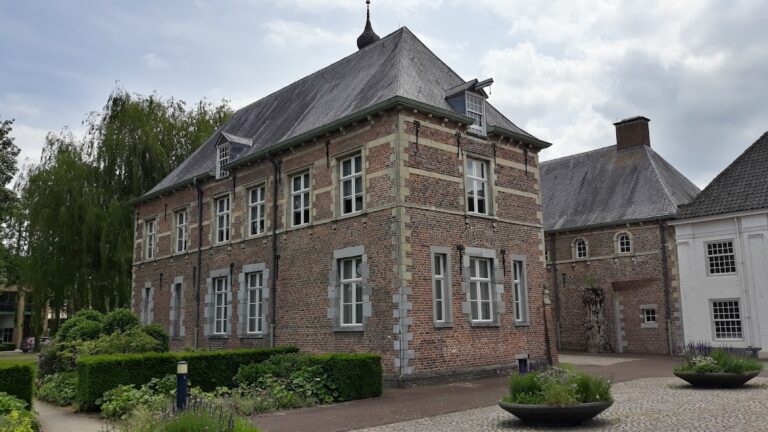
Stapelen Castle is organized around a moated complex whose southern section preserves numerous older elements, while the northern side was almost entirely renewed in the nineteenth century. The surviving fabric combines medieval features with later construction, and archaeological work has clarified the former arrangement of the buildings around the courtyard.
Castle Buildings
Knights’ Hall
The knights’ hall retains its original fourteenth-century roof and a barrel vault. These elements belong to the older fabric of the castle and survive within the complex shaped by later rebuilding.
Southern Wing
The buildings in the southern wing have stone walls dating from the sixteenth century. The wing was founded on a sandbank, unlike the northern side, which was built on raised ground. This difference suggests that the southern wing may originally have stood directly beside the Dommel River.
Towers and Chapel
The octagonal tower on the east side and the two towers on the west side of the main building are medieval in origin. The chapel on the south side is also medieval in origin and contains an altarpiece dating from about 1600. The altarpiece bears the arms of the Van Horne family.
Archaeological Evidence
Former Stables
Excavations during the 1968 restoration uncovered the foundations of former stables against the west wall. The foundations lay where car garages had been built in 1957, revealing an earlier use of that part of the complex.
Earlier Courtyard Buildings
Additional building remains were found in front of the present south wing. They show that the courtyard was formerly considerably smaller than it is today and provide evidence for an earlier arrangement of the castle buildings.
Garden and Religious Buildings
Mission House St. Theresia
The former Apostolic School St. Theresia, also known as Mission House St. Theresia, was built in the castle garden in 1927, close to the castle. It was exceptionally large for the surrounding area and is now an apartment building.
Castle Park and Saint George Chapel
The castle park contains the Assumptionist cemetery. The complex also includes the Saint George Chapel, named for Saint George, a Christian martyr and saint. The chapel has been withdrawn from worship.
Nearby sites