Margarethen am Moos Castle: A Former Renaissance Water Castle in Austria


Site at a Glance
- Rating
- 4.6
- Popularity
- Low
- Country
- Austria
- Primary era
- Modern
- External website
- Open
- Eras represented
- Medieval, Early Modern, Modern
- Civilizations
- Duchy of Austria, Habsburg, Holy Roman Empire
- Site type
- Domestic
- Remains
- Castle
On this page8 sections
History
Margarethen am Moos Castle is a former Renaissance castle in Austria, originating as an eleventh-century fortified refuge and defensive stronghold. Its later Renaissance form incorporated the architectural character of a fortified or residential noble complex associated with the Renaissance. The castle helped protect the eastern border of the Duchy and later Archduchy of Austria against attacks from the east, and it remains a protected historic monument.
Frontier fortress and medieval remodelling
The castle formed part of a defensive network that also included later Trautmannsdorf Castle and fortifications at Enzersdorf an der Fischa, Schwechat, Götzendorf an der Leitha, and Fischamend. Its position in muddy alluvial ground strengthened its defensive value. The surrounding area was additionally cleared to deny approaching attackers cover, making the refuge comparatively easy to defend. The complex was first remodelled in 1336.
Transformation into a Renaissance residence
As firearms developed and reduced the military importance of medieval fortifications, the castle changed from a primarily defensive stronghold into a Renaissance water castle in 1683. A water castle is a fortified complex surrounded or partly protected by a water-filled moat. This transformation reflected the changing relationship between noble residences and military technology.
Ownership and nineteenth-century remodelling
The lordship and castle were initially associated with the Harrach and Breuner families before passing to Count Alois von Moncenigo. Prince Philipp von Batthyány-Strattmann, a nineteenth-century aristocrat and landowner, took over the Margarethen lordship in 1812. In 1860, he commissioned a remodelling that gave the complex its present form. The moat was filled and replaced by a castle park.
Philipp died without children in 1870, after which the castle passed through the marriage of his niece and heir, Countess Juliana Batthyány-Strattmann, to Wilhelm Albrecht von Montenuovo, a member of the Montenuovo princely family. Wilhelm Albrecht bequeathed the estate to his son Ferdinand von Montenuovo in 1927. Ferdinand divided it among his daughters Julia, Franziska, and Marie Felizia in 1951. The Schwaner-Ries family has owned the castle since 1998.
War damage and later use
In April 1945, Soviet airfield personnel were quartered in the castle. The occupation damaged the interior and caused the loss of valuable panelling and stucco work. The complex has been progressively renovated in recent decades and is now used as an events centre.
Remains
Castle building
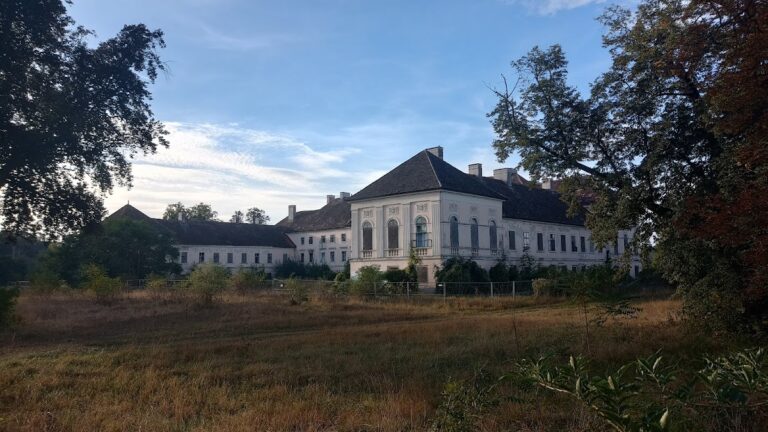
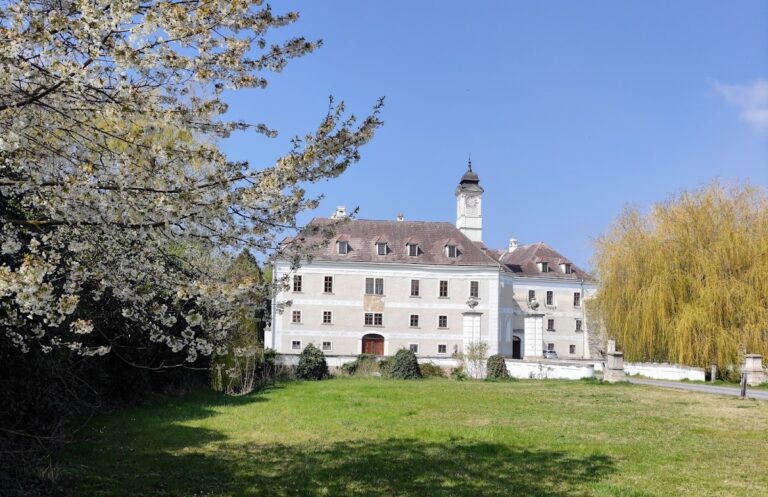
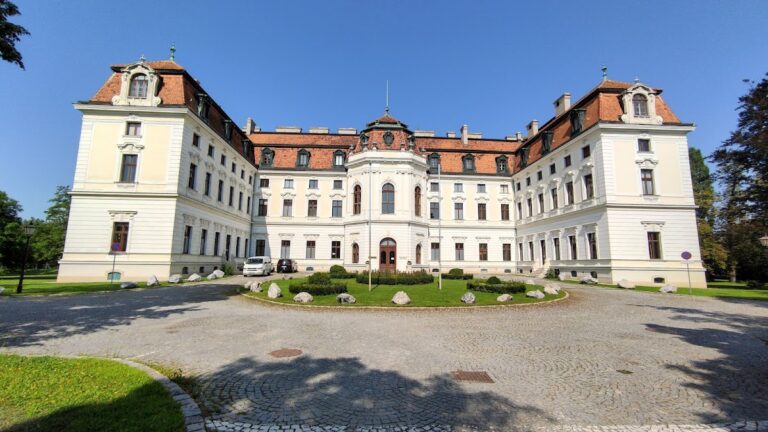
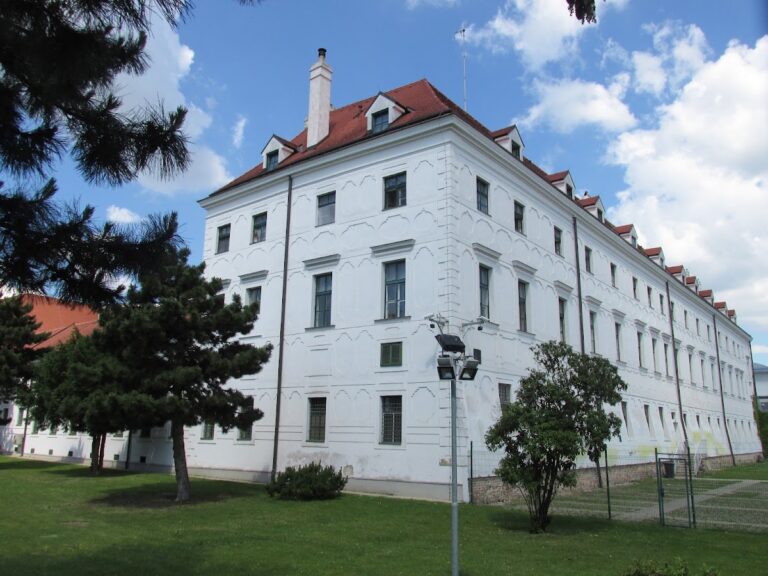
The castle stands at the northwestern edge of Margarethen am Moos, about 15 kilometres southwest of Vienna, roughly midway between the Danube and the Leitha Mountains. It is a two-storey building made up of four wings arranged as an almost square block beneath a hipped roof, which slopes down on all sides. The southwest principal facade has nine bays and a three-bay central projecting section with rounded corners. Its first storey contains the main portal, crowned by a broken pediment. Fascia strips, pilasters, which are shallow wall-attached vertical elements, and cornices decorate the facade.
Chapel and castle grounds
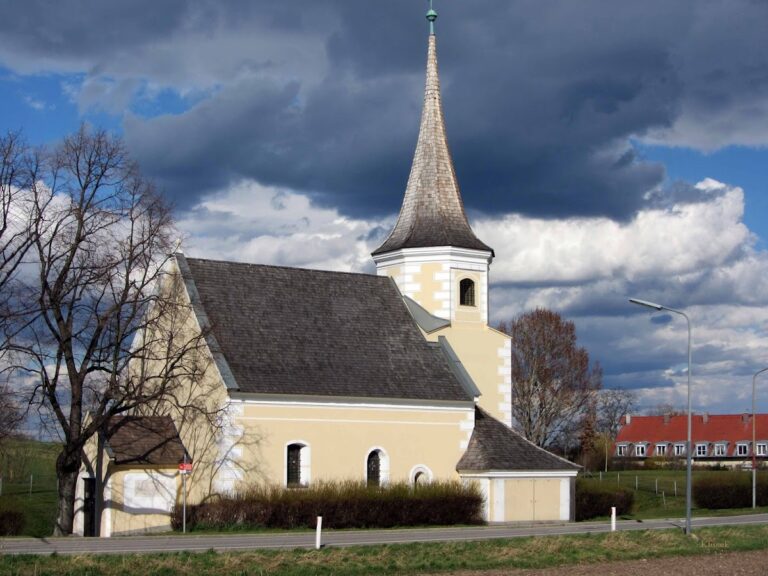
The interior includes a chapel with frescoes associated with the circle of Franz Anton Maulbertsch, an eighteenth-century Austrian painter known for religious frescoes and altarpieces. The surrounding castle park covers about 2,000 square metres and occupies the area of the filled moat. A riding-sports centre stands directly within the park. The Catholic parish church of Margarethen am Moos lies across the B60 road from the castle.
Nearby sites